

5 '80s Songs That Wouldn't Be The Same Without Their Legendary Bass Lines
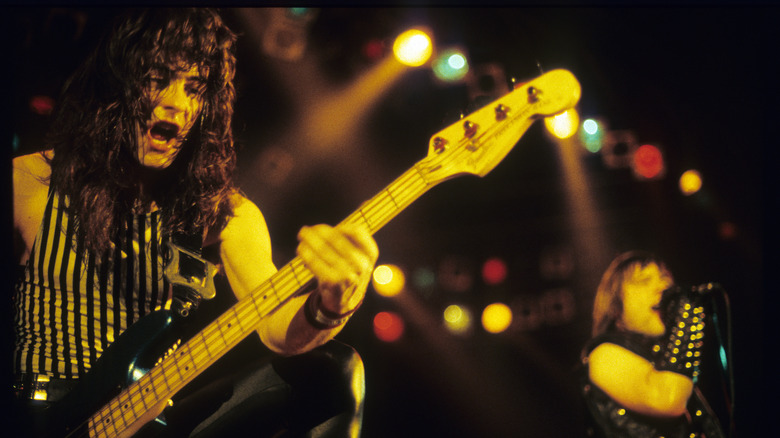
It's time to put respect on the low end: the bass. Why? Because without these humble four strings of rumble, some of your favorite songs from the 1980s wouldn't be the tunes you know and love. Sure, music is littered with the best drum solos in rock history and guitar solos that changed music forever. But the bass (often overlooked thanks to its reliable role in building rock's groove) is just as vital a component. It rarely gets a few bars to show its stuff, but when it does, you realize just how amazing it can be. That's why we're taking a look at '80s songs that wouldn't be the same without their bass lines.
The following list of '80s classics range from a soft rock staple to a post-punk pioneer. Unsurprisingly, heavy metal was rife with great bass lines and solos, including a blistering performance from a British heavy metal titan and a composition from a genius cut down in his prime. We considered them all for this list — which includes songs that feature the traditional solo, with the band dropping back behind the thunderstick, and songs where the bass is so ingrained in the melody that removing it would make the songs just not the same.
You Can Call Me Al — Paul Simon
Paul Simon's "Graceland," his landmark album that won the Grammy for Album of the Year, wouldn't exist without Heidi Berg first giving him a bootleg tape of South African music, prompting Simon to fly to Johannesburg to make an album full of these sounds. And "Graceland's lead single, "You Can Call Me Al," wouldn't be the bouncy staple of '80s soft rock without the bassline from Bakithi Kumalo. Simon loved Kumalo's work on Tau Ea Matsekha's "Ha Peete Kea Falla" and recruited him into his band of mostly South African musicians in 1986.
Those who know "You Can Call Me Al" might not recognize Kumalo, since the popular music video had Simon goof around with '80s-era Chevy Chase. But it's Kumalo who worked on the bassline and the song's impressive solo. "When it came to the bass solo, the breakdown, it was May 10th, my birthday," Kumalo said (via the Scott Bass Lessons YouTube channel). "After we played the groove, I didn't know what was going to happen ... then I had to ask Paul, 'Can I just play something? It's my birthday today.' And Paul said, 'Hey, look. Just go for it. If it's good, we'll keep it. If not, then we'll lose it and replace it with something else.'"
Kumalo's idea became one of the funkiest solos of the '80s, and that extra bit made the song pop. Though "You Can Call Me Al" first hit the wall when it was released (No. 44 on the Billboard Hot 100), both the new music video and Simon's Grammy win sent it back up the charts, ultimately hitting No. 23.
Everytime You Go Away — Paul Young
One could make a solid argument that much of the music of the 1980s wouldn't exist without bassist Pino Palladino. The session musician, whom The Guardian dubbed "pop's greatest bassist," pioneered a distinct sound by pairing a fretless bass with a chorus pedal, creating what's been described as a quintessential sprrroing that became part of the decade's sonic tapestry.
"I was so lucky — it resonated with people, captured their imagination, and it took on a life of its own," Palladino told The Guardian. The song that first introduced that sound to the masses was Paul Young's "Wherever I Lay My Hat," the third single from his debut album and a No. 1 hit on the U.K. singles chart. But most know Palladino for his work on Young's cover of Hall and Oates' "Everytime You Go Away," a song that topped the Billboard Hot 100 in 1985.
The main difference between the two versions is that Hall and Oates don't have Palladino's bass line, which practically makes Young's version a duet. Every moment that Palladino's bass gets to shine, it does. And it's evidence as to why he was one of the most in-demand session players of the past 40 years, playing with everyone from Peter Cetera to David Gilmour to Adele, Harry Styles, and Beyoncé.
Age of Consent — New Order
One cannot talk about "bass" and "1980s" without discussing Peter Hook. Hook had already etched his name in the halls of rock history as part of Joy Division, turning his bass from a mere support player to the lead star on tracks like "She's Lost Control," "Transmission," and "Digital." But following lead singer Ian Curtis's death in 1980, Hook and the rest of the band metamorphosed into New Order, kicking off one of rock's greatest second acts.
With Bernard Sumner as the primary lead vocalist, New Order took post-punk onto the dance floor, thanks to Hook's unmistakable bass lines. One of the shining examples is "Age of Consent," from the band's second album, "Power, Corruption & Lies." Opening with one of Hook's best compositions, "Age of Consent" details a failing relationship and the singer begging to be granted release. "Won't you please let me go / these words lie inside, they hurt me so," sings Sumner. It's romantic like a dead rose, joyous like a rainy day, and a perfect example of post-punk, one that would be hollow without Hook's bass.
Hook told Louder, "My favorite New Order bass riff, ... I suppose you'd have to say my favorite is 'Age of Consent,' because to a bass player, it was such a gift. The song is [led] by the bass and it's very melodic. That's my favorite New Order one."
The Number of the Beast — Iron Maiden
As the founding (and last original) member of Iron Maiden, Steve Harris has spent the last 50 years banging heads with his bass, thanks to his signature "gallop" rhythm. A trio of an eighth note followed by two 16th notes, the "gallop" gives a sense of urgency, and Harris utilized it in songs like "The Trooper" and "Run to the Hills."
Though his bass has been the driving force behind Maiden since its inception, Harris doesn't need a traditional solo to command attention. His performance on 1982's "The Number of the Beast" establishes the song's ominous pulse before accelerating alongside the rest of the band. Even as Dave Murray and Adrian Smith take turns delivering blistering guitar solos, Harris's melodic playing remains a force beneath them and helps drive the song through its furious conclusion.
It's hard to imagine this or any Maiden song without Harris's work. And his impact on metal has been immeasurable. It's why Metal Hammer's readers voted him the "World's Greatest Bassist" in 2015, with the publication claiming he's "an icon, a hero and a living testament to the power of ambition, determination and humility. But more important than that, Steve Harris is an absolute beast of a bass player."
Anesthesia (Pulling Teeth) — Metallica
Considering the debacle with "...And Justice For All," it might be odd to see "Metallica" and "best bass solo" in the same sentence. But "Anesthesia (Pulling Teeth)," from 1983's "Kill 'Em All," is a testament not just to the power of the bass, but also to the talents lost with the death of Cliff Burton (who died in 1986 in a tragic bus accident while Metallica was on tour in Sweden).
A fuzzy, hazy trip that goes for two-and-a-half minutes before Lars Ulrich's drums kick in, "Anesthesia" is an impressive feat of what sound Burton was able to pull out of his Rickenbacker through the use of pedals and his own creativity. "'Anesthesia' was a bass solo disguised as a song, instead of it just being called 'Bass Solo.'" Lars Ulrich told Metal Hammer. "It was like what Geezer Butler did in Black Sabbath — he just gave it a clever, cool title."
"Cliff had studied music. He was at a more musical level than I was," added lead guitarist Kirk Hammett. "There were concepts I didn't understand, which he knew and explained to me — relative scales and whatnot." Ulrich added, "He understood words like 'harmonies' and 'arpeggios'. We couldn't even spell them."