

5 Buffalo Springfield Songs That Prove 1966 Was The Best Year Of Their Career
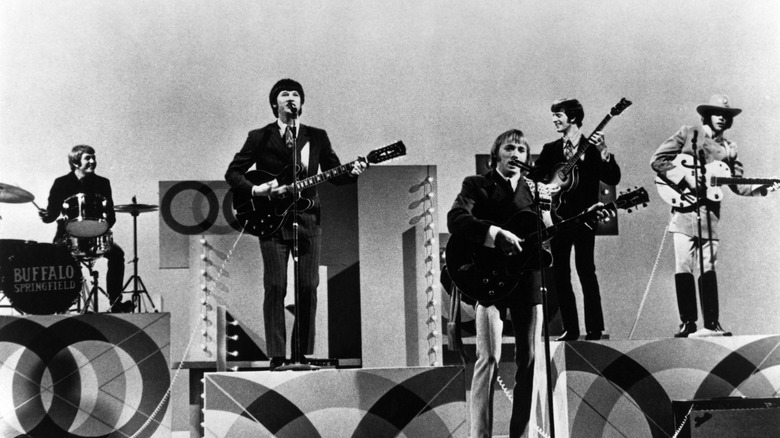
Buffalo Springfield was an incredibly short-lived project compared to their notable influence on rock 'n' roll, only releasing three albums from 1966 to 1968 — and though each year is integral to the band's legacy, it's clear that only one year, 1966, was the best of their career. Originally forming as Buffalo Springfield and playing their first show in '66 show at the Troubadour in Los Angeles, the folk rock group consisting of original members Neil Young, Stephen Stills, Richie Furay, Dewey Martin, and Bruce Palmer began recording their first album soon after, which was simply titled "Buffalo Springfield" (a continuing theme for the band, whose '67 album was titled "Buffalo Springfield Again."
Though the band could be categorized as one-hit wonders, each of their three records stand near the top of folk rock in the '60s; their debut album in '66 features both their most iconic tune as well as a consistent level of quality that makes it difficult to narrow down into only five top songs. Honorable mentions include "Hot Dusty Roads" and "Leave," but the five songs of this list prove that 1966 was the best year of Buffalo Springfield, balancing their catchy and poignant protest songs with their fun and easy-to-play-on-repeat love songs. From the band that could truly do it all, these are the five songs that prove 1966 was the best year of Buffalo Springfield's short but sweet career.
For What It's Worth
This protest song was one of a few key '60s and '70s tracks that snapped the boomer generation awake and has since become the most popular and definitive Buffalo Springfield song. "For What It's Worth" took a relaxed but effective melody over a sparse instrumental into a standout hit, which became the band's most successful commercial hit. It entered into the Billboard Hot 100 in January of 1967 and held a chart position for 15 weeks, with a peak position of No. 7 in late March. "For What It's Worth" symbolized many of the era's anti-war sentiments in one song, sung by Stephen Stills with a concerned but still rocking tone.
Lyrically, it's poignant and clear, blending vivid verses with a chorus that rings in the mind of rock 'n' roll fans to this day: "There's something happening here / But what it is ain't exactly clear / There's a man with a gun over there / A-telling me I got to beware / I think it's time we stop / Children, what's that sound? / Everybody look what's going down." Musically, "For What It's Worth" is an excellent representation of the power of Buffalo Springfield, with a stickiness that has resonated to the tune of over 920 million streams today. It's also the most important song of Buffalo Springfield's career, helping them take off into what was the defining year of their music.
Sit Down I Think I Love You
This bright and twangy love song is a sizable stylistic difference from the band's career defining hit, but it proves they could achieve just as enjoyable results in a less serious setting. "Sit Down I Think I Love You" did not chart to the levels of "For What It's Worth" (as did none of the entries on this list), but it's one of the most standout tracks on the album, bringing a Beatles-esque catchiness in its two-minute and 30-second runtime.
The song's bright guitar licks steal the show often, but the memorable and yearning lyrics make the experience whole: "Can't you see that I'm a desperate man? / I get high just bein' around / You know what they say about the bird in the hand / And that's why I ain't leavin' without you / So if you want someone to love you / Pretty baby, I'm your guy / It's not much I'm askin' of you/ Just to please give me a try." Vocally, "Sit Down I Think I Love You" is an excellent showing from the band, cementing the song among the very best of the pop-centered tracks in Buffalo Springfield's catalog.
Nowadays Clancy Can't Even Sing
As the track that immediately follows "Sit Down I Think I Love You" on the album's tracklist, at third and fourth, respectively, this waltz-like rock song is one of the premier examples of Buffalo Springfield's unique style and its colorful execution. "Nowadays Clancy Can't Even Sing" was the band's debut single, written by Neil Young, which started their string of Southern California success. It's a song that transforms into multiple distinct sections, with a structure that is as fascinating as it is enjoyable.
The band's vocalists harmonize excellently in the chorus (and pre-choruses), which crescendo before the song relaxes back in its verses. "Nowadays Clancy Can't Even Sing" is filled with a familiar larger commentary in its lyrics, which discuss the band's then-stagnant place in the music industry in juxtaposition to a more successful figure: "Who's trying to act like he's just in-between? / The line isn't black if you know that it's green / Don't bother looking, you're too blind to see? / Who's coming on like he wanted to be / Who's saying baby, that don't mean a thing? / 'Cause nowadays Clancy can't even sing." Even from just one listen, this song stands out as one of the best of the band's career, further proof that the band's first year as a group was definitively their best.
Do I Have to Come Right Out and Say It
The band's take on an easy-listening, smooth rock song yielded excellent results on this track, the ninth track of their self titled '66 record. "Do I Have to Come Right Out and Say It" is another of the band's love songs, with Richie Furay's vocals landing as smooth as can be throughout the song, with the rest of the band delivering gorgeous background harmonies. It's another simple but effective love song, but still imbued with the inherent style of Buffalo Springfield.
The instrumental of "Do I Have to Come Right Out and Say It" is laid back and groovy, letting the vocals and lyrics keep the full attention of the listener. Lyrically, it's lovestruck and desperate, but still suave in its delivery: "Do I have to come right out and say it? / Tell you that you look so fine / Do I have to come right out and ask you to be mine? / If it was a game I could play it / Tryin' to make it but I'm losin' time / I got to bring you in, you're overworkin' my mind." This song was one of the band's best attempts at love songs, further showcasing their extreme versatility and mastery of a number of sounds. "Do I Have to Come Right Out and Say It" may not be the most remembered of Buffalo Springfield's catalog, but it's worth a listen for any serious '60s or folk rock fans.
Flying on the Ground Is Wrong
This final entry, the seventh track of the 12 on "Buffalo Springfield," holds just as strong an argument for the catchiest song on the album as each of its previous entries. Also written by Neil Young, "Flying on the Ground Is Wrong" again utilizes the smooth vocals of Furay in some of the best soft rock of the '60s. The song didn't take off in the charts, but it's become one of the most remembered songs on the album, with a fourth-highest stream count of over 8 million today.
"Flying on the Ground Is Wrong" again utilizes the unique Buffalo Springfield style that twists a simple premise or sound into something more complex and compelling. Most memorable is the song's gorgeous chorus, but there's not a dull moment in its over two and a half-minute runtime: "But if crying and holding on / And flyin' on the ground is wrong / Then I'm sorry to let you down / But you're from my side of town / And I'll miss you." There's an impressive number of excellent songs from the band's short career, but this song and the other four on this list cement 1966 as the clear peak of Buffalo Springfield.