

The 5 Best Songs With Epic Guitar Solos At The Beginning
Rock music owes a tremendous debt to the guitar, and some songs say their thank you right up front with a spotlighting solo. Starting with riffs and chords may be standard for rock jams and in popular music in general, but making that part a freewheeling solo is a mission statement. Opening with one is a band coming out guns blazing — or more aptly, axes blazing — and the best track follows up that attack with a suitably epic remainder. A killer guitar solo is often a song's sonic peak, so anyone willing to stick theirs upfront is setting a high bar — one the examples we've gathered here meet.
We've put together five tunes that kick in with guitar solos well before any lyrics, verses, or choruses and then hold up that shredding energy through their final seconds. That doesn't mean they are wall-to-wall soloing. In fact, we've disqualified any that are essentially all solo because they start to strain the definition of the word "song." Instead, these five are real, singable, verse-chorus tracks that were built with epic guitar leads at the forefront. From Led Zeppelin to Prince and all the way to Weezer, these are five awesome songs that begin with epic guitar solos.
Since I've Been Loving You — Led Zeppelin
Most of the major British rock bands that dominated in the late '60s and '70s were students of the blues, but the best among them took that foundation and built something original upon it. Led Zeppelin, for example, injected the genre with their own sinister, almost otherworldly air. Perhaps their best display of bluesmanship is "Since I've Been Loving You" off of "Led Zeppelin III," one of the best albums of 1970). Not only does the song begin with a solo over a minute long, it does so without a single second of preamble. The first notes in the first moments are Jimmy Page improvising an emotive and tense solo over the track's minor blues progression, and it imbues the track with a dark and menacing tone that it maintains throughout.
Similar to a number of Page's solos, the opening of "Since I've Been Loving You" builds gradually towards an elevated, climactic flurry. The first few bars are almost straightforward blues licks but played in the natural minor key instead of the more common pentatonic, giving them a tension that feels anticipatory. And indeed, Page fulfills that anticipation with wailing, high-register bends by the turnaround. During the song's verses, the heavy lifting is done by the organ and Robert Plant's soulful screams. Eventually, Page's guitar inevitably comes back around for another solo, and this one is searing. When "Since I've Been Loving You" finally hits its climax, the whole band has reached and amplified that same taut and unsettling tone that the solo established when the song began.
Don't Take Me Alive — Steely Dan
Among songs that begin with solos, Steely Dan's "Don't Take Me Alive" stands alone for just how precise, melodic, long, and darn-near perfect the solo actually is. The opening guitar winds its way through a fairly complicated, jazzy chord progression with ease, navigating the tricky harmony with enough calm to sound like the effortless, cruising leads on the Eagles' "Hotel California." The secret is renowned session guitarist Larry Carlton, whose jazz sensibilities were employed over the years by artists ranging from Dolly Parton to Michael Jackson to, of course, Steely Dan.
In opposition to the smoothness of the song's music, the lyrics to "Don't Take Me Alive" are surprisingly dark for a band known best for silken, jazzy hits like "Rikki Don't Lose That Number." They tell the tale of a nameless criminal ready to blow up himself and seemingly others with him. Not merely bleak, the perpetrator's tale becomes deeply poetic: "I hear my inside / The mechanized hum of another world / Where no sun is shining / No red light flashing / Here in this darkness / I know what I've done." It could be crazy, it could be genius, and it's likely both, but the juxtaposition of the easy-listening music and fatalistic lyrics in "Don't Take Me Alive" is certainly notable. It's the type of complexity that Steely Dan became known for and one of the reasons they sound even cooler today.
When Doves Cry — Prince
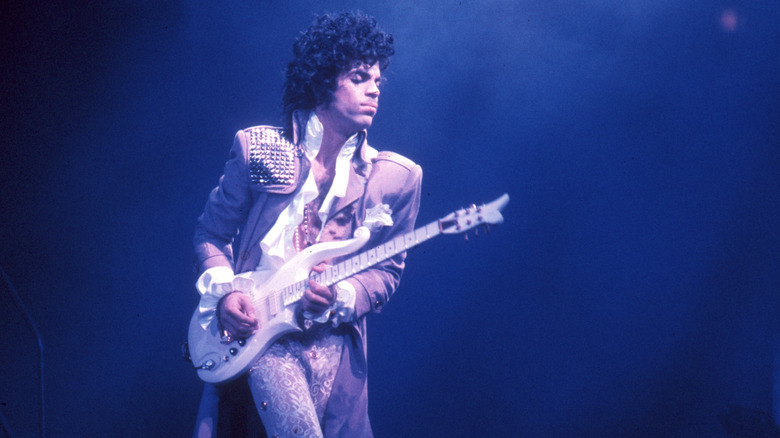
The word "blistering" is used a lot when describing guitar solos, but Prince's opening salvo in "When Doves Cry" feels like it earns the title more than most, especially when measured in notes per second. Clocking in at barely 13 seconds, the Prince's hyper-distorted, hyperspeed shredding streaks through the opening of "When Doves Cry" like a bolt of lightning. It's a promise that this won't be your average funk song — one that's thoroughly delivered.
Along with the popular radio edit, "When Doves Cry" also has an extended version. It'll be the preferred option for those interested in guitar solos, as it adds a second, far longer one that pairs well with the first. This lead has more time to breathe and takes advantage by letting some emotional bends linger and slowly building up speed. By the end, it's become quick and deft enough to sound like a mimic of the first, albeit with some of its growl hidden behind the rest of the band.
Contrasting its whirlwind guitar work, "When Doves Cry" oddly omits a bass part entirely — a rarity in popular music and especially funk and rock. "It was just sounding too conventional, like every other song with drums and bass and keyboards," Prince told Bass Player of the strange choice. He further explained in an especially Prince-like way: "'When Doves Cry' does have bass in it — the bass is in the kick drum. ... Bass is a lot more than that instrument over there. Bass to me means B-A-S-E. B-A-S-S is a fish."
Perfect Situation — Weezer
Casual listeners will likely know Weezer from pop radio hits, but true fans know them as lifelong standard-bearers for modern guitar rock. Frontman and guitarist Rivers Cuomo isn't just the nerd king that wrote underdog anthems like "Buddy Holly" and "Say It Ain't So" — he's also a devout metalhead and solid shredder himself. Understandably, the idea to open the band's 2005 power pop singalong "Perfect Situation" with a pitch-perfect wah-wah solo is one that could only occur to a true guitarist. Just make sure you find the full version, which should be about 4:15 in length.
The solo kicks in immediately and gives the song an instant punch while still leaving room to build. Cuomo's guitar begins relatively low, playing octaves increasingly higher for a couple of chord progressions until finally opening up at the 20-second mark as the rest of the band takes over. Then, a series of expressive and wah-wah bends and licks mark an early peak before Cuomo lets the guitar hang and then die as the verse begins.
Without the solo, "Perfect Situation" would sound like any other cookie-cutter pop rock hit, but with it, the song contains a fun, unusual dynamic. Its early placement creates a climax only matched by the second solo — in particular its opening, mournful wail of a double-stop bend. They act like high-energy bookends around the otherwise straightforward verse-chorus routine, keeping things fresh before its anthemic chanting coda.
Voodoo Child (Slight Return) — Jimi Hendrix
It's hard to imagine any opening solo more iconic than Jimi Hendrix's "Voodoo Child (Slight Return)," which as a whole is easily one of the most revered pieces of guitar playing in history. There are any number of licks to analyze and celebrate throughout the song. But the opening minute-long solo before Hendrix's voice enters is the track's peak in terms of recognizability and maybe even musicality.
One of the coolest features of the intro solo is the way Hendrix structured it into distinct segments that almost tell their own story. After the famous opening wah-wah riff to hook us in, he drops the effect and goes into the low, hard-rocking E minor riff. As if it were the song's bass, Hendrix climbs higher and higher past it with some blues shredding high up on the neck before triumphantly returning to the base. In that way, it parallels the first lines: "I stand up next to a mountain / And I chop it down with the edge of my hand."
Like so much of Hendrix's other work, "Voodoo Child" continues on without ever really being reduced to just chords — he was almost always playing some hybrid of rhythm and lead. The track basically cycles between riffing low and soloing high without ever getting repetitive. Hendrix was truly the best and always knew when to quiet things with some palm muting, for example, or shoot up to the top of the neck and scream through bends. "Voodoo Child" not only has an epic intro solo but is also an excellent all-around song.