

5 Of The Biggest Band Rivalries In Rock History
Musicians not getting along with each other? That's a tale as old as time, and there are countless accounts of bandmates who hate each other. Thus, it should come as no surprise that there are entire bands who've been known to stand on opposite sides of the fence, eyeing each other head to toe with visible disgust. And as with any other sort of public drama, these clashes have fascinated fans and the media alike, with every statement, gesture, or passive-aggressive song lyric being meticulously documented and analyzed.
Rock bands have found themselves at odds with one another for a variety of reasons. Some conflicts were speculated to be manufactured publicity stunts — not entirely without a grain of truth, but mostly designed to generate as much buzz for the bands as possible. However, a fair few of these band brawls were (or are) rooted in genuine animosity — think Oasis and Blur — whether because of an off-hand comment in an unguarded interview, a joke taken too far, or just plain old professional jealousy. Sadly, sometimes the clashing bands started out with warm feelings toward each other, only for things to turn ugly in record (pun intended) time. Without further ado, here are five of the most infamous examples of rock band rivalries in music history.
The Beatles versus The Rolling Stones
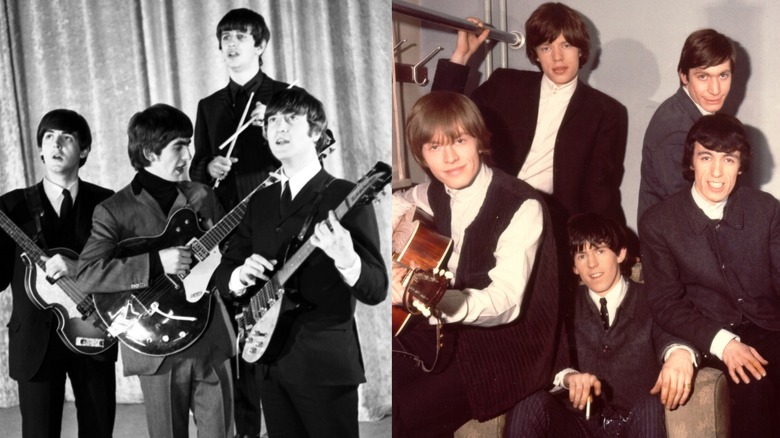
Since the '60s, the Beatles and the Rolling Stones have been trading barbs in a manner that, while not severely antagonistic, hints at a complicated relationship. The Beatles first crossed paths with the Rolling Stones in 1963, when the Stones were still known primarily for performing blues covers. After the Stones signed with Decca, thanks to a good word from George Harrison, the media predicted that the two talented groups would inevitably butt heads, though it wasn't really obvious at the time; in fact, the Beatles even wrote a song for the Stones.
Eventually, the cracks in their friendship began to show, with John Lennon calling the song they lent the Stones — "I Wanna Be Your Man" — a "throwaway" in a 1980 interview with Playboy (via The Beatles Interview Database) and telling Rolling Stone Magazine in 1970 that the Stones, whom Lennon accused of being Beatles imitators, couldn't match his band's talent. Almost two decades later, Mick Jagger threw a jab right back at the Beatles by publicly downplaying the significance of their disbandment. Keith Richards followed up in 2015 by telling Esquire that "Sgt. Pepper's Lonely Hearts Club," hailed by many as the Beatles' best album, was a "mishmash of rubbish."
The Stones and the Beatles don't hate each other, for sure. After all, Jagger did induct the Fab Four into the Rock and Roll Hall of Fame in 1988. Regardless, their pseudo-rivalry lives on; in Paul McCartney's 2021 New Yorker profile, he implied that the Stones never really outgrew their blues cover band roots.
The Red Hot Chili Peppers versus Faith No More (and Mr. Bungle)
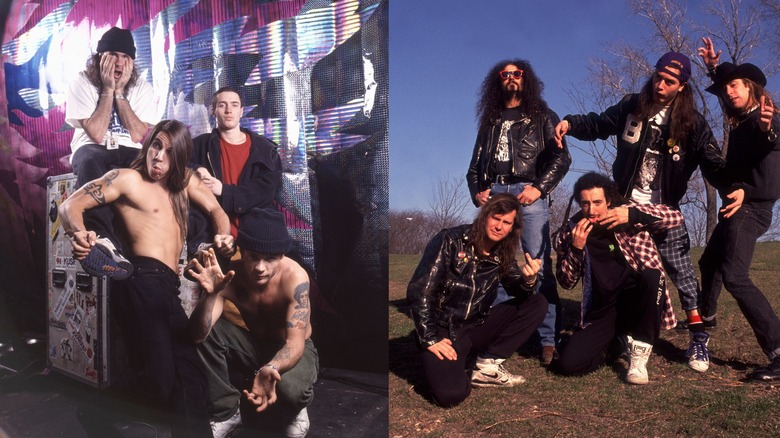
It's not entirely accurate to say that the Red Hot Chili Peppers can't stand Faith No More or vice versa. The actual bad blood is between RHCP's Anthony Kiedis and FNM's Mike Patton (which explains why Patton's other group, Mr. Bungle, got caught in the crossfire). Before Patton joined FNM, the relationship between RHCP and FNM was amicable, with the bands performing side by side in the late '80s sans animosity.
The spark that lit the conflict was a 1990 Kerrang! interview in which Kiedis made a gory joke about Patton lacking originality. Apparently, Kiedis had seen an FNM music video where Patton performed moves allegedly swiped from Kiedis. Nine years later, while FNM was on break, the feud escalated. At the time, both RHCP and Mr. Bungle were signed under Warner Brothers; the label pushed back the release of Mr. Bungle's album "California" to prioritize the launch of RHCP's similarly named "Californication." Additionally, Kiedis reportedly got Mr. Bungle tossed out of several summer festival lineups, allegedly because he didn't want the band (or more accurately, Patton) performing alongside RHCP. Mr. Bungle retaliated by mimicking and mocking RHCP at a Halloween concert.
So, do Kiedis and Patton still hate each other? In an unspecified 2010 interview (via Faith No More Followers), Patton seemed to have mellowed, saying, "I bet we'd have a warm embrace if we saw each other now."
Blur versus Oasis
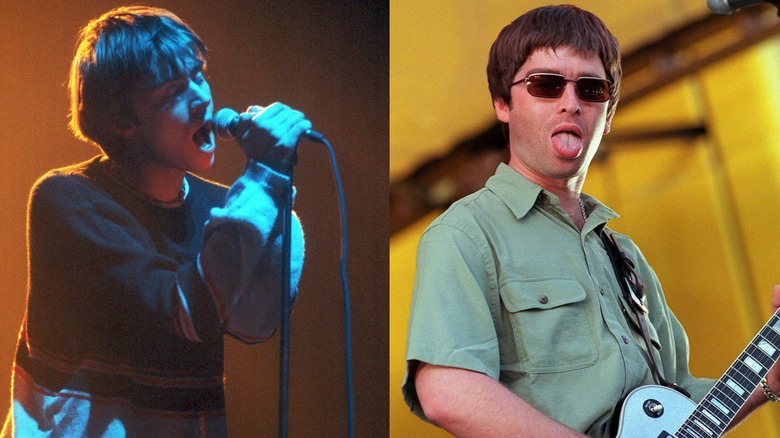
The list of stars who can't stand Oasis is long and colorful, and for a time, it included fellow Britpop band Blur (in particular, vocalist Damon Albarn). The part-creative, part-personal feud between Blur and Oasis began in 1995. At a victory party in honor of Oasis' first chart-topper, "Some Might Say," Liam Gallagher (who, like his brother and bandmate Noel, had a reputation for being a pot-stirrer) walked up to Albarn and allegedly said "We're Number One, you're not, you're not" to his face (via NME). This pushed Albarn, who once likened Oasis to his old school bullies in the 2010 Blur documentary "No Distance Left to Run," to challenge the band.
Later that year, Blur dropped a new song, "Country House," on the same day as Oasis' single "Roll With It." This match-up captured the attention of the British media, who compared their chart conflict to the Beatles and Rolling Stones feud from decades before. Blur's lighter-sounding release (with a matching music video) outsold the Gallaghers' textbook Oasis track by over 50,000 units. However, Blur's victory hurt the band's reputation and morale because of the unserious video. It also seemingly incensed Noel: In a 1995 interview with The Guardian (via Oasis Interviews Archive), he wished that Albarn and bassist Alex James would "die because I f***ing hate them," a comment he later retracted.
The conflict persisted for years, even when the Gallagher brothers themselves were feuding. But in a 2025 interview with The Sun, Albarn, now with Gorillaz, buried the hatchet, declaring Oasis the ultimate victor and wishing them well on their reunion tour.
Pavement versus the Smashing Pumpkins
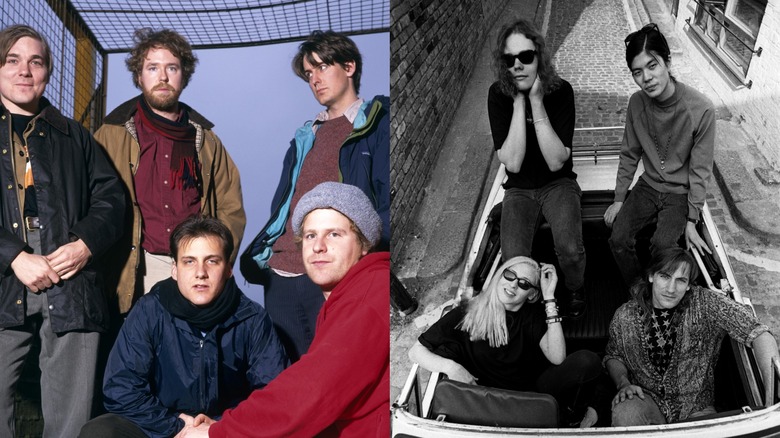
It's not a stretch to say that if you were part of the 1990s music scene, you would look at the Smashing Pumpkins and say, "Now there's a successful band." After all, they were consistent hitmakers at the time, and they even released a classic album that defined '90s alt-rock. Perhaps that's what inspired Pavement's vocalist Stephen Malkmus when he wrote the lyrics of "Range Life," released in 1994 as a single from their album "Crooked Rain, Crooked Rain." Near the end of the song, the Smashing Pumpkins get name-dropped, and the narrator sings, "Nature kids, I, they don't have no function / I don't understand what they mean / And I could really give a f***."
Speaking to NY Rock Magazine (via Rolling Stone) in 1999, Malkmus clarified that it wasn't meant to be an insult to the band, but a thoughtful observation about the industry. "I only laughed about the band name, because it does sound kind of silly ... I just dissed their status. I never really cared for the rock 'n' roll lifestyle or being indie." However, Pumpkins frontman Billy Corgan didn't take it that way. Fuming at the name-drop move, Corgan reportedly got Pavement kicked off the 1994 Lollapalooza line-up.
Although Malkmus claimed he had no ill intent when he wrote "Range Life," he has nevertheless expressed regret for the diss-like lyric. During a 2022 performance, Malkmus even removed the mention of Corgan's band from the song. Judging from Corgan's angry 2010 tweets and lack of reciprocal comments, he still hasn't forgiven Malkmus for this perceived slight.
Guns N' Roses versus Nirvana
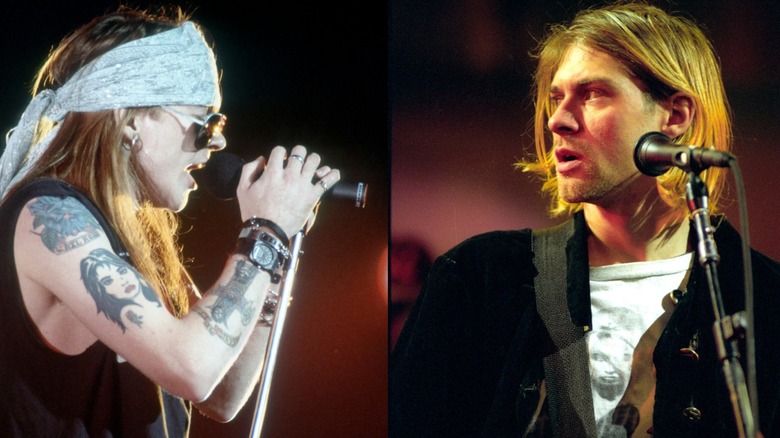
It's impossible to think of '90s rock music without thinking of Guns N' Roses and Nirvana, two musical acts that perhaps embodied the dominant trends of their time more than any of their contemporaries. It's a known fact that, unsurprisingly, GNR's Axl Rose held Nirvana in high regard; unfortunately, Nirvana's Kurt Cobain felt the exact opposite way toward GNR, dismissing them as a band with no substance in a 1991 interview with Seconds Magazine (via Rolling Stone).
The following year, Rose and Kirk Hammett of Metallica repeatedly reached out to Cobain to get Nirvana to join the GNR-Metallica co-headlined tour as their opening act. Cobain responded to Hammett by revealing the real reason he hated Guns N' Roses: The band represented the toxic macho culture that Cobain despised. After that, a public feud was on, with the nadir occurring at the 1992 MTV Video Music Awards. Enraged by a taunt from Cobain's wife Courtney Love, Rose reportedly screamed, "You shut your b***h up, or I'm taking you down to the pavement!" (via Rolling Stone) — and Cobain reacted by mockingly repeating the words to Love, causing Rose to retreat as witnesses laughed. Other noteworthy events that night include the bands' bassists (GNR's Duff McKagan and Nirvana's Krist Novoselic) nearly brawling backstage and drummer Dave Grohl jokingly calling out for Axl during Nirvana's rambunctious performance.
Years later, McKagan and Novoselic reconciled, and even became friends. Sadly, it seems the feuding frontmen never had the chance to let bygones be bygones before Cobain's tragic passing in 1994.