

4 Best Female Duets Of The '70s
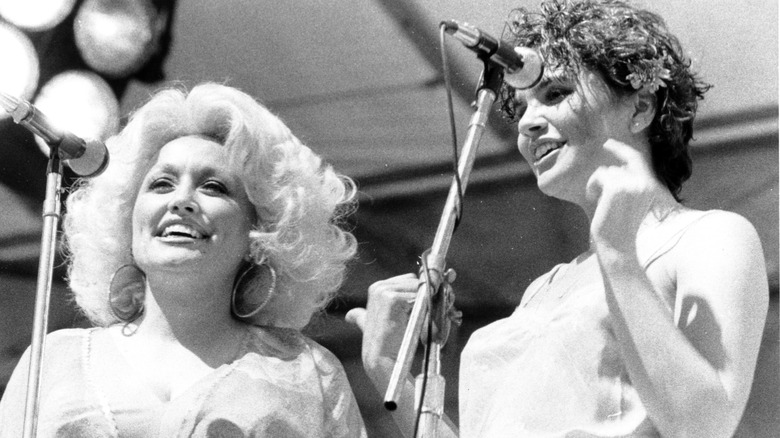
There's something wonderful about a well-sung duet, since listeners get treated to two strong vocal performances for the price of one. There have certainly been some top-notch duets by male singers throughout music history, as well as classic songs sung by a male and female vocalist. However, having two female singers share a song is rarer, possibly due to that old boys' club mentality that's been associated with some record execs, and we've chosen the four best female duets of the 1970s.
We singled out these songs because they showcase some of the characteristics of an extraordinary duet: Two highly skilled singers who've mastered the required balance of power and restraint in their voices, so each vocal performance can be highlighted. The four songs that we've chosen also display flawless harmonizing, which requires using another skill set, since it's safe to say that each singer on this list — such as Dolly Parton and Linda Ronstadt — sang more solo songs than duets.
If one is a singer and thinking about teaming with another vocalist, all of these songs can be used as perfect examples of just how a high-quality duet should sound. Everyday music fans can also benefit from these classics by sitting back and being treated to some true artistry.
The Sweetest Gift — Linda Ronstadt and Emmylou Harris
In the mid-'70s, Linda Ronstadt and Emmylou Harris sang a touching rendition of "The Sweetest Gift," a bluegrass classic written by James B. Coats and first made popular by James and Martha Carson's 1946 version. Ronstadt's version was released in 1975 on her "Prisoner in Disguise" album, where she and Harris blend their voices seamlessly to create dazzling harmonies. The heartfelt tune could be called one of the most beautiful and well-sung duets in mainstream folk history.
The lyrics portray a mother visiting her son in jail, but only to bring him love, comfort, and a warm smile, rather than fuss at his jailers to get him freed: "She did not bring to him a parole or pardon plea / She brought no silver (Brought no gold), no pomp or style (None to see) / It was a halo bright, sent down from heaven's light / The sweetest gift, a mother's smile."
The cut reached the No .12 spot on Billboard's Hot Country Songs chart, proving their version truly resonated with listeners. Some may associate the song with Ronstadt and Harris singing it with Dolly Parton, whose tragic death was heavily mourned by rockers. The women sang it in 1976 on Parton's variety show, which would be a precursor to the three artists teaming up to release their 1987 album "Trio," followed by "Trio II" in 1999.
When Will I Be Loved — Sandy Denny and Linda Peters
Oftentimes, what looks like a promising relationship in the beginning ends up shattering someone's heart, and some people face that kind of disappointment repeatedly. That relatable experience is tackled in the song "When Will I Be Loved," written by the Everly Brothers' Phil Everly and released as a single by the Bunch in 1972. Sandy Denny shares vocal responsibilities with Linda Peters — later known as Linda Thompson after marrying musician Richard Thompson — and the women use a two-part harmony to accentuate the somber lyrics.
"I've been cheated / Been mistreated / When will I be loved? / I've been made blue / I've been lied to / When will I be loved?" Denny and Peters sing. Their vocals showcase a beautiful softness, total voice control, and perfect blending.
The Bunch's version of "When Will I Be Loved" didn't have the same chart success as The Everly Brothers, who reached No. 8 with the song on the Billboard Hot 100, or Linda Ronstadt's rendition that went No. 2. However, they still achieved plenty of artistic success by combining their near-perfect voices into one breathtaking vocal performance.
Dida — Joan Baez and Joni Mitchell
It could be said that scat singing is a wonderful way to highlight a singer's voice and level of vocal control, something that's shown in "Dida," sung by Joan Baez and Joni Mitchell. The uptempo, summery-sounding track is on Baez's 1975 album, "Diamonds & Rust," and it shows both legendary folk performers harmonizing without singing actual lyrics. Instead, they harmonize the words "Di-da, di-da" and throw in a few "La-la-la las" for good measure.
Baez begins the song with her rich soprano, followed by Mitchell's mezzo-soprano, and the end result is a light, airy-sounding vocal delivery that blends superbly with the jazz-inspired backing music. Mitchell just happened to be in the studio working on other music when she joined Baez on the song, who then completed it after heading back to Los Angeles.
But despite the gorgeous collaboration between the women, Mitchell once told MOJO (via her website) that she thought she and Baez would be at odds. "I always thought the women of song don't get along, and I don't know why that is," said Mitchell in the interview. "Joan Baez would have broken my leg if she could, or at least that's the way it felt as a person coming out." Of course, we're glad that no legs were broken in the studio and something exquisite was made instead.
I Never Will Marry — Linda Ronstadt and Dolly Parton
There are a bunch of traditional folk rock hits with no known authors, and "I Never Will Marry" happens to be one of them. It's also been covered by numerous artists, from the Carter Family to Loretta Lynn and Pete Seeger. Linda Ronstadt and Dolly Parton's version is on Ronstadt's 1977 album, "Simple Dreams," and both superstars use just the right amount of balance while sharing verses, so each voice can be heard together or separately, depending on where you place your focus.
"I Never Will Marry" peaked at No. 8 on Billboard's Hot Country Songs and spent 13 weeks on the chart. Ronstadt spoke about the ballad with PopMatters in 2017 and explained why she recruited Parton for the song, saying, "Dolly has a plaintive quality to her voice, sort of pleading with the world to deal her a good hand and a sense that it never will. It's just devastating ... She has plenty of food now, but she still has that little girl quality in her voice. It's so touching."
The song helped Ronstadt's "Simple Dreams" album reach No. 1 on the Billboard 200, where it stayed for five weeks.