

The 5 Best Duets Between Female Rockers
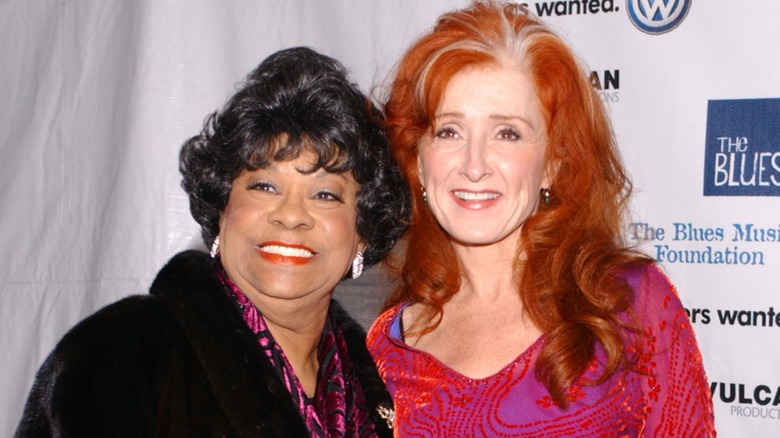
The history of rock is teeming with iconic duets between women and men: There's the powerful pairing of Lita Ford and Ozzy Osbourne on "Close My Eyes Forever," Stevie Nicks joining forces with Tom Petty for her debut solo single "Stop Draggin' My Heart Around," Peter Gabriel and Kate Bush giving art rock an unforgettable crossover event with "Don't Give Up," and pretty much anything out of the Sonny & Cher vault. Collaborations between female vocalists, however, are much rarer in the genre.
Some of the most momentous team-ups between women throughout rock history have resulted in highly underrated releases, as you may notice by the following selection of five incredible duets between female rock stars. Only a couple of these became as legendary and widely played as they ought to have, while others are thorny, willfully abrasive artistic feats that consolidate two rule-breaking personalities into riotous music with no pretensions towards mainstream accessibility. There are many more studio tracks and live performances we could have cited, including several pairing the women on this list with different collaborators altogether; in any case, these five duets are all incredible, brilliantly compatible matchups that the history of music is better and luckier for having seen.
Joan Baez and Joni Mitchell — Dida
It's impossible to overstate the momentousness of a collaboration between Joan Baez and Joni Mitchell in 1975, at the height of both women's popularity, prestige, and sway over the folk music landscape. As if its sheer historical scale weren't big enough, "Dida" is even more extraordinary for how counterintuitive it is as a meeting spot between these two specific artists: Unusually for Baez, it's an original song penned by her — yet, unusually for poet laureate Mitchell, it's a lyricless number made up entirely of singsong. In other words, "Dida" provides an excellent opportunity to cherish Baez's underrated prowess as a composer and melodist, and to focus on the enrapturing power of Mitchell's voice in pure, non-verbal form.
Originally recorded solo by Baez for her 1974 Spanish-language album "Gracias a la Vida," on which it acted as a melancholy pause for contemplation amid songs of protest against Augusto Pinochet's rule in Chile, "Dida" had the kind of clear, flexible melody that could fit any number of moods. And so, on her 16th studio LP "Diamonds & Rust," Baez called in Mitchell to help rework "Dida" into a sunny, richly produced folk rock hymn to perseverance and rebirth.
Like the original, the lyrics to the duet version of "Dida" consist of nothing but the two titular syllables, elongated and repeated by Baez and Mitchell with the effortless improvisational flair of a two-piece jazz band. The way their voices braid together along the song's mellifluous "da da da" lines is nothing short of magical — like witnessing mighty forces of nature cohere into a shimmering rainbow.
Lizzy Mercier Descloux and Patti Smith — Morning High
A Parisian punk music journalist who refashioned herself as a New York City rock maverick in the late 1970s, Lizzy Mercier Descloux had a sound so intense and unconventional that it barely made a commercial blip — yet its brilliance was so undeniable that it became the stuff of underground legend. Arguably more instrumental than anyone else to Mercier Descloux's acclimation to New York was another envelope-pushing titan: Patti Smith, with whom Mercier Descloux struck up a profound friendship and creative partnership, even crashing in Smith's Lafayette Street place for some time.
Among many other things, the two rockers bonded over their love of French poet Arthur Rimbaud, and it was this shared love that inspired what would go down as their only recorded duet: a reading of Rimbaud's 1874 composition "Matinée d'ivresse" ("Morning of drunkenness"), set to ominous, freewheeling music by bass guitarist Bill Laswell.
The track, titled "Morning High," only saw the light of day decades later, in the 2003 reissue of Mercier Descloux's debut album "Press Color." It was the unearthing of a treasure: Rattling off Rimbaud's poem in their respective native tongues, Mercier Descloux and Smith imbue its drug-induced ecstasy with a droning, incantatory morbidity that makes you feel as though you're being made privy to a dark secret of the universe. Leave it to two of punk's great bards to demonstrate that poetry and punk are one and the same.
Sharon Van Etten and Angel Olsen — Like I Used To
It's rare that contemporary songs become as immediately and self-evidently iconic as Sharon Van Etten and Angel Olsen's "Like I Used To" did in 2021. Self-described as chummy but intermittent road acquaintances who had always admired each other's work from afar, the two indie luminaries first started working together when Van Etten gathered the courage to send Olsen an unfinished song in June 2020. It turned out they'd both been wanting to ask each other about collaborating; sure enough, over that glum 2020-21 period, they began to trade verses, gradually building out what would become the arena-ready folk rock anthem of a generation.
Finally released in May 2021 as a standalone single, "Like I Used To" is a paradoxical feat: Its mood is one of hard-earned emergence from darkness and pain, yet its hooks and guitar lines are so big and effortlessly sweeping that it feels like a victory lap, a flex of pristine pop craftsmanship from two musicians more accustomed to somber obliqueness. The lyrics speak of despondency, exhaustion, renewal, and return to life — in ways that nodded, then, to the world's jerky hope for post-pandemic reopening, yet remain indelibly affecting even years removed from that context. And then there's the meeting of their voices, as powerfully self-possessed yet drenched in expressive vulnerability as they've ever been before or since, interfacing into a tidal wave of emotion that somehow hits the ears like a full-blown choir. When all is said and done, it will be one of the defining songs of the early 2020s.
Linda Perry and Grace Slick — Knock Me Out
4 Non Blondes may have quit just as they were making it big, but lead singer Linda Perry went on to equally great things in her solo career, creating music that defied all expectations set by her former band's radio-friendly sound. Perry's 1996 debut, "In Flight," is peppered with dark, crunchy, emotionally raw songs with wailing verses and lugubrious guitar lines — material strong enough, in fact, to have impressed Grace Slick.
The iconic Jefferson Airplane frontwoman had long since walked away from her career and retired from music when Perry reached out to her through Slick's daughter China. To Perry's surprise, Slick agreed to visit her in the studio, where Perry swallowed her nerves and played her the downtempo blues cut "Knock Me Out." Slick liked it enough to ask Perry what she wanted her to do; Perry told Slick to do whatever she wanted with the song. So Slick, interpreting Perry's lyrics as the lament of a suffering lover in an abusive relationship, wrote a verse of her own from the perspective of the other person, and the two recorded a nearly seven-minute duet in which every line is bone-chilling.
"Knock Me Out" finds both Perry and Slick at their peak as gifted, full-throated rock vocalists, spiking the funereal lyrics with growls and furious belts so eloquently that, in the best blues tradition, the intensity of feeling becomes almost startling. And then, when they join voices in the chorus, it's a masterclass — Perry's raspy upper-register wailing and Slick's roiling alto combining to create a cinematic climax.
Ruth Brown and Bonnie Raitt — (Mama) He Treats Your Daughter Mean
When Ruth Brown was inducted into the Rock & Roll Hall of Fame in 1993, there was no more emblematic song for her to sing at the ceremony than "(Mama) He Treats Your Daughter Mean," her signature 1952 hit written by Johnny Wallace and Herbert J. Lance. And there was no one more fitting to join her onstage than Bonnie Raitt. The Virginian R&B pioneer and the Californian blues rock superstar had been friends for years at that point, as Raitt would later note in her 2006 eulogy for Brown; Raitt had even served as an early board member at the Rhythm and Blues Foundation, which Brown co-established in 1988. A duet in Brown's honor was the logical culmination of their affinity.
The performance, broadcast as part of the 1993 Hall of Fame inductions and later compiled in the museum's live album series, finds Brown putting on a vintage-style rendition of "(Mama) He Treats Your Daughter Mean" just three semitones below her original '50s key, while preserving all of the control, poise, and irreverent energy that made it an R&B staple. Meanwhile, Raitt accompanies her on guitar alongside the band, and steps to the mic to harmonize on the hook, adding a fiery country twang to the song's pronouncement of romantic exasperation that fits perfectly with Brown's lower, more seasoned take on her old classic. Given how in sync they are throughout the whole rendition, it's not much of a surprise that Brown and Raitt went on to tour together in the mid-'90s.