

The Best Vinyl Record Player Setups For Beginners
We may receive a commission on purchases made from links.
So you want to get into vinyl, huh? It's definitely a lot more complicated than unlocking your phone and tapping the arrow icon in Spotify, but not impossibly so. Beginner-friendly vinyl setups exist that cover all the bases of what a music lover actually needs.
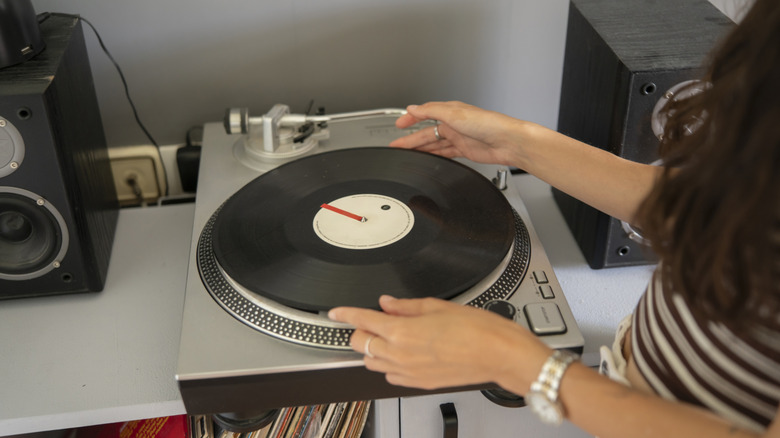
If you imagine what kind of setup you need to play vinyl, you might picture something resembling a shrine with a little stand containing shelf space, a turntable on top of that, some speakers to the side, and so forth. This is basically accurate. You've got to choose a turntable that's good enough for your needs and doesn't break the bank — preferable lower maintenance direct-drive turntables, the kind that music lovers had in the '70s. You need multiple speakers for stereo sound, spaced properly apart, which these days might be Bluetooth compatible. The size of your stand is important, too, not only to hold the turntable but to properly store a growing record collection (vertically, not horizontally). Overall quality of sound is obviously important, as is the complexity of your setup; there's no need for beginners to go overboard in either respect.
Beyond these general guidelines, there's a mountain of specific gear to choose from. We can't cover every possibility, because you can mix and match components as you like. But we can recommend four overall setups that range from most affordable and least complex to least affordable and most complex, including several specific options for each.
The all-in-one setup
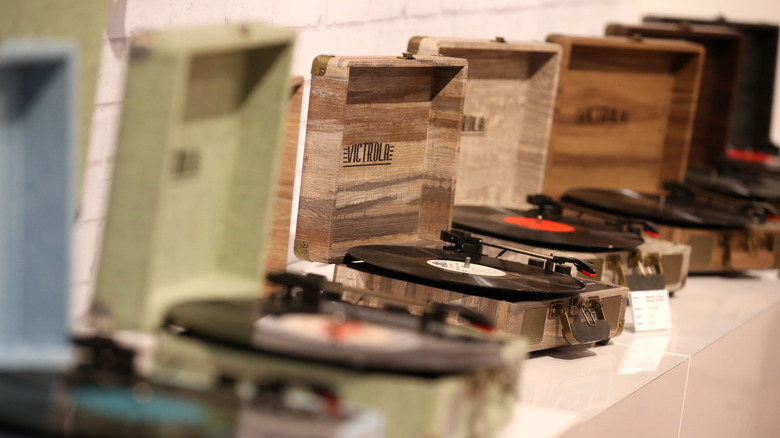
You can't get easier than this. If you want as little hassle as possible setting up and using your vinyl shrine, as little money spent as possible, maximum portability, and maximum versatility regarding interconnectivity with modern tech, this is the way to go. You just buy an all-in-one player, unbox it, plug it in, put a record on it, and listen.
The Victrola Eastwood II is kind of the lower-end, easy choice, here. It's roughly the size of a board game box or two small pizza boxes stacked on top of each other. The front of the turntable base is also the speaker and the sides of the body are wood, so it looks nice. It's so small and easy to carry that you could even bring it into the kitchen when you cook, put it in the bedroom if you want to listen to music while you read in bed, and so forth. It's like a Bluetooth speaker that plays one album at a time to mimic a vintage experience. And speaking of Bluetooth, you can play from a device to the all-in-one's speaker, or from the all-in-one to another speaker. It's also hella-cheap at $150. The sound quality isn't amazing, but what do you expect? It's also not too sturdy; the vinyl actually sticks out past the left side of the player.
There's a kajillion all-in-one players like this, with Angels Horn being one of the better-regarded, slightly more expensive brands (about $250). Fundamentally, they're all just as easy-to-use and require no additional components. The only extra things you need with this setup are a place to put the player and somewhere to store your records.
The Bluetooth setup
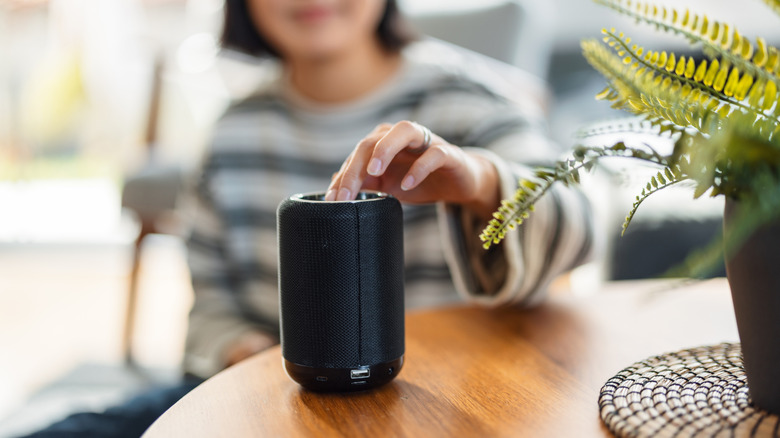
Slightly more complicated than an all-in-one setup but almost as easy to use, is the Bluetooth-enabled turntable setup. Rather than connect a turntable to old-school, wired speakers, you connect it to a Bluetooth speaker, the kind you connect to any other device: laptop, desktop, phone, etc. This means you've got two components to think about — the turntable and speaker — but you can control the quality of each, individually.
Audio-Technica is a good brand for Bluetooth-enabled turntables (or a good brand for any other kind of vinyl setup, to be honest). Their $259 AT-LP60XBT ("BT" stands for Bluetooth) is a good example of an entry-level, Bluetooth-enabled turntable. It's made of plastic and aluminum, uses a belt drive rather than a direct drive, and has an automatic start/stop option that moves the tonearm by itself. Critically, it also has a built-in amp (we'll get to this more later), meaning you just turn on your speaker and it connects to the turntable with no other steps. The turntable even has a 3.5-mm jack if you want to listen with wired headphones, which is good because we all know Bluetooth devices are prone to connectivity problems. As before, there's loads of other options, like the Sony PS-LX3BT or LX5BT, or the Cambridge Audio Alva TT V2.
Speakers run the gamut from simple, standalone, monophonic Anker portable speakers that cost less than $50 to Sonos sound systems that synchronize a suite of speakers across your home and can cost multiple thousands. But why have crazy expensive speakers if you don't have a turntable of comparable quality? Start simple and level up later if you want.
The active speaker setup
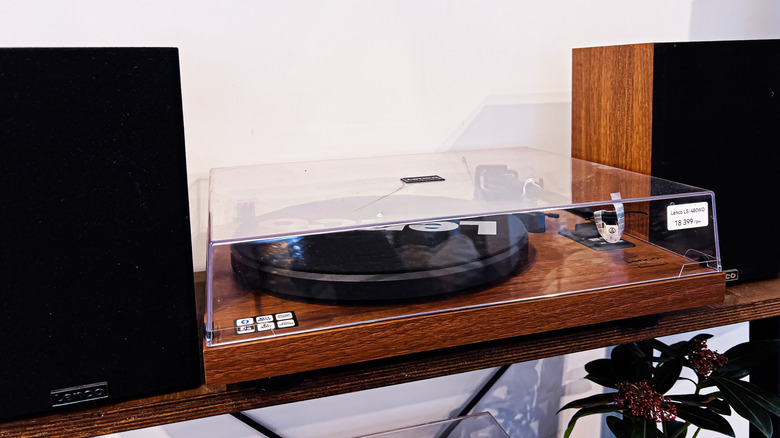
Note that the further we go in this article, the more we creep toward a vinyl setup that resembles setups of yore, with or without the kind of hi-fi stereo system that every music lover had in the '60s. Enter: power cords and wires. It's time to go old school and physically hook your turntable up to speakers and run some wires across or through your walls. Or, just put your speakers on a stand next to your turntable for a simple but suitably stereo solution.
Powered, or active, speakers are key here (as opposed to passive speakers). Active speakers have their own power source, meaning your vinyl setup will probably need a power strip. Active speakers also don't need a separate amp to boost their sound, which makes your setup simpler no matter the extra power cords. Such speakers can come with their own controls and vary wildly in price from $150-or-less Edifiers to multiple-thousand-dollar options. But, remember our advice about pairing turntable and speaker qualities.
Turntables in this setup are the same as Bluetooth turntables, but with or without Bluetooth connectivity. You can mix and match any combination of turntable and speaker you want, but to make things simpler, you can also just get a kit. Audio-Technica once again comes to our rescue, as they've got ideal beginner turntable/powered speaker combos from $370 and up. (Some of them have toggleable Bluetooth functions.) No matter the convenience of all-in-one players, this setup is probably the most en vogue at the moment, and the best all-around blend of quality, convenience, and affordability. Just get a nice stand for your player and records, and cozy up to an album.
The passive speaker setup
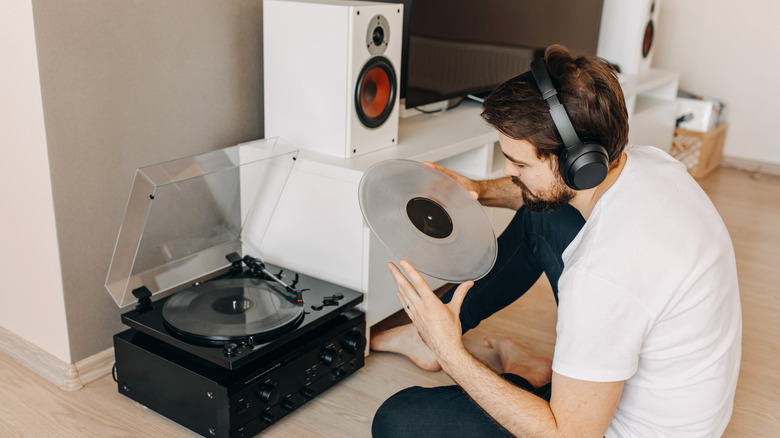
Finally, we've got the most complicated vinyl setup that requires the most components: the passive speaker setup. Passive speaker setups are still within reach of beginners, but are definitely suited for either the biggest audiophiles in the crowd or folks who care the most about the hobbyist aspect of vinyl collection, not just listening to music. Thanks to amps with multiple controls, this setup offers the most customization at the cost of buying and managing three main components: the turntable, speakers, and amp. (And yes, some amps have direct Bluetooth connectivity, too.)
Visualizing a passive speaker setup shouldn't be too tough. Sound goes from the turntable to the amp, then from the amp to the speaker, all connected in series. All three components have their own power sources, which means lots of wire management (which will actually delight certain people). Options can get out of control, as there's just so, so many amps to choose from. But, the Arcam A15 is an agreed-upon, simple choice with only two controls: input volume (aka gain) and output volume (what we typically call "volume"). Cambridge Audio makes a more complicated AXR-100 amp that has AM/FM radio functionality (with a really utilitarian, boxy design), while other brands like WiiM adopt a new-school design that looks like a Nintendo Wii.
Of course, you could also go the cheat-code route and get a combo package, as before. Denon's PMA-600NE package includes speakers and an amp with a decent amount of controls (treble, bass, balance), plus output options for subwoofers. Unless you get a deal, this kind of combo, minus the turntable, isn't going to go for less than $1,000.