

The 5 Longest Rock Songs Of The '70s Actually Worth The Runtime
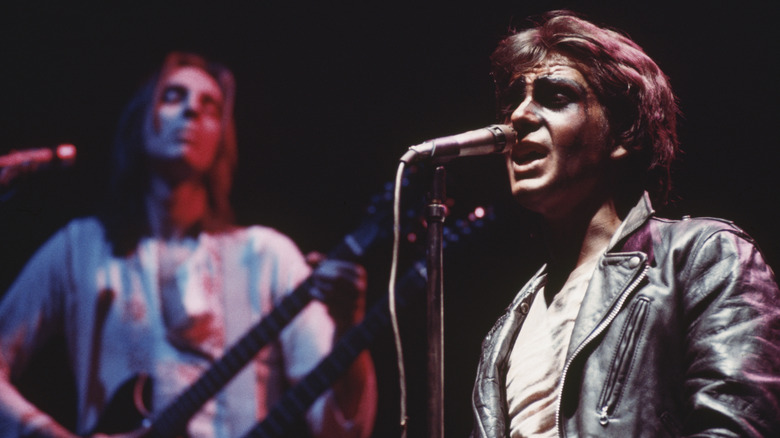
You'd be surprised how many songs from the album-rock era are epically long, and they're not all good. That said, some of the longest rock songs of the '70s are actually worth the runtime. We've found the best in storytelling and energetic riffs that will keep you listening as the clock ticks well past the radio threshold.
The songs you'll find here are a far cry from the shortest hits of the '70s. When we say they're long, we mean it. Our shortest pick on this list is "Terrapin Station Medley" by the Grateful Dead at over 16 minutes, so you might want to clear your schedule for an evening of musical experiences.
Where cult favorites in the vein of "Echoes" by Pink Floyd run over the 23-minute mark, they tend to have sparse lyrics and rely heavily on ambient atmosphere, and since they're not everyone's cup of tea, they didn't make the cut. Likewise, there are handfuls of awesome 10-minute songs that simply lost out because they weren't as long as other tracks that were just as epic. Let's face it: It's a lot easier to be "worth the runtime" at 10 minutes than it is at 40 minutes.
So, let's get to the list, shall we? Here are the five longest rock songs of the '70s that are actually worth the runtime, listed from shortest to longest.
Terrapin Station Medley — Grateful Dead
The Grateful Dead dropped the 16-minute, 20-second "Terrapin Station Medley" as the title track of their 1977 album "Terrapin Station." The song takes that classic Jerry Garcia feel and formalizes it into a studio masterpiece that is easily one of the best Grateful Dead songs from the '70s. Much of what defined the Dead feel had to do with their jam-style live performances — something very different from this heavily produced piece. Even so, it's hard for fans to deny that this seven-movement story is an epic worth the vinyl.
Roughly half of this track is almost orchestral in style — not because the Grateful Dead use an orchestra, but because of the way it moves you with instruments. Only three of the movements contain lyrics while the others rely on instrumental storytelling in much the same way you'd find in classical music.
The first part of the lyrical tale sets the stage for the master of stories to share his fable. The next turns the listener's attention to a mythic place known as "Terrapin Station." And the final leg of the story speaks of a fated return to Terrapin, "for good or ill again." The song then ends in a folk-rock-style jam that utilizes a chorus overlay to complete the mythic feel of the story.
The progressive rock piece will take you through several time signature changes and song styles that really do feel like you're listening to mythology unfold. It's an experience worth having, Deadhead or not.
Cygnus X-1 Book II: Hemispheres — Rush
You may experience a bit of a musical culture shock if you go straight from "Terrapin Station Medley" to this epic Rush piece. Where the Grateful Dead used orchestral-style composition, "Cygnus X-1 Book II: Hemispheres" by Rush hits you with the sharper guitars and heavier drums of 1978's hard progressive rock.
Three minutes of instrumental preceding the first lyrics of a song would usually have your thumb slamming the "skip" button of whichever digital music platform you prefer, but not here. This is an 18-minute, 8-second song that holds a drive similar to a hard rock ballad from start to — well — roughly 12 minutes in, when it drops to a slow, dark thunderstorm of a story. This lasts for a couple of minutes before the song slams you with more heavy rock. Don't take that the wrong way; the stormy bit breaks up the multi-part suite with a contrast that feels even more epic.
"Cygnus X-1 Book II: Hemispheres" ends with a minute of acoustic jamming that almost serves as a cooldown from the high energy that coursed through the majority of the song. It really shows Rush's versatility, and counterintuitively works alongside the harder sections.
You can find this song on Rush's "Hemispheres" album. And if you like heavy epic rock, you'll be grateful you turned it on.
2112 — Rush
Okay, so we have two Rush songs on this list, and there's a reason for that: They're good, and not just as cult hits. You don't have to be a Rush roadie or die-hard fan to appreciate these songs like you might for other similarly long tunes. You simply have to be a fan of rock music. That's it.
This 20-minute, 33-second piece is a work of heavy rock art. And while this title track comprised one side of the "2112" record, released in 1976, some people think Rush should've recorded an additional 39 seconds for continuity's sake. (20:33 + 00:39 = 21:12)
Much like the previously mentioned Rush epic, "2112" hits you with heavy drums and guitar, albeit more wildly in the beginning. It goes on to interweave high, driving vocals and rapid drum rhythms with slow musical sections that similarly contrast the high energy. In this way, it keeps from burning the listener out and makes it feel like you're progressing through several songs. One thing is certain, this song contains absolutely zero monotony.
"2112" is broken up into seven distinct sections, each carrying its own piece of a sci-fi story about a being fighting totalitarian control in a far-off galaxy. It's really a space epic in musical form, and a popular one at that. The second movement of this musical story is often played solo as Rush's most-played song in concert.
Supper's Ready — Genesis
It's not difficult to fill a third of an hour with music. It is, however, difficult to fill a third of an hour with the same rock song and keep it fresh. One thing you'll notice about the epics on this list is that they're never the same melody and identical chorus repeated on end for 20 minutes. Instead, these songs fill their extended runtime with what sound like completely different tunes connected by an overarching theme or that tell a connected story. "Supper's Ready" by Genesis adheres to this pattern as well.
The song rings in at a whopping 23 minutes and 6 seconds. Genesis released this epic on the 1972 album "Foxtrot." The piece was written and sung by the band's first frontman, Peter Gabriel, but don't shake it off just because you're a die-hard Phil Collins fan. Prog magazine readers voted "Supper's Ready" the greatest prog anthem of all time for a reason.
"Supper's Ready" tells an overarching story influenced by the Bible's book of Revelation. The lyrics outline a protagonist's progression as he traverses the tensions between the forces of light and dark. Outside of any deeper meaning the story holds, the song is just plain good, keeping the listener engaged as it transitions through seven movements. If nothing else, that beat drop by Collins on the drums just after the 6-minute, 30-second mark is well worth a listen.
Thick as a Brick — Jethro Tull
Jethro Tull's "Thick as a Brick" is a lot to take in at 43 minutes and 50 seconds. To be fair, it's two tracks that encompass the entire album. Both tracks, however, are two parts of the same song. Yes, "Thick as a Brick" the song is "Thick as a Brick" the album, making it the longest commercial rock song in history. It was only split into two tracks because one side of the physical record wasn't large enough to hold it, so listeners were forced to flip the vinyl halfway through.
Released in 1972 as musical satire, the song-album was just about as progressive as rock could get. It makes use of humor, social commentary, and extreme technical ability. And while this won't make much difference to the untrained ear or the casual listener, this specific blend adds up to some stellar rock 'n' roll.
"Thick as a Brick" has 14 distinct movements that make it feel like you're simply playing through an album, which you are, in a sense. The album just happens to be one very long song. So, even if you're not a fan of Jethro Tull's unique progressive folk-touched style of rock, listening through this entire song gives you some sort of mediocre bragging rights. That alone is worth the runtime, isn't it?