

5 Talking Heads Songs That Prove 1980 Was The Best Year Of Their Career
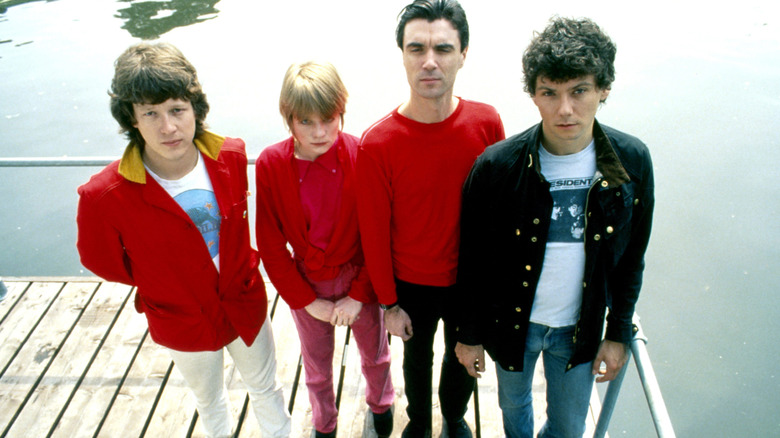
Talking Heads' 10 albums from 1977 to 1988 document the evolution of the band from their early days as graduates of the CBGB's punk scene in New York to their eventual new wave art rock stardom. They rarely missed a beat, but we believe it was in 1980, with the album "Remain in Light," that they truly hit their peak. "Talking Heads: 77" is as explosive a debut as any, and 1984's concert film and album, "Stop Making Sense," made them (and David Byrne's oversized suit) iconic. But it's on this fourth record, one of the decade's most defining, that the band's experimentation paid off like never before.
Other Talking Heads albums sold better, but none are as highly regarded. "It got great critical acclaim," drummer Chris Frantz remarked in Rolling Stone, "and we felt that it kind of took popular music to the next phase." That next step became home to one of their signature hits in "You May Find Yourself," whose music video would go on to make the band MTV darlings. But just as sparkling are "Remain in Light" tracks like the serene and hypnotic "Seen and Not Seen" and the haunting, industrial drive of "The Overload." The secret sauce to the Talking Heads' appeal was always their willingness to challenge what rock and pop music could be. These and other songs off "Remain in Light" showcase just how far the band had come while charting their way forward. They blew minds in 1980, and sound even cooler today.
Crosseyed and Painless
"Remain in Light" was the Talking Heads' third of three albums produced by iconic, pioneering electronic musician Brian Eno. As encapsulated on the second track, "Crosseyed and Painless," that partnership pushed the band toward incorporating world music, Afrobeat, and funk. "Our process led us to something with some affinity to Afro-funk, but we got there the long way round, and of course our version sounded slightly off," David Byrne told the Library of Congress in 2017. The song — and entire record — emerged from these jams: extended rhythmic grooves set against repetitive guitar licks and synthesizer squeals.
But what makes "Cross Eyed and Painless" top-shelf Talking Heads are Byrne's abstract, playful lyrics, which seem to depict someone losing their sense of self. "Facts are lazy and facts are late / Facts all come with points of view," goes the semi-rapped bridge. Byrne wrote the lines after drummer Chris Frantz played the band hip-hop pioneer Kurtis Blow's "The Breaks," which he'd just played on. "It was that whole rap thing, but in his own style," bassist Tina Weymouth told Rolling Stone. And in breaking down the idea of what "facts" are, his lines ring especially true in today's post-truth media environment.
The Talking Heads in 1980 created their own musical language by becoming creative sponges — soaking in each other and the sounds around them. "Crosseyed and Painless" showcases the band's ability to blend genres and create their own vernacular: Fela Kuti by way of the art gallery.
Once In A Lifetime
Driven by shimmering, cocoon-like synths and a driving funk groove, "Once In A Lifetime" is one of the Talking Heads' more quotable songs. Fans tend to sing — or really preach — along to the end of the second verse: "And you may tell yourself / 'This is not my beautiful house!' / And you may tell yourself / 'This is not my beautiful wife!'" Though you can read the song as jabbing at materialism and bland, suburban culture, David Byrne didn't have that in mind. It's about how "[w]e're largely unconscious," he told NPR. "You know, we operate half-awake or on autopilot and ... we haven't really stopped to ask ourselves, 'How did I get here?'"
Like the other songs on "Remain in Light," "Once in a Lifetime" was assembled and stitched together in the studio. Improvised jams were chosen from tapes of recorded jam sessions and arranged into a structure — a process more akin to sampling or looping in hip-hop or electronic music. Byrne's sermon-like vocal delivery, co-writer Brian Eno told Uncut, was inspired by "TV evangelists, preachers, the Islamic call to prayer, religious people getting into a trance." Despite "that blood-and-thunder intonation of a preacher," he added, "his words are terribly optimistic." In reminding us that time passes like "water flowing underground," "Once In A Lifetime" urges us to appreciate the moments we have. Transcendent and uplifting, it's among the new wave songs we'd trade the world to hear again for the first time.
Houses In Motion
While its cyclical and relentless Afro-funk groove evokes constant movement, "Houses In Motion" seems to concern itself with the feeling of being stuck, trapped in the business of survival. "As we watch him / Dig his own grave," David Byrne remarks in the first verse, "It's important to know / That's where he was at." Living in this economy means constantly pushing, earning, and paying bills; it means constant competition with co-workers, commuters, and even neighbors. "I'm walking a line / I'm thinking about empty-motion," goes the chorus, "I'm walking a line / Just barely enough to be living."
An artistic highpoint of "Remain in Light," "Houses in Motion" is the soundtrack of someone sinking in the quicksand of modern life and gradually losing themselves in the process. Intentionally or not, it comments on the culture of materialism and excess that would become dominant in the '80s. But at the same time, it's an undeniable hip-shaker, and one of the more danceable tracks on "Remain in Light." That's what makes Talking Heads in this period so brilliant and ahead of their time. As reviewer Ken Tucker put it in Rolling Stone in 1980, they produced "scary, funny music to which you can dance and think, think and dance, dance and think, ad infinitum." Or to put it another way: thinking with your body, dancing with your brain.
Seen And Not Seen
With a stomp-clap beat, repeated bass phrase, and chattering synthesizers and effected guitars, "Seen And Not Seen" is perhaps the most haunting and experimental track on "Remain in Light." Its pulsating, throbbing groove showcases the synergy bassist Tina Weymouth, keyboardist Jerry Harrison, drummer Chris Frantz, and David Byrne developed with Brian Eno, who added additional synthesizers. The machine-like groove is kinetic and dynamic, establishing the bedrock for an unsettling, spoken word poem about identity and self-worth.
The speaker thinks "That he might, by force of will / cause his face to approach those of his ideal:" that he could gradually take on the identity of celebrities he admires on TV or in magazines. But as he gradually transforms to become more like those he admires, he feels doubt. What if all this was "Based on some childish whim?" he wonders, before the devastating: "He wonders if he too may have made a mistake." "Seen And Not Seen" depicts a loss of self, highlighting the risk of tying your identity and ego to impossible standards. And yet, in typical Byrne fashion, the lyrics are playful and surreal, and, in the way of the rest of the band, the arrangement is jaunty. "Maybe they imagined that their new face / Would better suit their personality," goes the second verse.
On "Remain In Light" and "Seen And Not Seen," Talking Heads showcase a new "face," a new identity, and sensibility. Fittingly, the band members' faces are masked with red pixels on the Weymouth-designed album cover, which helps make vinyl collecting an art form.
The Overload
Brian Eno was basically a fifth member of the Talking Heads on "Remain in Light." According to Rolling Stone, only he and David Byrne were credited as songwriters, which became a bone of contention among the others. Regardless, the haunting, atmospheric closer, "The Overload," feels like an extension of the bleak, droning synthesizer soundscapes the English producer and composer had done with David Bowie on late '70s albums like "Low." The Afrobeat funk rhythms have been stripped away and pared down to a minimal kick and snare heartbeat that pushes through sonic textures and spaces.
As noted in Far Out, "The Overload" was the Talking Heads' attempt to recreate Joy Division's post-punk without ever actually hearing their music. Though they based their interpretation and homage solely on written reviews and interviews, you can hear that they were clearly careful readers. The lyrics, in keeping with Byrne's style, are abstract and nonlinear, yet they take shape and evoke decay as they interact with the overall bleakness of the track. "I'm touched by your pleas / I value these moments," he chants more than sings, "We're older than we realize / In someone's eyes." In stark contrast to the album's more danceable and upbeat tracks (particularly on side A of "Remain in Light"), the closer may well be a funeral procession.