

The 4 Best Folk Rock Supergroups Of The '70s
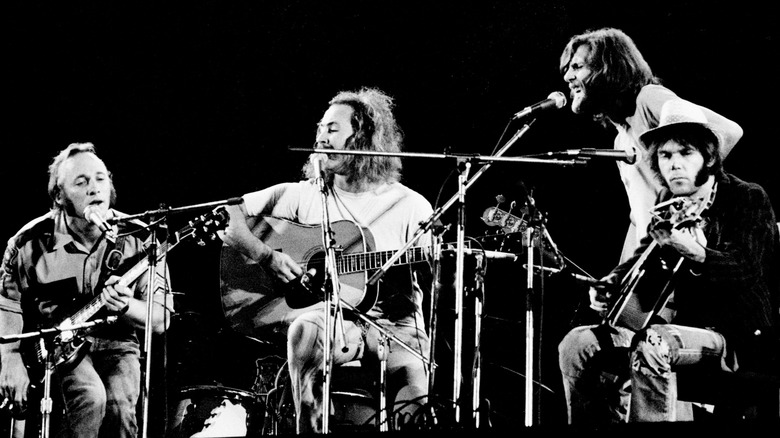
The 1970s was one of the most exciting decades for musicians, as several artistic scenes converged to bring about new subgenres, collaborations, and platforms to showcase their work, including folk rock. Throughout the '70s, countless artists were inspired by pioneers such as Bob Dylan, but the best folk rock supergroups made the genre something entirely their own. Whether folk was always their jam or their musical roots stemmed from harder rock, these groups developed and refined what would become one of the most defining sounds of the decade.
While several of these bands saw chart success and critical acclaim during their '70s heyday, we also selected our entries based on their unique musical contributions and the timelessness of their records. Regardless of some overlap between their star-studded members, these standout bands made inspired musical choices that shaped the soundscape for generations of musicians to come. It is therefore their genre innovations and staying power, demonstrated by supergroup anthems that have only gotten cooler with age, which we think truly elevates them to the best of their genre.
Crosby, Stills, Nash & Young
Composed of David Crosby, Stephen Stills, Graham Nash, and occasionally Neil Young, the story of Crosby, Stills, Nash & Young (CSNY) is a turbulent tale, but at the heart of what made them so effective was their ability to translate folk for a rock audience. Crosby had already seen massive success with his former band, the Byrds, after they covered Bob Dylan's "Mr. Tambourine Man," and a similar approach was taken with their cover of Joni Mitchell's "Woodstock" on their seven-time platinum album, "Deja Vu."
Other CSNY tracks, such as "Teach Your Children," allow electric guitar riffs to blend seamlessly into acoustic strums and tambourine beats, bringing an effortless coolness to melodies reserved for the fire pit. And while they managed to master putting an edge to their folksy harmonies, their song "Almost Cut My Hair" takes a much more traditional rock 'n' roll approach.
Ultimately, CSNY wasn't around to reject the rock establishment as a whole, but rather to find their own unique sound and carve out a lane of American folk music within a decade of rebellion and social justice. Protest songs such as "Ohio," written by Young after the Kent State shooting, helped to compose a contemporary mythology, remembered and replayed by generations to come. Their musical innovations made the band a standout group of their decade, and their influence and success are undeniably still felt today.
The Noel Redding Band
Noel Redding made major waves during his stint as the bassist for the Jimi Hendrix Experience, but fans of psychedelic rock may be surprised to learn that he became the frontman of his own folk rock supergroup. Conflicts arising from their chaotic studio sessions and a shifting band identity pushed Redding to quit Hendrix's band in 1969, before leaving the U.S. for Clonakilty, Ireland in 1972 and forming his own supergroup, the Noel Redding Band.
While drummer Les Sampson of Redding's previous band, Road, would follow the bassist from LA, there was no shortage of Irish talent available to them. Guitarist Eric Bell of the underground Dublin rock band Thin Lizzy was a legitimizing force, and pianist/vocalist David Clarke was the central songwriter for the group, penning most of the tracks from their debut 1975 album "Clonakilty Cowboys." While clearly embracing the group's Irish roots, their musical innovations came from blending San Francisco psychedelia with the sounds of Irish folk and country. Tracks such as "After All" and its steady organ melody feel almost like a sleepy church hymn, invigorated by a moody guitar solo that can't help but feel like a callback to Redding's time with the Experience.
While the band would only release one more album, "Blowin'" in 1976, their unique cultural blend is what truly made their musical contributions among the best. Although their tracks didn't live up to critics' or Experience fans' expectations at the time, their tours in the Netherlands, U.S., Ireland, and England showed that they had some international appeal – and their hybrid, globalized sound still intrigues modern audiences.
The Albion Band
The Albion Band fully embraced traditional Celtic folk music and made it their central philosophy. Bassist and founder of Fairport Convention and Steeleye Span, Ashley Hutchings, formed the ensemble group in 1971 to play alongside his wife Shirley Collins, gradually developing it into a cohesive heritage project over the decades.
Bringing together musicians from his two previous projects and other British folk legends, such as the Watersons, the Albion Band has featured numerous musicians over their 50-year run. Hutchinson saw this as a necessary expansion, sharing in the BBC documentary "The Albion Band," "There's so much to do, it couldn't be encompassed in a small lineup of musicians, so it becomes an umbrella." He also put a strong emphasis on creating English music over the more mainstream American folk rock, claiming, "There's no logical reason why English people should sing in American accents of course. And we found traditional [British] music; it was a bit like finding religion, for me."
Their 1978 album "Rise Up Like the Sun" feels like a truly enchanting debut, incorporating electric and traditional instruments to create an album that truly feels like a blend of authentic folk and emergent modernity. With their musical contributions being emblematic of how to carry culture into the future, it makes sense that the group's project will go on indefinitely. They're still mostly active in the 2020s, fronted by Hutchings' son Blair Dunlop after the bassist largely retired from the group in 2011. Their longevity, unique sounds, and strong philosophy more than justify the Albion Band's consideration for one of the best folk rock supergroups of the '70s.
Manassas
After the first of many Crosby, Stills, Nash, & Young breakups, Stephen Stills decided to form the long-forgotten folk rock supergroup, Manassas. Formed in 1971 in Miami, Florida, Stills enlisted the talents of former CSN members Calvin "Fuzzy" Samuels and Dallas Taylor, as well as Chris Hillman and Al Perkins of the Flying Burrito Brothers, popular session musician Paul Harris, and Blues Image's Joe Lala.
Packing some serious star power, Manassas masterfully blended Latin, blues, rock, folk, and country music. Songs such as "Colorado," off of their 1972 self-titled gold album, brought together heavenly harmonies, earthy instrumental tones, and sleepy guitar solos that epitomized Stills' folk rock sound. They played 78 international concerts in 1972, riding the success of their album, before ultimately splitting in 1973.
Although their bright light may have faded quickly, that is no reason to discount Manassas as one of the best folk rock supergroups of the '70s. Their debut album "Manassas" managed to reach the No. 4 spot on the U.S. charts, and their second album "Down the Road" peaked at No. 26 (a step down, but by no means a total flop). With so many big personalities in one band, it can be hard to keep things together, yet Monassas' musical diversity and lasting influence on Stills' legacy clearly showcase how this folk rock supergroup expanded the genre.