

The 1967 Guitar Solo That Changed Rock History Forever
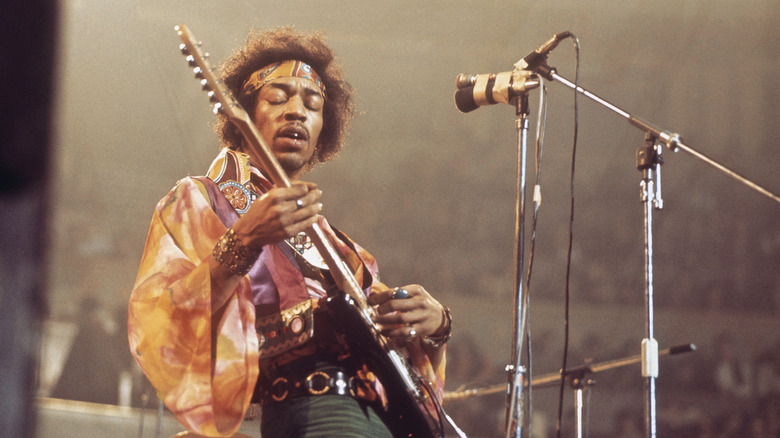
Jimi Hendrix was a one-man rock 'n' roll change-maker, and there are any number of songs, live performances, and entire albums that we could point to as evidence ("All Along the Watchtower," the "Star-Spangled Banner," "Electric Ladyland"). But it was "Purple Haze" off The Jimi Hendrix Experience's first album, "Are You Experienced," from 1967 that changed rock history forever and came to define '60s classic rock. From the moment Hendrix opened the song with a discordant tritone interval, aka the devil's interval, he announced rock 'n' roll was heading somewhere new with its blend of blues and Eastern modalities in a roaring psychedelic stew that heavily used his signature E7♯9 chord. His solos on the song, the first to feature a fuzz and octave changing Octavia pedal, were overtly aggressive, full of distortion, feedback, and fuzz, and were a shock to popular music's system.
The song, and Hendrix's live London performances in front of members of the Beatles and Rolling Stones, Eric Clapton, Pete Townsend of the Who, and others, forced a reckoning that the times were indeed changing and these other musicians better get on the bus or get left behind. This was only reinforced back in the U.S. when the Jimi Hendrix Experience played the Monterey Pop Festival, their first U.S. performance, which included "Purple Haze." It wasn't only Hendrix's contemporaries who were influenced by his solo on this song, but later generations of guitar players.
Generations of guitar gods influenced by Hendrix's Purple Haze
The number of guitarists who have been influenced by Jimi Hendrix is legion, but many of the greatest players specifically cite Hendrix's solo on "Purple Haze" as life changing. Joe Walsh of the Eagles included the song in his list of the best guitar solos of all time. "'Purple Haze' blew everybody apart," he told Guitar Player in December 2025. Both guitar virtuosos Joe Satriani and Steve Vai were influenced by the solo as was Kirk Hammett of Metallica, who played the song straight for three months as a teen learning guitar.
Besides rock guitarists, Hendrix's playing on "Purple Haze" has been enshrined by magazines like Rolling Stone, which listed it among the 500 Best Songs of All Time, while other outlets have celebrated Hendrix's solo as one of the most influential in rock history. In 2000, the song was inducted into the Grammy Hall of Fame. In popular music, one could define rock as pre-Hendrix's "Purple Haze" solo and post. His solo on the song proved that 1967 was the best year of Hendrix's career and the best year for psychedelic rock.