

Classic Covers The Original Artists Admitted Were Better Than Theirs
The best version of a song is not always the first, and sometimes, even the original songwriter has to admit it. Far from being a shortcoming, the ability to admit when they've crafted something beyond themselves is actually the mark of a true songwriter. While some songwriters fiercely guard their songs, either discouraging covers or panning them in the press, many of the greats know to be gracious and accept when a piece of music takes on a life of its own. From Dolly Parton to Bob Dylan to Tom Petty, a surprising amount of songwriters have gone on record as preferring covers to their original version.
That's not to say that some songwriters aren't right in criticizing some of their covers — even hit covers can become hated by the writer and fan alike. Some, however, not only become popular and commercially successful, but they become respected in their own right, and pass even the highest of bars: endorsement as the song's best version by the creator themselves. We've gathered four of those unrivaled covers here, all of which caused their writer to admit that the cover outdid the original.
I Won't Back Down — Johnny Cash
A lot has been said about Johnny Cash's powerful cover of Nine Inch Nails' "Hurt," which came during the eventful final year of Johnny Cash's life. It was profoundly deep, dark, and moving, with a video to match, and Cash's version shook songwriter Trent Reznor to the core. But "Hurt" was just one of the many covers Cash released in his final years as part of his "American" series, and not the only one that affected its creator. For the album "American III: Solitary Man," Cash covered Tom Petty's defiant heartland anthem "I Won't Back Down," a performance that caused Petty to lament that it had ever been his.
Undoubtedly, Petty's unique voice always fit the original well, as it still did when he provided backup for Cash's version. Cash's lead vocals, however, provide a remarkably different emotionality to the song. His tremulous gravel highlights his age in a bittersweet way, making the song's message seem like a late-in-life raging against the dying of the light, a resilient battle cry to keep on going. Hearing Cash's sincere take, Petty once remarked that "It made me wish I had never done it. It was done with such conviction that it sounded like it had been written for him to sing" (via Far Out). Even if Petty preferred the Cash version, we can still enjoy both equally.
I Will Always Love You — Whitney Houston
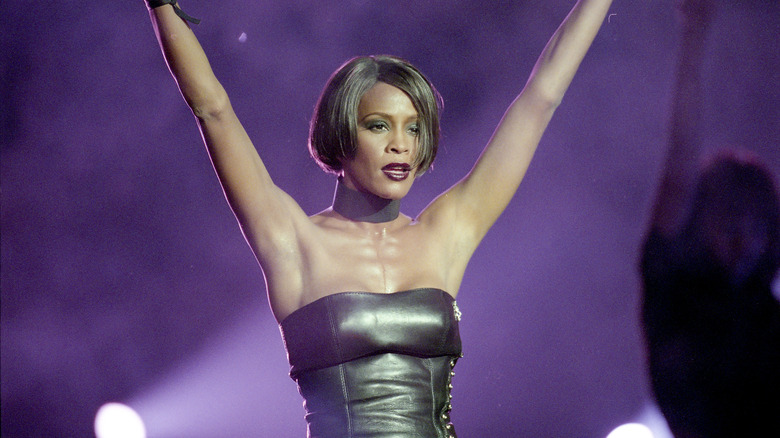
It's honestly understandable to assume "I Will Always Love You" was a Whitney Houston original, especially for anyone of a younger generation. Houston's version is larger than life in every way, and the singer's performance on the recording is legendary. Her version topped the Billboard Hot 100 for 14 straight weeks, a record at the time, won the Grammy for Record Of The Year, and as of this writing, holds the Guinness World Record for the best-selling physical single by a female solo artist, with over 24 million copies sold. In short, Houston's version is a tough act to follow or precede — a fact that original songwriter Dolly Parton has gracefully admitted to.
During an interview with Larry King for CNN, the late Parton confessed that, upon first hearing Houston's version soar into its belted chorus, she "just about had a heart attack ... It was a great feeling. What a great record." During her life, Parton was famous for putting her money where her mouth was, and the same held true for her appreciation of Houston. Parton reinvested some of the royalties she earned from Houston's cover in a predominantly black neighborhood in Nashville, and was also in attendance at Houston's funeral, during which Houston's "I Will Always Love You" was played. The song had a deep meaning for Parton, and for her to acquiesce to Houston's version so readily and so strongly says a lot about Parton, but also about Houston's version itself.
With a Little Help From My Friends — Joe Cocker
The second track on the Beatles' psychedelic pop masterpiece "Sgt. Pepper's Lonely Hearts Club Band" is "With a Little Help From My Friends," a simple, affable pop tune with a relatable message and typically bubbly hook. The song is the type of inoffensive and upbeat diddy you'd expect to hit broadly as a single, and though that did happen, it wasn't the Beatles that managed it. Instead, less than two years after the original's release, Joe Cocker plied the interpretive magic that would come to be his signature and took "With a Little Help From My Friends" to the next level. Not only did his version skyrocket to a hit, it also earned the admiration of at least one Beatle.
After Cocker's passing, Paul McCartney paid tribute to the late singer by saying in part that "I was especially pleased when he decided to cover 'With A Little Help From My Friends' ... it was just mind-blowing, totally turned the song into a soul anthem and I was forever grateful for him for doing that" (via Billboard). McCartney is spot on as usual, as Cocker's version does take the song's pleasant baseline and cranks its intensity up to 11. With Cocker's lush voice at the forefront, his version simmers with potential energy during the muted verses and then explodes into a blaze during the choruses. It may have been a Beatles' creation, but "With a Little Help From My Friends" didn't reach its soulful potential until Cocker sang it, a fact not lost on McCartney.
All Along the Watchtower — Jimi Hendrix
Topping Bob Dylan, one of the frontrunners for greatest songwriter of the 20th century, in anything relating to arrangement is no small feat. Yet, according to the Bard himself, that's exactly what Jimi Hendrix did when he recorded a cover of "All Along the Watchtower" for the 1968 album "Electric Ladyland." Dylan once said that, "I liked Jimi Hendrix's record of this and ever since he died I've been doing it that way ... Strange how when I sing it, I always feel it's a tribute to him in some kind of way" (via Far Out).
Indeed, when Dylan has played the song live through the decades, he has often channeled the Hendrix version in some way, all due to his open admission that Hendrix found ways to elevate the original. Talking about the cover to the Fort Lauderdale Sun Sentinel, Dylan explained that Hendrix "could find things inside a song and vigorously develop them. He found things that other people wouldn't think of finding in there. He probably improved upon it by the spaces he was using" (via "Younger Than That Now: The Collected Interviews with Bob Dylan"). The spaces Dylan likely refers to are the longer instrumental breaks in Hendrix's version (guitar solos, of course) that help break up the relatively dense song lyrics into more processable chunks, as well as keeping the song's energy electric. It's no wonder that Dylan preferred Hendrix's high-octane cover and even admitted that in some ways, it was better than his own.