

The Top 5 Folk Rock Hits That Took Over 1967
A revival of earnest, old-fashioned American folk music developed in Greenwich Village and other places took hold in the early 1960s. By the middle of the decade, the influence of songs of both protest and emotion played on acoustic guitars and often delivered with harmonizing singers had impacted and mixed with mainstream rock, resulting in an electrifying but not entirely electrified new genre called folk rock. That very '60s genre reached its creative and musical peak in 1967, the same year that the anti-war, boomer, hippie counterculture similarly took hold, what with the ongoing "Summer of Love" and scores of young people congregating in San Francisco and other hippie hotbeds.
A few songs from 1967 define rock history, and several songs of '67 sound even cooler today, because it was such a fruitful, expressive, and important period of time. Over in folk rock, purveyors figured out the most widely appealing ways to combine emergent rock elements and production techniques with traditional folk elements and instrumentation. That year, plenty of folk rock songs went pop and raced up the Hot 100 and became bona fide hits. Here are the folk rock classics from Buffalo Springfield, the Cowsills, the Mamas and the Papas, Scott McKenzie, and Bobbie Gentry that gently flavored 1967.
For What It's Worth – Buffalo Springfield
The folk and rock arrive in equal measure in "For What It's Worth" by Buffalo Springfield, but what really makes it a folk-heavy folk-rock song is the themes. It's an ominous and defiant protest song, although it's not about what listeners might think such a tune from the Vietnam War era would cover. Buffalo Springfield wrote it about youth-led protests against a curfew in Los Angeles's club-heavy Sunset Strip area, aligning it with the truth-to-power-speaking motivations of American folk music of the 1960s.
Buffalo Springfield launched and moved along the careers of several standard-bearers of folk rock as it evolved in the late 1960s and 1970s. After "For What It's Worth," featured in so many '60s-set movies, rose to No. 7 on the singles chart in the spring of 1967, it didn't take long for Buffalo Springfield members Stephen Stills and Neil Young to join Crosby, Stills, Nash & Young, and Richie Furay and Jim Messina to start Poco.
The Rain, the Park & Other Things – The Cowsills
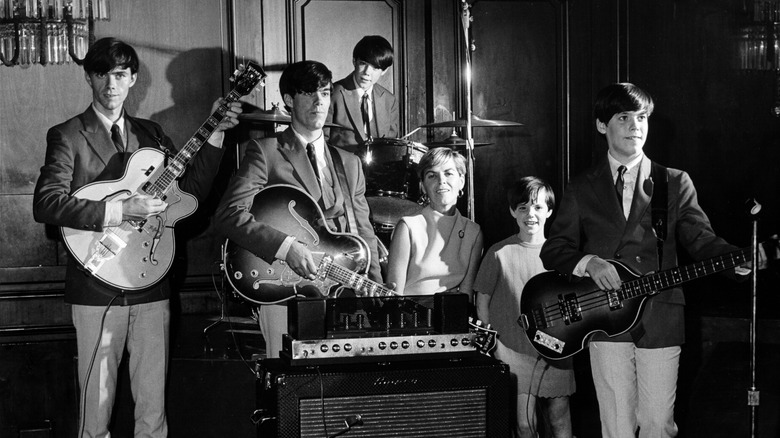
As unlikely and contradictory as it may sound, the Cowsills provided the genesis for a popular sitcom while also playing a big role in spreading the sound and vibes of the folk-loving boomer-hippie contingent. The Cowsills were a family band, made up of five brothers, a sister, and their mother. The real-life "Partridge Family" mostly played their own instruments, and that included a lot of acoustic guitars that supported the singers' vocals. With so many voices that they could sound like a choir if they wanted to, the Cowsills brought stunning harmonies on songs like "Hair," their pop radio-friendly cover of the title tune from the countercultural Broadway musical, and "The Rain, the Park & Other Things."
The Cowsills' ringing guitars and blending voices from a variety of ranges sound like they came from folk music of yore, while modern production techniques and bold organ stabs provided the late '60s hard rock punch to make "The Rain, the Park & Other Things" a giddy and soaring love song that plays out over multiple format changes and diversions, cool enough to feel like it was part of a cultural shift. The Cowsills' biggest hit, it went all the way to No. 2 in 1967.
Creeque Alley – The Mamas and the Papas
Perhaps there's no act more synonymous with the quintessentially 1960s folk rock ideal than the Mamas and the Papas. Consisting of four uniquely talented singers of different ranges and styles whose vocals harmoniously blended in a seamless and transcendent way, the Mamas and the Papas represented the rising and idealistic boomer generation with its rock attitude in common but called back to generations of American music with its folk-centric preferences. Along with folk-adjacent hits like "California' Dreamin'" and "Monday, Monday," the Mamas and the Papas climbed into the Top 10 — for what would be the final time — in June 1967, with "Creeque Alley."
This single by the Mamas and the Papas detailed the origin story of one of folk-rock's most notable acts: the Mamas and the Papas. Composed by members John and Michelle Phillips, the autobiographical "Creeque Alley" is a bittersweet and nostalgic look back on the band's early days. It recalls and brings to life the since-dissipated folk world of the early 1960s, name dropping members of bands like the Byrds and the clubs they all frequently played.
San Francisco (Be Sure to Wear Flowers in Your Hair) – Scott McKenzie
For the counterculture movement of the late 1960s, the center of the universe was San Francisco, site of numerous hippie enclaves and a thriving music scene. Many of those bands pulled from folk, singing like balladeers and playing on their acoustic guitars songs about social ills and contemporary events. Scott McKenzie's "San Francisco (Be Sure to Wear Flowers in Your Hair)" is a song from the hippie point of view about that very hippie subculture at its pivotal, historic moment in time.
McKenzie sounds like a medieval bard the way he sensitively and admiringly describes the influx of young people to San Francisco, selling the idea by describing their kindness, values, and appearance. Beefed up with some persuasive percussion, the jangly, guitar-powered, and meandering "San Francisco" is the late '60s and folk rock in a nutshell. It was also a smash hit when it was still relevant, as it peaked at No. 4 on the pop chart in 1967.
Ode to Billie Joe – Bobbie Gentry
Some of the best songs in the folk tradition are story songs, and "Ode to Billie Joe," written and performed by Bobbie Gentry, has plenty of that. It weaves a narrative in the Southern gothic literary tradition with a spooky, unsettling vibe and some tantalizingly unsolved mysteries. The song tells of a distraught Billie Joe McAllister and his throwing of an unidentified item from a small town bridge before leaping off himself a day later — for reasons not revealed in the song nor anywhere else as far as Gentry is concerned.
The recording of the "Ode to Billie Joe," which came to Gentry mostly formed in the middle of the night, was quick and simple, finished in an hour and consisting of the singer accompanying herself on the guitar and accompanied by little more than a small string section. Speculating on the fate of Billie Joe McAllister became a national pasttime, as "Ode to Billie Joe" spent four weeks at No. 1 in the late summer of 1967.
If you or someone you know is struggling or in crisis, help is available. Call or text 988 or chat 988lifeline.org