

Classic Rock Hits That Also Smashed In Japan
The major, guitar-based hits of the 1960s and 1970s, eventually collectively classified as classic rock, were recorded almost entirely in the English language. But there wasn't much of a language barrier — the power of good songwriting and the energy of rock 'n' roll made those songs hits all over the globe, and often in places where English wasn't the dominant language or even widely spoken. Japan, for example, embraced a lot of American-built and European-made classic rock in the genre's heyday. As a result, some of the best-selling and best-known songs in Japan aren't in Japanese — they're the same English songs that thrilled audiences and record-buyers in North America and western Europe.
These songs are quite familiar to even casual American classic rock fans of the 21st century, and those who were around when these tracks were brand new. But they were just as successful — if not more so — in Japan. Here are some classic rock staples from solo artists and groups alike, such as Daniel Boone, Cheap Trick, Simon and Garfunkel, the Beatles, and Shocking Blue, that were unequivocally big in Japan.
Beautiful Sunday — Daniel Boone
Daniel Boone is a one-hit wonder who you may not know passed away. Back in 1972, the British musician born Peter Green scored a No. 15 hit in the U.S. (and a No. 21 in the U.K.) with "Beautiful Sunday," an effervescent and infectiously upbeat folk-rock song about enjoying a lovely sunny day in the park, taking a drive, and just basking in the feeling of being in love.
Boone soon thereafter largely faded from public consciousness and hitmaker status in the U.S. and the U.K., but four years after "Beautiful Sunday" was first issued, it became a monster smash in Japan. When it was selected as the theme song for the Japanese television program "Ohayo 720," awareness skyrocketed.
By the end of 1976, "Beautiful Sunday" had crossed the two-million sales threshold, making it one of the top-selling singles ever in Japan and easily the most successful English-language song. Boone's song also amassed a record as one of the longest No. 1 song streaks for a rock song, spending 15 weeks atop Japan's pop chart.
I Want You to Want Me — Cheap Trick
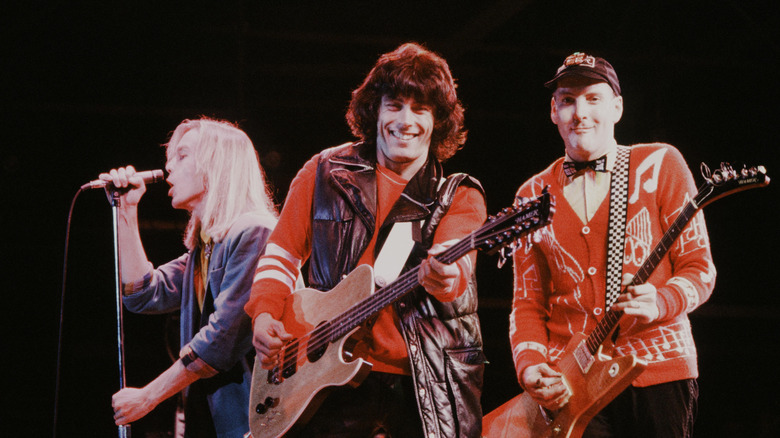
Hailing from Rockford, Illinois, Cheap Trick nailed the sound of '70s power pop, but their loud and crunchy mix of radio-friendly melodies with hard rock values took a while to catch on in the United States. Their first three late '70s studio albums sold poorly in America but were all top sellers in Japan, prompting the band to not only tour to packed houses across the country but to record two shows at the Tokyo venue Nippon Budokan to populate the live LP "Cheap Trick At Budokan."
That album made Cheap Trick even bigger in Japan and far more popular back in the U.S., too. The live, sped-up version of the previously ignored single "I Want You to Want Me," a wordplay-filled tongue-twister of a love song about yearning, made it to No. 7 in the United States. But in Japan, it went all the way to No. 1 on one of the country's national pop charts.
The Sound of Silence — Simon & Garfunkel
"The Sound of Silence" introduced the world to Simon & Garfunkel. The folk-inspired duo, which paired the angelic vocals of Art Garfunkel with the plaintive style and guitar-strumming of Paul Simon, hit No. 1 in the United States for two weeks in early 1966 with this eerie, melancholy song that builds to something epic and dramatic, reflecting its anguished and barely restrained lyrics. Simon & Garfunkel's first single enjoyed a second life when it was used on the soundtrack of the 1967 Oscar-winning film "The Graduate" to great narrative effect.
And then, the song just kept on going: "The Sound of Silence" made a lot of noise in Japan. The gentle-then-loud single was massively successful there in 1968, when "The Graduate" premiered in Japanese theaters. The three-year-old song spent two weeks as the No. 1 single in all of Japan.
Let It Be — The Beatles
A moving, cathartic, piano-powered rock 'n' roll hymn about letting go of the things that cannot be changed, "Let It Be" is among the Beatles' most transcendent works. Credited to John Lennon and Paul McCartney, it was written primarily by the latter about an experience in which his long-deceased mother came to him in a dream and offered him solace and comfort when his professional life was in disarray. Released in early 1970, "Let It Be" was also one of the last singles by the Beatles, who'd publicly split up the same week the song spent the first of two weeks at No. 1 on the Hot 100 in April of that year.
It went on to sell two million copies in the U.S., but "Let It Be" was a phenomenon in Japan as well. Among the top 15 most enduring English songs in the country's recorded music history, "Let It Be" sold about 558,000 copies to Japanese record buyers.
Venus — Shocking Blue
One of the biggest American hits of 1970 was the first Hot 100 chart-topper ever by an act from the Netherlands, and it proved popular all over the planet. Guitarist Robbie Van Leeuwen left one of the most successful Dutch bands of the '60s, the Motions, and subsequently started a new group, Shocking Blue. With the addition of distinctively voiced singer Mariska Veres, Shocking Blue started storming the Dutch charts, especially with "Venus."
Written by Van Leeuwen with a circular, jangly, and infectious guitar lick about an idealized woman compared to classical models of beauty and perfection, "Venus" reached No. 3 in the Netherlands in 1969, and then went all the way to No. 1 in the likes of Belgium and Sweden. Colossus Records imported the song into the U.S., where it spent a week at No. 1 in early 1970.
"Venus" was additionally a major hit in Japan, soaring to No. 2 on the nation's overall pop chart. While "Venus" charted higher in the U.S., its sales in Japan were proportionally more impressive considering its smaller population. While the U.S. was home to about twice as many people at the time, roughly a million copies were sold stateside versus around 550,000 in Japan.