

5 Heart Songs That Prove 1985 Was The Best Year Of Their Career
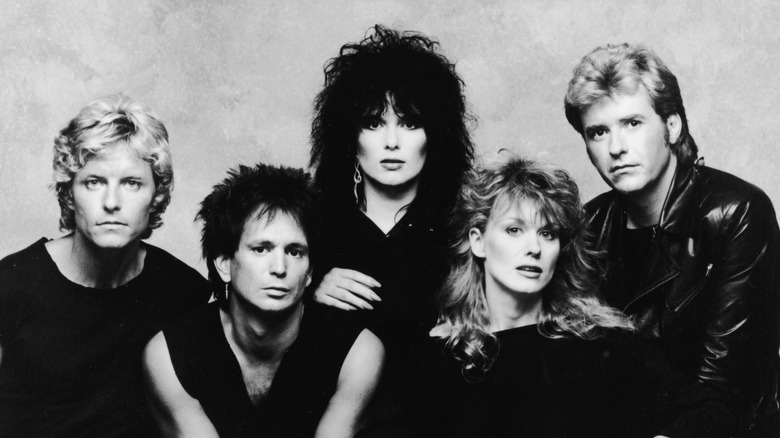
Hard rockers Heart spent the better part of the '70s proving women could rock just as hard as men, tossing out classics like "Barracuda" and "Magic Man" like it was child's play. Then the '80s arrived and the band hit a bit of a snag, stumbling into the new decade without knowing where they fit. But when the hard-rocking, hair-band-heavy year 1985 came about, there was a whole new energy that gave the Wilson sisters and their mighty backing players new life; a self-titled renaissance album and a five-stack of superior, radio-friendly hits helped along by outside songwriters brought Heart beating back to life, stronger and more commercially viable than ever. Embracing the campy leather-and-teased-hair motif of the era may have been an unexpected career move for the band, but boy, did it ever work.
The album itself was a high point of 1985 for both the band and the rock music world, but the hits kept coming well after 1986 rolled around. Heart had mounted a comeback that would keep them soaring into the next decade, and anyone lucky enough to own their eponymous LP in 1985 got a preview of the five songs that would make the release a launchpad for their most successful run.
What About Love
Heart's comeback was roaring at full throttle from the jump with "What About Love," the 1985 power ballad extraordinaire that reminded old fans what they may have forgotten and alerted new fans to what they'd be dealing with. Heart wasn't the first to record it, though; this classic rock song is actually a cover of an unreleased 1982 tune by Canadian band Toronto. It presented a more polished sound than the band had previously utilized, though the powerhouse guitar work from Nancy Wilson and the battle-cry vocals from her sister Ann Wilson were present and accounted for. But now, the steel had been polished to a fine sheen and augmented with reedy synths and thundering drums, all glistening under the utmost in modern production. Hidden under the sleek sound work was a plaintive song that posed the question, "What about love? / Don't you want someone to care about you?" at top volume.
"What About Love" levitated up the charts and gave Heart a No. 10 smash that showed the band was ready to rumble again. It may have taken outside songwriters (including Bryan Adams' creative cohort Jim Vallance) and some backing vocal help from Starship's Mickey Thomas and Grace Slick to spark the revival, but with this iconic lite-metal classic, Heart had been restarted.
Never
Heart's follow-up single was another hammer-against-anvil rocker called "Never," an anthem about perseverance served in a foil wrapper of crunchy chords and searing harmonies. The empowerment that bolstered many of the band's earlier hits was back in fine fashion: "Anything you want, we can make it happen / Stand up and turn around, never let them shoot us down." This was the sort of brass-knuckle knockabout that felt like a natural outgrowth of the Wilsons' early feminist messages, only this time it was a rallying cry for the whole audience. It may have been a tune about finding love, but if you try not to read between the lines, it becomes a fist-pumper about self-belief.
There was more outside songwriting help for the Heart crew on this one, in part from legendary tunesmith Holly Knight, who'd crafted similar shakedown tunes for Tina Turner ("Better Be Good to Me") and Pat Benatar ("Love Is a Battlefield"). The assist helped the band book the No. 4 spot on the Billboard Hot 100 in December 1985, making for a sweet-Heart of a holiday season.
These Dreams
The supreme recharge that Heart underwent with their self-titled album in 1985 kept churning out the hits as the calendar rolled over to a new year. That January, the band released their shimmering ballad "These Dreams." A gauzy slice of power pop filled with surreal imagery and washy synth passages, it was by far the most electronic-friendly song the team had put forth in their career. It arrived with a dreamy video that's instantly recognizable by late boomers who ate up MTV content, too. For this stream-of-unconsciousness fairy tale love song, Nancy Wilson took over lead vocals to pine for her elusive fantasy lover, in a sound-alike tone just slightly less forceful than her sister's. "In a wood full of princes, freedom is a kiss," Wilson sings, "But the prince hides his face from dreams in the mist." The blushing romance was a relatively novel look, ironically enough for a band named Heart.
Originally written by Elton John lyricist Bernie Taupin and English songwriter Martin Page for Stevie Nicks to record, the song ended up a signature tune for Heart and became the band's first-ever No. 1 single in March 1986, more than a decade after they started out.
Nothin' at All
Another pop-oriented single that helped shift the band's image in a more accessible direction, "Nothin' at All" was the fourth single from the "Heart" album, a chiming, upbeat number about how easy falling in love can be. There's nothing deeper in the lyrics than admission of romantic surrender: "No one else has ever made me feel this way / When I asked you how you did it, you just say / It was nothin' at all." The sunlit joy that shone out of the gold-spun harmonies and piercing fretwork showed how unafraid the band was to embrace their brighter side. Sure, this meant altering their image to become more video-friendly in the heady days of MTV. But that was what helped sell records back in the day, and Heart was selling them like hotcakes.
Penned by multi-award-winner Mark Mueller, who also wrote the pop hit "Crush" for Jennifer Paige and, oddly enough, the theme from the Disney series "DuckTales," "Nothin at All" hit No. 10 in June 1986. The band now had a string of Top 10 hits, a major comeback album, and tons of airtime on radio and television. But the juice hadn't been fully squeezed out of the gold-plated, hit-making release just yet.
If Looks Could Kill
Another cover originally released by singer Pamala Stanley in March 1985, "If Looks Could Kill" was notably less polished than the other singles from the 1985 "Heart" album. Instead, it was a fierce, noisy rocker that channeled some of the bold "Barracuda" energy from back in the day. It was a return to the chugging electric guitar and take-no-guff lyricism that became the Wilson sisters' standard, and a welcome return to form for fans of the band's older material. The cheating lover playbook gets a more direct treatment here, with a chorus that declares, "If looks could kill / You'd be lying on the floor / You'd be begging me, 'Please, please / Baby, don't hurt me no more.'" There's no mistaking the blazing anger in the music and the lyrics, which made it a perfect kiss-off song.
Only reaching as high as No. 54 in August of 1986, it signaled a need for new material and a follow-up to the multi-million-selling 1985 album that put Heart back in the limelight. It may not have charted as high as the other singles from the "Heart" reintroduction album, but it gave the band's presence a long tail into its post-release year and proved that even the lesser hits were still pretty popular overall.