

The 5 Best Duets Of '70s AM Gold
Picture this: It's the 1970s, you're behind the wheel of your car, be it a compact Gremlin or land-boat Chevy Caprice. It's morning time, and you're dragging yourself into the office or worksite. To get yourself motivated and perhaps deal with the workaday drudge of being stuck in traffic, you turn on your favorite AM radio for a hit of the most golden of songs. Of the many such hits from the decade, quite a few featured not just one, but two singers. The best duets didn't merely double the power of the vocals; they drew on key components of the decade's musical trends in ways that still have us listening even in the era of custom playlists and Bluetooth connections.
What qualifies? First, a track must have been a hit that would have gotten play on A.M. radio stations throughout the U.S., meaning morning listeners got an earful regardless of their location. Then, there's quality. Some songs are artistically great no matter the year; really, after listening to "Where Is the Love?," could you argue that Roberta Flack was anything other than a music legend? Meanwhile, others may not please the snootiest of listeners, but what they might lack in artistic refinement, they make up for by remaining catchy bops through the decades. Take John Travolta, whose star turn alongside Olivia Newton-John in "Grease" resulted in a chart-topping duet that you may be humming right now ... even if we didn't name the title.
Don't Go Breaking My Heart — Elton John and Kiki Dee
Back in the '70s, Elton John was another working artist, albeit one who loved a flashy costume. In fact, he didn't get his first No. 1 hit in his home country of the U.K. until 1976, courtesy of his duet with Kiki Dee, "Don't Go Breaking My Heart." When it hit the British charts, it stayed at the top for six weeks, not to mention a separate four-week stint at No. 1 in the U.S. Future film composer James Newton Howard, then a keyboardist in John's band, stepped in to arrange the strings for this track, taking inspiration from Motown hits. Dee recorded her part separately in London, as John and his band had already recorded their side in Toronto, with John demoing her part in his own pitched-up voice.
The general conclusion nowadays may be that this is cheese served most earnestly, but you also can't deny that it's an utter earworm that combines a love song with a compelling dance floor groove. Yes, there's a bit of edge that's lacking. There were rumors that John originally thought to record the track with soul legend Dusty Springfield — just imagine her smoky, cool voice on the recording — but Kiki Dee has disputed that story. Some have noted that Dee's part in the song seems oddly devoid of personality, but unless you were driving to your job as a music critic, this was an energetic, cheerful bop to start your day.
Reunited — Peaches & Herb
While the Peaches & Herb duo weren't exactly keeping secrets, there is a bit of an ironic twist in the background of their '70s hit, "Reunited." You see, while Herb was a stalwart member of the act from the beginning — that is, Herb Fame, though his real name was the rather less stage-worthy Herbert Feemster — Peaches was a different matter. When Peaches & Herb got started in the '60s, Herb's musical other half was Francine Barker, nicknamed Peaches. Barker stepped back from touring after two years, and Marlene Mack replaced her during live performances, though Barker continued singing on the duo's records. Herb retired from the act in 1970 to join the Washington, D.C. police department.
When he wanted to return to music, this necessitated the appearance of another Peaches, now played by Linda Greene. She was a key player in their 1979 hit, "Reunited," in which a couple blissfully sings of their return to one another ... and Peaches & Herb joyfully watched the track climb to No. 1. Yet, before that, Peaches and Herb's new effort was a bit rocky, with an album that failed to make an impression. But after switching labels, the duo began to get traction with the help of a new production team.
While they also released the hit "Shake Your Groove Thing," the smooth jam of "Reunited" may be the real hallmark of their legacy. It was eventually certified platinum in May 1979, joining other iconic platinum love songs of the '70s. Perhaps the fact that Greene was Peaches the Third may make a song swooning over true love a bit awkward. No matter, it offered a nice break from the more frantic, emotionally fraught hits of the day.
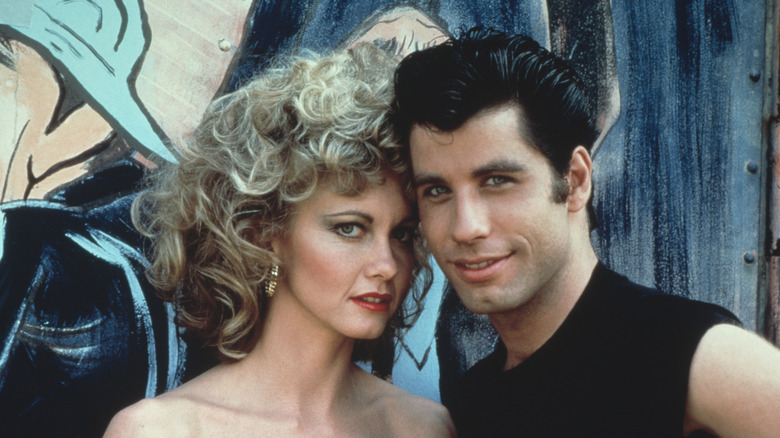
You're the One That I Want — John Travolta and Olivia Newton-John
Admittedly, "You're the One That I Want" isn't high art. Written specifically for the 1978 film adaptation of the musical "Grease," it's a tidy enough way of wrapping up the film's plot as John Travolta's bad-boy character tries to clean up and Olivia Newton-John's unbearably wholesome Sandy gets PG-rated raunchy in skintight pants. But, in the world of musicals and morning radio alike, no one wants to think about things too hard, especially when the tune is so dang catchy. That made this bright, energetic duet a favorite among radio DJs and the overall chart-topper for a week in 1978. Over in the U.K., it was even more successful, becoming one of the market's best-selling singles of all time.
Both Olivia Newton-John and co-star John Travolta had experience with acting and singing (Travolta even broke into the U.S. top 10 with 1976's "Let Her In"). Still, she was reluctant to join in after participating in a couple of flop films. She was also not the first choice: Marie Osmond turned it down, wanting to preserve her "good girl" image. But Travolta championed Newton-John, helping secure her participation.
Producer John Farrar was surprised by the single's popularity, telling The Independent on the occasion of the movie's 45th anniversary, "I still don't know why it was such a hit. It affected young people greatly, it seems." Really, as evidenced by the Foo Fighters covering the song, it affected just about everyone listening.
Mockingbird — Carly Simon and James Taylor
Back in 1974, when you heard "Mockingbird" come over the radio waves in the A.M., you surely listened. With its bouncy beat and wry lyrics, this duet featuring Carly Simon and James Taylor offered an edgier contrast to other, more inoffensive A.M. gold hits. And there was real tension behind the song, as Simon and Taylor, then married, would divorce in 1983. While the end of a marriage is oftentimes complex, the two may have felt the push-pull of two highly successful music careers. Certainly, Taylor has spoken of feeling tentative about offering professional criticism of his wife's work, while Simon wrote in her memoir that "When the two of us were onstage together, there was often a healthy, unspoken competition." Listeners really dug the duet, as "Mockingbird" hit No. 5 in the U.S. and eventually went gold.
Yet, much as you might have grooved to "Mockingbird" while it floated in on radio waves and may or may not have picked up on its deeper meanings, the Simon-Taylor single was actually a cover. It first became popular as yet another duet, this time featuring Inez Foxx and her brother, Charlie. This 1963 original, with its more playful, soulful character, reached No. 7 in the U.S. and enjoyed some popularity in the U.K., too. In fact, Taylor (who brought up the song when Simon suggested they record a duet) first heard the song in the '60s while visiting the Apollo Theater, where he saw the Foxx siblings perform.
Where Is the Love - Roberta Flack and Donny Hathaway
It could be that, after a while, you would have had enough of the cheese so popular in '70s A.M. hits. Hey, no shame in enjoying a hit that doesn't require deep thought, but if you were ready for something different, "Where Is the Love" brought a more complicated view of romance to morning radio. The achingly beautiful vocals are provided by Roberta Flack and Donny Hathaway, underlain by a seriously catchy bass line and sweet strings. Despite the smooth jam, it's about a messy relationship that leaves everyone involved feeling used, speaking to the real experiences of many listeners.
Written by Ralph MacDonald and William Salter, the song was originally intended for another band, but MacDonald spontaneously offered it to Flack and Hathaway when they were coming up short on an album track list. Flack and Hathaway met while both were students at Howard University, with Flack leaving college to pursue her music career and Hathaway also finding work on Curtis Mayfield's label, Curtom Records, as a songwriter, producer, and session musician.
The friends eventually both signed to Atlantic Records and agreed to record an album of duets, which became 1972's "Roberta Flack & Donny Hathaway," including "Where Is the Love." The duet, boosted by Flack's masterful solo track, "The First Time Ever I Saw Your Face," peaked at No. 5 on the Billboard Hot 100 chart in August 1972, making it an easy pick for the DJ's playlist, even if it didn't have the cheeriest view of romance. But, hey, who can argue with the vocal perfection of Flack and Hathaway, or the realness of their duet?