

The Best Female-Led Moments In Soft Rock History
The history of soft rock is filled with prime moments led by women who made the whole industry sit up and take notice. Some of the most noteworthy occasions are centered around landmark performances, mind-blowing collaborations, and shifts in style and format that turn careers on their ears, but in the best possible way. The genre may have slowly faded out of view with the millennial and Gen Z tastes driving trends, but that doesn't make the groundbreaking happenings of the past any less spectacular.
What happens when a soft rock luminary teams up with a dance music diva to record a glossy mash-up duet that becomes a boomer-era disco classic? How can an iconic soft rock vocalist alter the way we hear a timeless American composition and sell millions of records at the same time? Can a shapeshifting soft rock singer and part-time film star evolve her image into a sexier, more adult-oriented identity? These occurrences and more mark the most memorable moments in music history in which female soft rock artists stole the spotlight and made it count.
Barbara Streisand and Donna Summer team up for No More Tears (Enough is Enough)
Barbara Streisand was the crown-wearing queen of soft rock in 1979 when she took an experimental left turn and tried something slightly out of her wheelhouse: "No More Tears (Enough is Enough)." The break-up anthem connected Streisand with her counterpart in disco, the indomitable Donna Summer, for a rousing single that blended the two styles into a genre-bending piece of pop culture synergy. The tune split the difference between a ballad-like opening that felt distinctively Streisand-ish and gave way to a swirl of dance floor strings and a thumping bass groove that was unmistakably Summer-esque. There was even artistic drama behind the scenes, in the form of a long-held high note that made Summer pass out during rehearsals, according to what Streisand told People. In short, it was the Reese's peanut butter cup of the soft rock scene, a mix of two great tastes that tasted great together — and fans ate it up.
The musical combo platter drew attention from both artists' audiences, resulting in a No. 1 hit that let both Streisand and Summer show off different sides of their considerable talents. It stands as a pinnacle moment in the '70s music world. It also heralded the beginning of the end of the disco era while giving radio stations and dance clubs one of the best female duets in rock of the softer persuasion.
Olivia Newton-John changes her image and gets Physical
Where can a soft rock artist go after she's crossed over from country to pop and made movie soundtracks rain with hit singles? If the artist in question is Olivia Newton-John, she gets "Physical," a suggestive song with a double-entendre chorus that radically reinvented her presence. Newton-John had come off of a star-making turn as high school senior Sandy in the blockbuster 1978 musical "Grease" and a dud-tastic turn as grounded muse Kira in 1980 future cult favorite "Xanadu" with an edgier soft rock album called "Totally Hot" sandwiched in between. When she returned to the charts in 1981 with "Physical," a steamy musical come-on that took the charts by storm with a goofy video that marketed it as a "workout song," she evolved her good-girl image into that of a playful, assured grown woman with a trendsetting look and a cheeky attitude that rocketed her into a whole new sphere.
The song hit No. 1 in countries around the world, remaining at the top of Billboard's Hot 100 for a historic 10 consecutive weeks. The controversy surrounding the suggestive lyrics, which are more than tame by today's conventions, set off radio bans, though none of it stopped "Physical" from paving the way for pop artists like Madonna and Sheena Easton to create their own sexually charged songs. For Newton-John, it was yet another pivotal moment in a career that seemed filled with them.
Tina Turner comes roaring back to life with What's Love Got to Do With It
Tina Turner didn't begin her career as a soft rock artist; she started as a full-fledged rocker, co-headlining the Ike and Tina Revue with her notoriously abusive husband. She fled the marriage, taking nothing but the rights to her stage name (Turner was born Anna Mae Bullock), with no idea of how she would continue. After making slow inroads in the European music scene, Turner teamed up with English songwriting-producing team Terry Britten and Graham Lyle to create "What's Love Got to Do With It" a sophisticated reinvention of the Tina Turner brand that transformed her into a solo soft rock juggernaut. The song, which had already been turned down by other artists, seemed to be a declaration of independence from her tortured past as much as a manifesto of self-protection going forward. It was a gorgeous song all on its own, but Turner's real-world truth infused it with a survivor's spirit that made the whole world root for.
Both the Grammy-winning song and the album it came from, "Private Dancer," became No. 1 smashes around the globe, clinching Turner's return and launching her reign as one of music's most energetic acts. "What's Love Got to Do With It" also served as the title of the 1994 movie depicting Turner's survivor story, which garnered an Oscar nomination and a Golden Globe win for lead actress Angela Bassett's portrayal of the music icon.
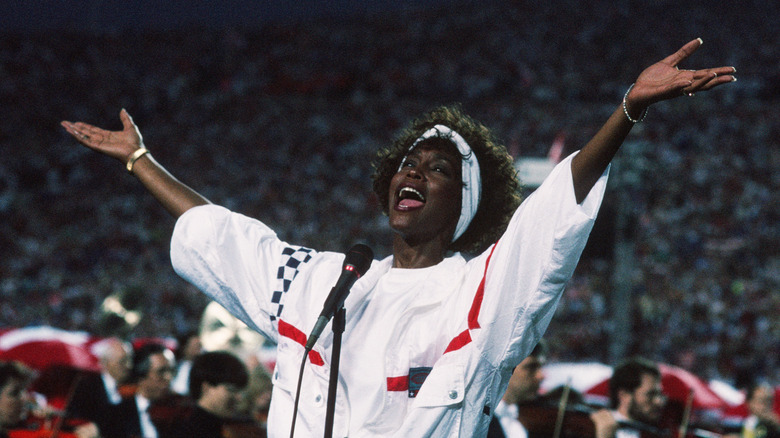
Whitney Houston slays The Star-Spangled Banner
You know you've done something significant when your version of a 200-plus year-old anthem becomes the new modern standard. Whitney Houston may not have had an inkling that the rendition of "The Star-Spangled Banner" from the opening of Super Bowl XXV in January 1991 would become a performance, but she certainly knew it afterward. It was such a stirring occasion; it gave Houston a singular-hit song wrapped in a never-repeated public performance that, while lip-synced to her recorded voice on the field rather than being sung live, as ABC News reported in 2012, became the singer's biggest moment prior to releasing her record-breaking smash "I Will Always Love You" the following year.
How defining a moment was it? In the pre-Internet world of the early-'90s, it still felt like the clip of Houston belting somehow went viral for those who experienced it. It became a single that went to No. 20 on its initial release in 1991 and all the way to No. 6 in its post-9/11 rerelease in 2001 — the most successful recorded version of the song in history. It also defined the delivery for countless singers who followed the soft rock goddess all the way to the top of that skyrocketing high note — to varying degrees of success, of course. Few singers have the skill to pull off such a Herculean feat, though thanks to Houston's soaring example of how the song could be done, that didn't keep them from trying.
Celine Dion dominates the music industry with My Heart Will Go On
Celine Dion was doing perfectly well taking over the soft rock scene with songs from her various albums and soundtrack work — both in English and French, mind you — when she was presented with the opportunity to record "My Heart Will Go On" for James Cameron's soon-to-be-blockbuster film "Titanic." Despite Cameron's hesitation about including a love theme in his movie, composer James Horner conjured a composition and lyricist Will Jennings crafted a narrative that encapsulated the film's tragic romance, which Cameron approved for the film.
Dion had already conquered cinematic love themes with the self-titled Oscar-winning ballad from Disney's "Beauty and the Beast" in 1991; she had nothing to prove. In fact, Sissel Kyrkjebø, a singer from Norway, was the intended vocalist. But an assistant to Horner recommended Dion, who recorded the sweeping vocals for the film in a single take and transformed the tune into 24-karat soft rock gold. The single sold 18 million copies around the world and became the best-selling song of 1998. It also rode the top spot on the Billboard Airplay chart for a whopping 10 weeks, topped the singles chart for two weeks, won an Oscar for best original song, and took home the biggest Grammys possible — best song, record of the year, best female pop vocal, and best song written for a motion picture. Now that's how you do soft rock.