

The 5 Best Kinks Songs That Aren't You Really Got Me
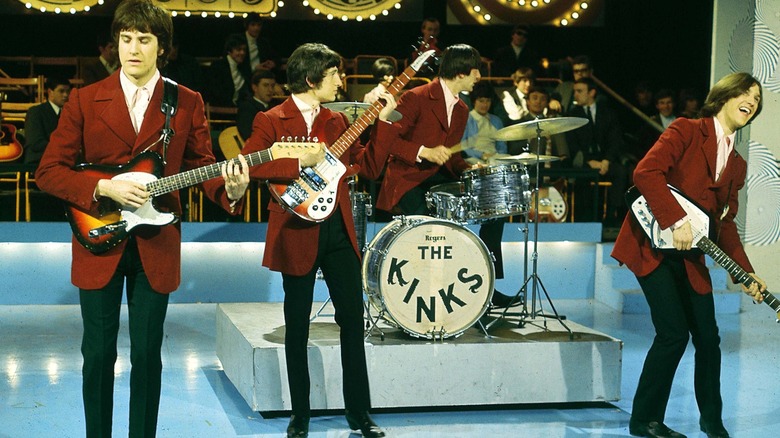
British rock band the Kinks may have skyrocketed to the U.K.'s No. 1 spot with their breakout single "You Really Got Me" in 1964, but it's just the tip of the iceberg when it comes to their innovative and influential catalogue. The track's persistent tambourine, edgy guitar riff, and climactic vocals would come to define generations of hard rock, punk, and metal artists — but the full range of their catalogue touched several other genres.
For this list, musical contribution and legacy are truly what set these five songs apart. So many of the Kinks' melodies, vocal patterns, and rhythms can be heard echoing through their contemporaries, as well as modern acts — proving that the tracks managed to transcend their own positions in the charts. Although some of these songs easily compare to "You Really Got Me" in terms of commercial success, it's truly their influence on other groups and contributions to the band's iconic sound that justify their ranking as some of the Kinks' best.
Although the group would continue to release music up until their inevitable split in 1996, it's safe to say that their disciples quickly overshadowed them in the years after one of their last hit singles, "Lola" (which didn't make this list but is a supremely honorable mention). For that reason, the selection pool for this list also cuts off with the band's contract expiring with Pye Records in the early '70s. One of the key players in the British Invasion of the '60s, here are five of the Kinks' most legendary hits.
All Day and All of the Night
Off the same record as "You Really Got Me," the Kinks' 1964 single "All Day and All of the Night" peaked at No. 2 on the British charts. The guitar riffs, vocals, and progression of the song were very similar to their breakout single but invigorated by their proven success. In an interview with Classic Rock, Ray Davies noted how "It's more demanding. Maybe that was because we'd just come off a success with a number one single. So it was a bit cocky."
This track in particular has been heralded as one of the blueprints for modern heavy metal and punk genre, and immediately inspired some other iconic tracks. The Doors' 1968 No. 1 hit "Hello, I Love You," and its vocals follow an incredibly similar melody, including an escalating tempo. The Kinks not only had a concrete influence on their contemporaries, but also the next generation of rock 'n' roll legends thanks to this track. Metallica's frontman James Hetfield even introduced Davies during the Rock & Roll Hall of Fame 25th anniversary concert by declaring that "We got completely schooled on early riff-rock by this man and his band — the Kinks" (via Classic Rock). The song's confidence is contagious and clearly inspires personal victories as well as world-changing ideas.
Picture Book
As much as the Kinks are revered for their hot and heavy sound, songs such as 1968's "Picture Book" affirm their rank as Britpop legends. A little closer to the Beatles than Black Sabbath, there's something deliciously cheeky about the rolling bass line and hums throughout. Although the song didn't quite stand out in their discography at the time, it found a new audience in 2004 as the background track for HP printer's award-winning ad campaign. Ray Davies thought it fit perfectly in the commercial, telling Performing Songwriter in a 2008 interview that "I always knew that song would have its day. Sometimes you just know. It was never a hit, but it's become a hit in another way."
Even if it didn't share the same hard rock sound as some of their earlier hits, "Picture Book" definitely still made its influence known on the genre. Green Day's 2000 track "Warning" undeniably found inspiration from the Kinks' instrumentals, giving it their own Y2K punk rock twist. The rolling bass line can also be found in David Bowie's "The Man Who Sold the World" — a much less direct reference, but still speaking to the sounds the Kinks pioneered.
Top of the Pops
Off the Kinks' 1970 album "Lola Versus Powerman And The Moneygoround, Part One," their song "Top of the Pops" definitely paved the road for some of the punchiest rock anthems of the decade and beyond. Its power chord intro gives the track a distinctly rock 'n' roll vibe, and its self-reflexive lyrics clearly convey how integrated the group had become into the music industry. Tracking the progression and possibilities of fame as your songs begin to chart, while still pointing out how "It's strange how people want you when your record's high / 'Cos when it drops down they just pass you by."
While the Kinks may not exactly have seen the writing on the wall, they would never chart as high as this album's titular single, "Lola," which occupied the Top 10 (peaking at No. 2) for seven weeks in the U.K. charts. It went to No. 9 in the U.S. However, that isn't to say that the group ever lost its desirability or influential spot among artists and audiences alike. A glimpse into the YouTube comments section for "Top of the Pops" features a comment reading "AC/DC can thank the Kinks for this rhythm guitar," with a reply claiming that "Every rock band can thank them! The Kinks and Link Wray basically invented power chords." It's hard to ignore how similar the opening of "Top of the Pops" is to AC/DC's 1979 rock-defining track "Highway to Hell." Whether it's the Kinks' musical ingenuity or attitude that expanded the horizons of emerging acts, there's no doubt that this song set a whole new rock 'n' roll precedent.
Sunny Afternoon
1966 has already proved to be the best year of the Kinks' careers, and No. 1 hit single "Sunny Afternoon" undoubtedly contributed to their continuously expanding fame. Descending chords mimic the narrator's string of bad luck, juxtaposing the sarcastic and lonely sentiment of how "And I love to live so pleasantly / Live this life of luxury." Despite the main misfortunes of taxes on the rich, the inability to sail his yacht, and his girlfriend leaving him due to his neglect and violence, the tongue-in-cheek critique of privilege manages to break these lyrics with the soft spiraling "In the summertime" echoed throughout.
In a 1969 interview with Rolling Stone, Ray Davies shared how, while writing "Sunny Afternoon," "I was only playing 'The Greatest Hits of Frank Sinatra' and [Bob] Dylan's 'Maggie's Farm,'" setting the tone for the kind of elite malaise poked fun at in the lyrics, as well as the vintage twang of the vocals in the pre-chorus. In terms of its musical legacy, tracks like Oasis' 2005 No. 1 hit "The Importance of Being Idle" mirrors both the indifference of "Sunny Afternoon's" themes, as well as its melodic structure. "Sunny Afternoon" was also featured in Wim Wenders' 2023 Oscar-nominated film "Perfect Days" about a rock loving janitor, proving how enduring both the track's influence and themes have proven to be.
A Long Way From Home
While the Kinks' 1970 song "A Long Way From Home" may never have climbed its way through the charts, it is certainly one of their most underrated gems. The brooding piano intro leading into Ray Davies' raw vocals, twinkling acoustic guitar, and his brother Dave joining for some echoing harmonies feels like a deeply personal duet. It's a common interpretation that the track is actually dedicated to Dave, speaking to the renowned sibling rivalry that defined the Kinks' dynamic for decades. In a 2020 interview with Rock and Roll Globe, Dave shared how "It's one of my favorite Ray songs. Many, many times during our lives, me and Ray, a lot of these feelings mutually crop up about how we are lost, but c'mon, together we can do this! We can find another route, another route back to home, to one-ness, to safety."
Lyrics lamenting, "Now you think you're wiser because you're older," and "But your wealth will never make you stronger" seem to be a loving callout to a younger, more naive brother being thrust into the highs and lows of superstardom — showing off a more sentimental side to the energetic and spunky group. "A Long Way From Home" and its atypical sound also highlights the Kinks' lesser-acknowledged influence on indie rock, with tracks like Wilco's 2007 song "On and On and On" and Radiohead's 1997 song "Let Down" mimicking its melody and structure. It may be a far cry from "You Really Got Me," but is one of the best examples of the Kinks' maturity, evolution, and legacy.