

The Top 4 Yacht Rock Songs That Took Over 1975
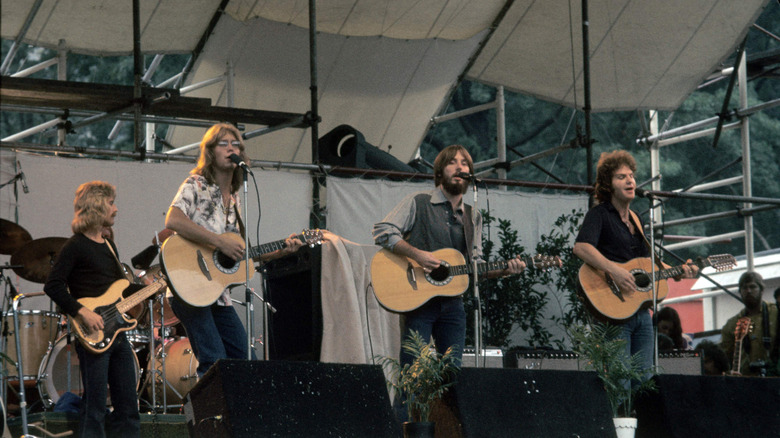
1975 was a groovy time for popular music, to be sure: There was a slew of songs that define rock history, and a lot of those songs sound even cooler today. But the year had some major hits in a genre that would later become known as yacht rock — the eternally chilled-out, carefree, and refreshing adult-contemporary pop. Those gentle-voiced paladins of '70s cool didn't know at the time that they were crafting a sound that would be so beloved five decades later, but they definitely kept the decade's middle period mellow and manageable.
Yacht rock fans are given to looking at the past through rosé colored glasses, but there was plenty to celebrate: 1975 was the year the Vietnam War finally came to a close, and Muhammad Ali fought Joe Frazier in the epic "Thrilla in Manila" boxing match. So, whether it's a folk trio becoming adult pop sensations or English crooners demanding to know how long "this" has been going on, we wanted to take a look at a few of the cuts that Bill Gates and Paul Allen probably had kicking in the background as they got Microsoft off the ground.
Ace — How Long
"How long has this been going on?" asks Ace on their up-tempo smooth jam that reached No. 3 on the Billboard Hot 100. It's not made entirely clear in the lyrics exactly what "this" is, but there is no doubt that Ace finds it completely unacceptable. That said, they certainly aren't going to let a little betrayal harsh their laid-back buzz.
Though it features a keyboard vamp that feels like it was personally sculpted by yacht rock standard-bearers the Doobie Brothers, the first evocative component of the piece is its syncopated bassline that echoes classic doo wop grooves. The interplay between keys and bass (intercut with tasteful funk from the guitar and drums) makes the track as danceable as it is relaxing, and it's a rare gift to pull off two distinct listening modes within a single tempo. Al Jarreau-style soul vocals complete the utterly captivating mix.
"How Long" would prove to be Ace's only major hit (follow-up single "Rock and Roll Runaway" would reach a paltry No. 71 on the Billboard Hot 100), and the group would disband in 1977. Their stardom was a flash in the pan, but their influence continued to be felt across the musical landscape, with various members going on to play with Roxy Music, Frankie Miller, and Squeeze, among others. So, how long has this been going on? Not nearly long enough, lads. Keep on jamming.
Gary Wright — Dream Weaver
By the time Gary Wright released his 1975 smash-hit solo album "The Dream Weaver" and its eponymous single (minus the "the"), he'd already staked out a claim for himself as a crackerjack sideman for none other than ex-Beatle George Harrison. That pedigree alone would make for an impressive resume, but it was "Dream Weaver" that made him a solo artist sensation.
Wright, a consummate keyboardist, commences the song with the sort of ethereal synthesizers normally associated with the interstellar explorations of progressive rock or the soundscapes of Vangelis. It's an unusually cerebral turn for yacht rock, but one that serves as nice thematic set dressing. Once Wright's gentle, blue-eyed soul takes over, the digital cascades complement the whimsical, drifting reverie. The slick escapism of yacht rock is all the more comforting as a result.
The song would reach No. 2 on the Billboard Hot 100 while the album itself would clock an impressive No. 7 on the Billboard 200 album chart. Wright's solo career would continue with varying degrees of success, but notable chart-toppers included "Love Is Alive," which reached No. 2 on the Hot 100, and "Really Wanna Know You," which hit No. 16 on the same chart.
America — Sister Golden Hair
Their morose memories of anonymous equine notwithstanding, the mid-'70s were peak years for America (the band, but the country was doing okay, too). "Sister Golden Hair," an outgrowth of the band's fruitful collaboration with Beatles producer George Martin, became the group's second No. 1 hit on the Billboard Hot 100 after their breakout smash, "A Horse With No Name."
That second career high point — though bolstered by a series of additional top 10 hits before and after — came as a result of Martin's intentional evolution of the group's sound away from simplistic folk and into sophisticated adult pop. The new direction, borne out of a desire to transcend the Neil Young comparisons that had plagued their early recordings, served to enshrine America in what became known retrospectively as yacht rock.
Seen in that light, "Sister Golden Hair" showcases America's maturation process with subtle modifications to the tone: Backing vocals are more ethereal than previous outings that had seen harmonies sit close against one another in the mix à la Simon and Garfunkel. On top of that is a tasteful country-Western lead that adds some Southern gentlemanly gravitas to the plaintive folk stylings. It's a moment of bittersweet reflection in the normally cheerful yacht rock canon.
Captain & Tennille — Love Will Keep Us Together
There's something unforgivably saccharine about "Love Will Keep Us Together," the smash hit from Captain & Tennille that shot to No.1 on the Billboard Hot 100 in the summer of 1975. It's aggressively peppy and chock-full of twee sentimentality, but boy, howdy, was it everywhere that year.
One of those chart-topping songs you didn't know '60s crooner Neil Sedaka wrote for other artists, the track became a blow-up mega hit for the husband-and-wife duo of Daryl Dragon and Toni Tennille. It was the start of a massive streak of mid-1970s success for the pair, with "Love Will Keep Us Together" topping Billboard's year-end chart for 1975. That's about as taken over as any year can be by one song.
Musically, there is, admittedly, plenty to appreciate in Captain & Tennille's debut hit. The raucous push-pull dynamics of the underlying keyboard patterns underscore Toni Tennille's sultry, bluesy vocal with patterns that alternate between stride blues and straight-ahead rockabilly. It feels like a sped-up torch song that somehow manages to have a tiny tinge of punkish energy underneath all the polished schmaltz.
Another of the duo's singles, the oddly titled "Muskrat Love," would become a solid hit in its own right, only to be retroactively dubbed one of the worst songs of all time in a CNN poll. But even so, you couldn't ask for a better out-of-the-park, grand-slam home run to start a career with than "Love Will Keep Us Together," and the couple became an unstoppable commercial force throughout the second half of the decade.