

The 5 Longest Saxophone Solos In Rock And Pop History
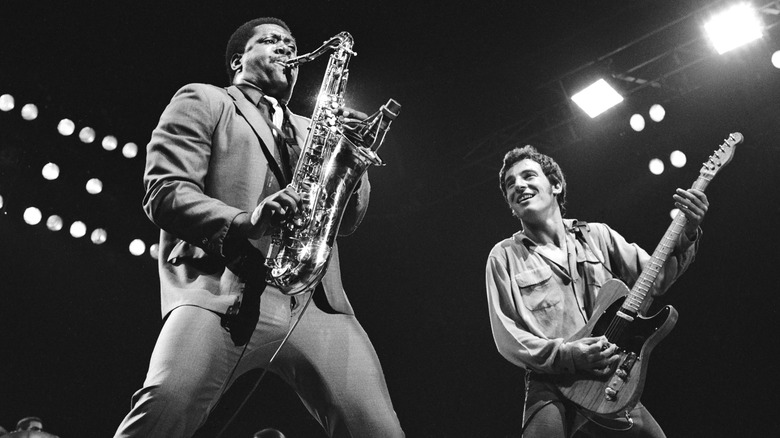
Most of the time, it seems that saxophone solos are only associated with jazz or blues, despite there being a bevy of outstanding rock sax solos. It could certainly be said that the best rock solos, whether by a sax or another instrument, are fairly short and to the point, while other times a lengthy solo is needed to capture the full emotion of a song. So, we picked the longest saxophone solos throughout rock and pop history.
These five solos made our list because every second and every note is justified, as opposed to the sax player being overly self-indulgent by playing as long as possible to show off their talent. Our chosen saxophonists also did a phenomenal job of bringing a jazz or blues sound to these rock tunes without letting it overtake the track's core — knowing just when to hold back and when to let it all hang out.
Furthermore, it seems that whenever these five songs are examined by music aficionados and fans, the sax solos are among the first things mentioned, which is a sign of just how vital they are to the popularity of these songs, as well as their success. So, let's dig into these long, superbly played solos and fully appreciate the saxophonists who brought them to life.
Aja — Steely Dan
In 1974, Steely Dan's Walter Becker and Donald Fagen decided to put their touring days behind them to focus on their studio work, since they found it hard to write songs on the road. So, in an effort to nail down the exact sounds they wanted, they used that increased studio time to hire even more musicians than before. By the time 1977 rolled around and Steely Dan released their sixth studio album, "Aja," they had brought in 30 musicians for the project, one of them being jazz legend Wayne Shorter, who gifted the group with a flawless sax solo on the title track that extends for just over one minute.
Shorter's playing is nothing short of a sax solo masterclass, despite it only taking him a little over a half an hour to construct. "Wayne did his solos, six passes in all," said Dick LaPalm in an interview with JazzWax (via Far Out). LaPalm was the owner of the Village Recorder studio in Los Angeles where the solo was played.
"He loved the music and was gone in 35 minutes," he continued. "The guys were sitting around watching, stunned. After he left, Donald and Walter spliced together the six passes, and that's what you hear on the album. Donald and Walter couldn't thank me enough." They're certainly not the only ones who are thankful for the solo; so are millions of people around the globe.
Will You — Hazel O'Connor
Hazel O'Connor's "Will You," off her debut album "Breaking Glass," features a sultry saxophone solo about three-quarters into the nearly five-minute song, artfully played by Wesley Magoogan, and it extends to the very end, giving the cut an added layer of emotion. Magoogan really makes the sax cry during the solo. It's as if the instrument is spewing tears instead of notes, while responding to O'Connor's tender lyrics about a love interest.
Arguably, the sax solo is so long that it serves just as much purpose as O'Connor's vocals and the rest of the backing music, which is probably why Magoogan sought co-writing royalty shares in court. During the legal battle, all royalty payments for the single were frozen, but they were released when Magoogan received a 25% share.
But O'Connor didn't show any frustration with Magoogan or his solo when she talked to Ferocious Dog, saying that Magoogan improvised the entire thing. "It was what we call a composite recording," she explained. "Composite meaning that when I recorded that with Tony Visconti, we asked Wesley Magoogan to blow a sax solo over one verse, middle eight, and another verse ... just do whatever comes into your head. So he actually blew six solos. And then we said, 'Right, see you later, Wesley.' And then Tony Visconti and I comped the solo together, which means you cut it and paste it."
Can't You Hear Me Knocking — The Rolling Stones
Making a song sometimes requires careful planning, and it's best to know exactly what needs to be done before a band walks into the studio. But other times, the best approach is to allow the overall creative energy dictate what'll be laid down, which the Rolling Stones did for their 1971 cut, "Can't You Hear Me Knocking." The song transitions into a Latin-inspired groove, and that's where legendary saxophonist Bobby Keys lets his tenor sax sing, something he was able to do in just a single take.
Keys' solo, which lasts nearly one and a half minutes, enters a few seconds into the music change and shares time with a guitar and bass guitar, before taking full command. One thing any good solo needs is the musician exhibiting a solid balance of skill and restraint, something that Keys did perfectly on the popular tune.
"That just happened by accident. I mean, that was never planned," said former Stones member Mick Taylor in a 1979 interview with Jas Obrecht, when talking about the music change and solo. "I just felt like carrying on playing and everybody was kind of putting their instruments down, but the tape was still rolling and it sounded good. So, everybody quickly picked up their instruments again and carried on playing. It was just a one-take thing." That could be why the saxophone solo works so well, because it's loose and free-flowing. It's almost like you can hear the spontaneity pouring out of Keys as he plays.
Shine On You Crazy Diamond — Pink Floyd
The saxophone solo on Pink Floyd's "Shine On You Crazy Diamond" is just one component of a nine-part masterpiece written about the group's former frontman, Syd Barrett, who left the band in 1968. It took a number of days for the band to create the instrumental track, which they did at the famed Abbey Road Studios. In fact, engineer Brian Humphries told Sound on Sound in 2014 that the song was laid down in three different parts, and he couldn't get the rhythm or pace to properly align during the editing process.
Dick Parry's epic solo, which comes in at Part V, lasts for nearly two minutes, and there's no indication from Humphries or Pink Floyd that it was just slapped into place once everything was completed. That suggests that the solo was part of those recording sessions that Humphries had trouble editing, which is why it sounds like an integral part of the song instead of something separate.
Parry had been playing with Pink Floyd guitarist David Gilmour since they were teenagers, toured with the band in the '70s, and played on other projects like "The Dark Side of the Moon," so it made sense to recruit him for the cut. The gifted sax player, who passed away in May 2026, used both a baritone and tenor sax in the solo, showcasing his jazz chops while extracting pure emotion from his instrument.
Jungleland — Bruce Springsteen
On Bruce Springsteen's "Jungleland," from his "Born to Run" album, Clarence Clemons plays one of the longest and most astounding sax solos in rock history, taking listeners on a nearly three-minute musical escapade. Clemons and Springsteen worked on the solo for over 16 hours, which speaks to their sheer dedication. That's because Clemons had so much ownership over the saxophone, he could've easily walked into the studio, played something wonderful off the top of his head, and been home in time for dinner.
But instead, Clemons — who died of a stroke in 2011 — parked himself in front of the microphone and slowly crafted his part piece by gorgeous piece, while pouring all of his joy, pain, and expertise into the solo. "Yeah, 16 hours sitting in front of a microphone working it all out note for note," he told Hot Press in 2005. "It was hard work and it was painful at times but it was all worth it in the end. It's my favorite song on the album, artistically." "Jungleland" has been lauded by the music media, and it's clear that the sax solo has a lot — if not everything — to do with that.