

5 Debut Singles That Changed Rock History, Ranked
The classic rock era is defined largely by its albums. As the 1960s progressed and groups such as the Beatles and the Beach Boys began to grow in their aspirations as artists, rock LPs began to evolve from simply a selection of disparate songs to a cohesive artistic statement. But the truth is that seven-inch singles also remained impactful, with some debuts seeming to change the game entirely when it came to what rock music could be.
Here, we revisit five classic debut singles that changed rock history overnight, ranking them for the seismic effect they had on the music landscape of the day. From the King of Rock 'n' Roll himself to the band that scandalized British society with their calls for anarchy, each of these tracks was monumental in their own way, pointing new directions for rock music that would help sustain it as the dominant form of popular music in the 20th century. And what is especially remarkable is that they have remained classics, with each as listenable today as they were when they were first released.
5. Break On Through (To the Other Side) – the Doors
The Doors was one of the defining bands of the psychedelic era, whose eclectic musical influences paired with the poetic inclinations of frontman and lyricist Jim Morrison made them genuinely thought-provoking, atmospheric, and forceful. In 1967, they announced themselves with "Break On Through (To the Other Side)," their debut single that doubles as a statement of intent from the Los Angeles foursome.
Built around a bossa nova beat and the intricate keys of organist Ray Manzarek, the song brought jazz and classical influences into rock when the genre was at its most psychedelic, remolding what was initially a primal form of music and indulging in its capacity for intellectualization. The meaning of the song, too, is confident and exploratory. "Break on Through" failed to chart when it was first released, but became a signature song the band during live shows, and is now one of the most popular tracks in the band's discography.
4. Good Times Bad Times – Led Zeppelin
It seems unthinkable now that the music press was unimpressed by British hard rockers Led Zeppelin when they first arrived on the scene in 1968. The four-piece rock band was formed in the aftermath of the Yardbirds, which guitarist Jimmy Page found himself in charge of for a final tour after the band's previous members had dropped away. Recruiting vocalist Robert Plant, bassist John Paul Jones, and drummer John Bonham, the band finished the tour as the Yardbirds before renaming themselves and going in a heavier direction that played to their collective strengths.
"Good Times Bad Times" was released as the band's debut single in 1969, and also features as the opening track on their self-titled debut album. It was built around a riff written by Jones, serving as a perfect introduction to the band's swashbuckling take on the blues, which is credited with setting the template for the hard rock genre that would define the 1970s. As Page later explained (via Long Live Vinyl), the idea of Led Zeppelin was that the band wasn't simply a guitar showcase; every member's skills ought to be highlighted, and with "Good Times, Bad Times," it's Bonham's drumming that stands out, with his performance announcing him as one of the finest rock drummers ever heard on record at that point.
3. Hey Joe – the Jimi Hendrix Experience
Jimi Hendrix is revered as arguably the greatest electric guitarist of all time, a self-taught genius whose incredible dexterity and innate understanding of sonics combined to bring rock fans an array of new sounds with his group the Jimi Hendrix Experience in the late 1960s. Under the tutelage of manager Chas Chandler, formerly of the Animals, Hendrix became a phenomenon in the U.K. where he started his career as a rock star in his own right.
"Hey Joe" was the Experience's 1966 debut, a cover of the popular song of contested origin which was recorded by several acts throughout the 1960s. None, however, matches Hendrix's version for its impact, with the track's pounding, gain-heavy guitar sound and distortion ushering in a bevy of genres to come after, including hard rock and heavy metal. Despite its technical innovations, the song retains the melodic and narrative elements of the song's blues-based source material, keeping its tempo low and focusing on the emotional core of its story of a jealous man planning to gun down his partner for her infidelity. It still makes for a thrilling listen six decades later, reminding us that the best rock music crackles with malevolence.
2. Anarchy in the UK – Sex Pistols
Speaking of malevolence, while the Ramones were kickstarting the U.S. punk explosion with their single "Blitzkrieg Bop," British punk rockers the Sex Pistols were making their subversive intentions known to British society with their debut, "Anarchy in the U.K." Released in November 1976, the single was arguably the most intentionally provocative rock song ever recorded to that point, with a snarling Johnny Rotten declaring himself an anarchist and the anti-Christ over a grinding and primitive instrumental.
The song only scraped into the British Top 40, peaking at No. 38, but it was regarded as a statement of intent of the burgeoning British punk movement, which had been propelled after the Sex Pistols' legendary pair of shows at the Lesser Free Trade Hall in Manchester in 1976. The band would go on to gain mainstream attention after giving a tumultuous TV interview that saw its members curse repeatedly live on air and insult the host, leading to the single being withdrawn by the band's record label.
Of course, the move only increased the band's notoriety, seeming to validate the band's apparent dangerousness. Meanwhile, the raw simplicity of the Sex Pistols' music, and Rotten's vocal in particular, would influence countless musicians who, whether they would play punk or one of the subgenres to come after, would look to the band and realize that when it comes to making rock music, there are no rules.
1. That's All Right (Mama) – Elvis Presley
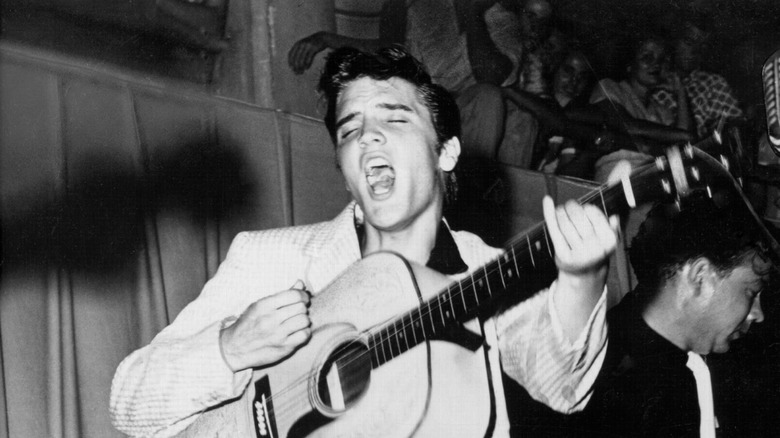
It's easy to overlook how revolutionary Elvis Presley was when he first rose to fame in the mid-1950s. Raised in poverty in Tupelo, Mississippi, the young Presley immediately turned heads when he arrived at Sam Phillips' Sun Records in Memphis, Tennessee. Philips' selling-point was that he would record anything for anyone, and Presley had arrived at his premises to record a ballad as a gift to his mother.
However, Phillips was so taken with Presley that he retained him for more sessions, looking to record something to be professionally released. Backed by a trio, Presley performed several more ballads, but nothing suggested he was a future star until he and the band recorded "That's All Right," a rhythmic, high-tempo take of a blues song by Arthur Crudup. The 1954 track was something entirely new and would form the foundation of a new genre, rockabilly, which became a Memphis phenomenon before sweeping the nation and turning Presley into the biggest star of the decade. There may have been influential precursors such as Sister Rosetta Tharpe, but for many critics, the story of rock starts here.