

Who Are The Mystery People On These Classic Album Covers?
We may receive a commission on purchases made from links.
The best classic rock album covers of the '70s and other decades are as famous and entrenched in the memories of millions as the music etched into the vinyl inside those cardboard sleeves. Because this was the era of large-format physical media, album covers were another opportunity for artistic expression, resulting in richly illustrated and expertly photographed images tied to the songs or vibes within. Along with a number of album covers with hidden meanings, the identities of some of the people depicted on LPs were not immediately disclosed or explained — if ever.
Despite the sleeves of these hit albums being pored over and scrutinized for decades, it's not widely known who those people are or were. Let's explore, as best we can, the names and histories of the mystery figures who graced the covers of legendary albums such as Led Zeppelin, the Beatles, and Black Sabbath.
Led Zeppelin – Led Zeppelin IV
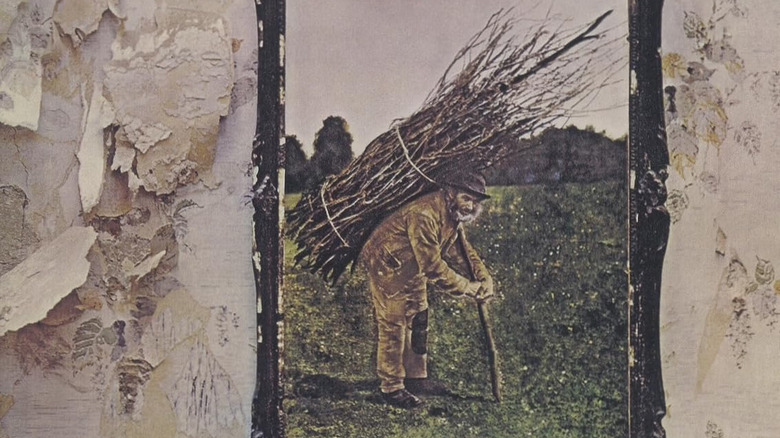
One of the best-selling albums in history, Led Zeppelin's officially untitled fourth full-length release, colloquially known as "Led Zeppelin IV," is a classic and foundational example of the hard and heavy rock that would come to define the 1970s. More than 24 million people in the U.S. alone have purchased the LP so that they can listen to "Black Dog" and "Stairway to Heaven" whenever they want, yet the cover bears a pastoral image quite at odds with the contemporary and confrontational sounds within: an older, bearded man in a field, hunched over under the weight of a large, double-tied stack of hazel on his back.
"Led Zeppelin IV" hit stores in 1971, but the source of its cover photo wasn't uncovered until the 2020s. Brian Edwards, an academic fellow of the University of the West of England's Regional History Centre, was curating an exhibition for the Wiltshire Museum. While studying a trove of old photographs of the area, he found one that he recognized from its use on "Led Zeppelin IV." The band had always maintained that frontman Robert Plant found a print of the image in an antique store, believing it was a painting. Contemporary analysis showed that it was a colored photograph from the late 19th century. The man's identity is not 100% certain, but researchers believe he was a thatcher named Lot Long, explaining the bundle of raw materials.
Abbey Road – The Beatles
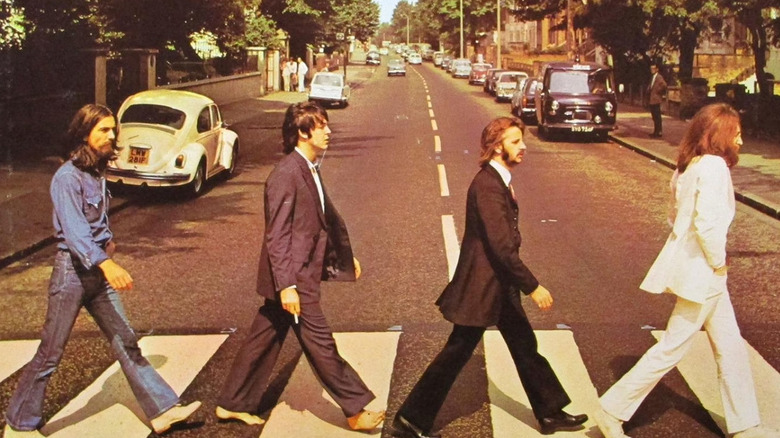
When it came time to knock out the cover image for their 1969 album "Abbey Road," the Beatles didn't have to expend much effort to snag one of the best-known sleeves ever. One day in August 1969, the Beatles walked back and forth across a crosswalk by their Abbey Road studio for over 10 minutes, while photographer Iain Macmillan snapped away. The pic used for "Abbey Road" shows the Beatles in mid-stride mostly dressed in suits; Paul McCartney went barefoot, and George Harrison wore all denim. A few parked cars stand in the background, along with a man in the top right, standing still and observing music history unfolding.
That man knew who he was, of course, but it took decades for the rest of the world to learn his identity or believe his story. Paul Cole of Deerfield Beach, Florida, happened to be in London on vacation at the time, and he was waiting for his wife to finish her visit to a local museum. Many months later, Cole saw the LP when his wife brought it home, and noticed himself staring back. In 2004, Cole solved the mystery of the mysterious "Abbey Road" man through an interview with a Florida newspaper.
Hotel California – Eagles
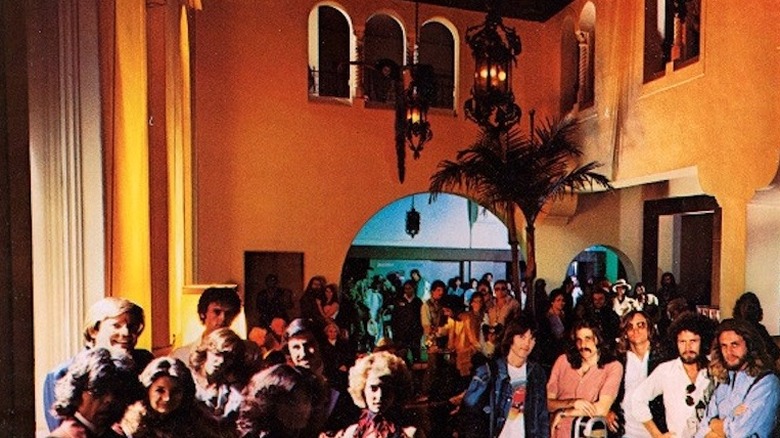
There's hidden meaning in the Eagles' "Hotel California," both the No. 1 hit from 1977 and the cover of the LP that spawned the classic rock staple. The sleeve opens up to reveal a full-size image of the Eagles in a party-like situation at the titular location. In a high-placed archway, looking down on them is an obscured and fuzzy figure who became an integral part of a musical urban legend: The song "Hotel California" is supposedly laden with language that suggests or encourages satanic worship practices, and all those revelers have no idea that they're hanging out with Satan himself — the weird character up above. Art director John Kosh suggested it was a ghost that haunts the site, the Beverly Hills Hotel.
It's a long walk and a deep read of an interpretation of "Hotel California" in all its forms, but it's just not true. The "devil" is just a poorly lit model hired for a photoshoot, albeit one whose name has been lost to time.
Sgt. Pepper's Lonely Heart's Club Band – The Beatles
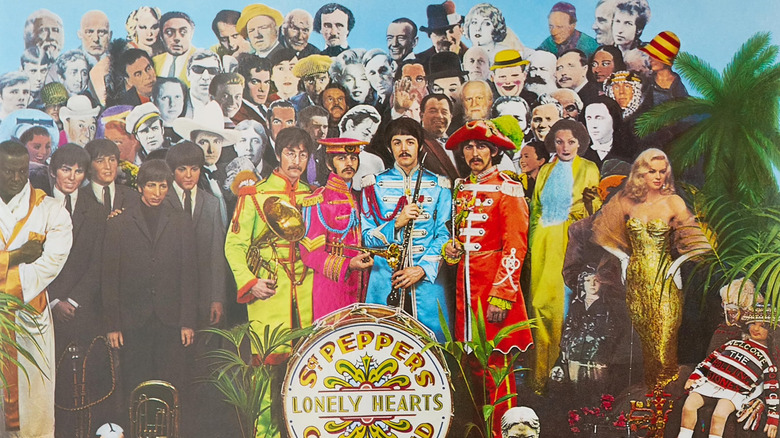
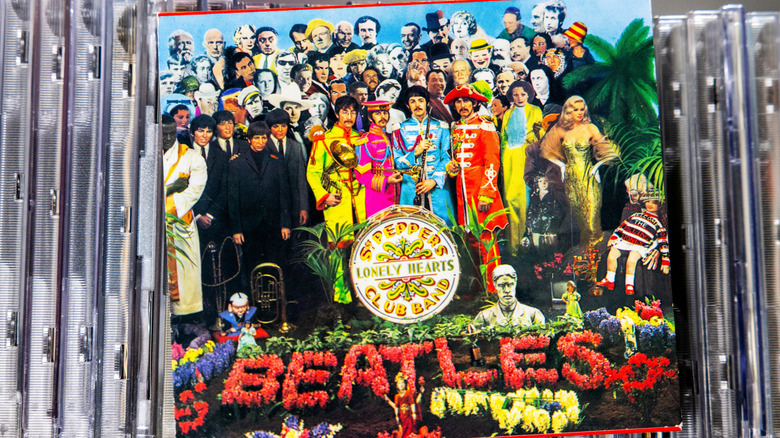
The cover art for the Beatles' 1967 concept album opus "Sgt. Pepper's Lonely Hearts Club Band" gave listeners much to examine as they listened to the record. Over 80 distinct people and items appear in the collage tableau built by artists Jann Haworth and Peter Blake using mostly dummies and photos of important historical figures and creative types. Most of the images surrounding the Beatles in their militaristic marching band regalia are instantly identifiable, such as Marlon Brando, Marilyn Monroe, Bob Dylan, Karl Marx, and an early '60s rendition of the Fab Four.
Showing up just behind a model of Beatles member George Harrison in a low-resolution, black-and-white form is one depiction whose identity remains undetermined nearly six decades later. Conventional fan wisdom suggests that it might be a picture of famed pilot Amelia Earhart or silent film comedian Charlie Chaplin. However, when Blake was directly questioned in 2024, even he couldn't remember.
Black Sabbath – Black Sabbath
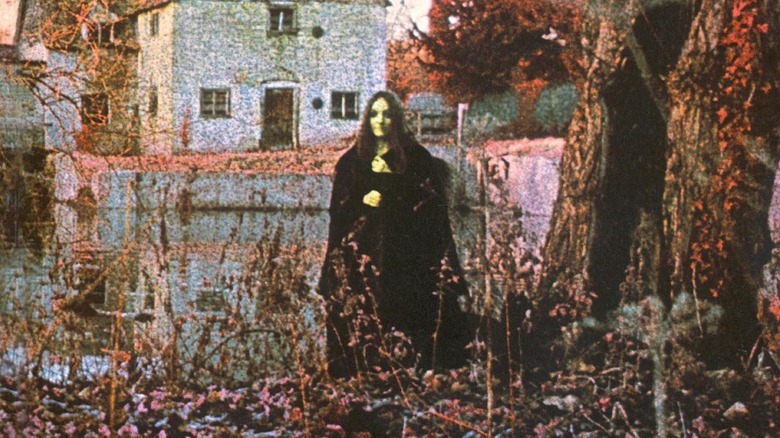
The 1970 self-titled debut album by British band Black Sabbath helped establish the tropes of the genre that would come to be known as heavy metal. The influential LP, featuring Ozzy Osbourne on lead vocals and classic dark, heavy, and imposing metal songs like "N.I.B.," "The Wizard," and "Behind the Wall of Sleep," came packaged in a cover that depicted a decaying country home surrounded by overgrown foliage. In the center was a ghostly figure dressed in flowing black garments, made all the more haunting by being slightly out of focus.
In keeping with the spooky and menacing tone of Black Sabbath's music, the band and their associates kept the identity of the woman on their debut LP's cover a secret for 50 years. When compiling a retrospective on the groundbreaking album in 2020, reporters from Rolling Stone followed some clues and confirmed that the pictured figure was a model named Louisa Livingstone. She'd also posed for marketing material for British rock bands such as Fair Weather and Queen, but none as infamous as the Black Sabbath record. In the years after she retired from modeling, Livingstone adopted the artist name of Indreba and moved into making electronic music.