

The 4 Best Folk Rock Supergroups Of The '60s
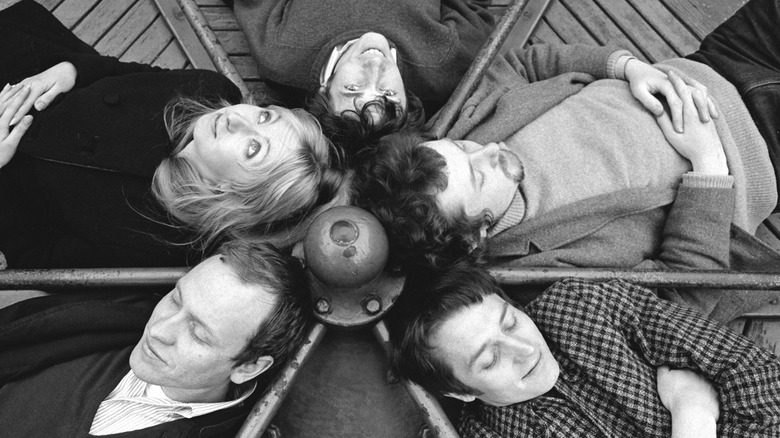
Supergroups are often hit-or-miss affairs that sputter out quickly. Sometimes you get an absolute masterpiece, like Them Crooked Vulture's self-titled album in 2009. Other times you get a group that time forgot, like Jimmy Page's the Firm. Some supergroups are destined for commercial success, like Cream or Audioslave, and others for obscurity. So it was with the best folk rock supergroups of the '60s.
But first, we've got to address the word "best." Anyone even remotely familiar with '60s and '70s folk rock could probably cite Crosby, Stills, & Nash (with or without Neil Young) off the top of their head. At the height of the Bob Dylan-led, mid-60s-birthed folk rock, they were a supergroup characterized by as much talent and quality songwriting as they were record sales and critical acclaim. But even a lesser-known folk rock supergroup like Pentangle produced superbly written music, even arguably better than CSN. Both kinds of success qualify for this article: commercial and/or artistic.
Also, we've got to be judicious about our definition of "supergroup." Bands like the Byrds turned more than a few musicians into icons, like David Crosby; same goes for Buffalo Springfield, which produced Neil Young and Stephen Stills. But these gentlemen weren't household names at the times so those bands weren't supergroups. They were incubators for later supergroups, or perhaps crucibles.
Finally, we can be a little flexible with our definition of folk rock because folk rock itself is a flexible genre shell. So long as we've got folk elements attached to plugged-in instruments and rock rhythms and tempos, we're good to go.
Crosby, Stills & Nash
Is there a more prominent, legendary folk rock supergroup than Crosby, Stills, & Nash? (And Young, which we'll get to). David Crosby broke off from the Byrds, as mentioned, much like Stephen Stills from Buffalo Springfield, while Graham Nash came from the Hollies. They'd all met each other out and about while touring and decided to fuse powers to get a record deal and produce their self-titled 1969 debut, "Crosby, Stills & Nash." It reached No. 6 on the Billboard 200, stayed there for a stunning 107 weeks (i.e., over two years), was the fourth best-selling album of the year with 4.2 million copies sold, and solidified CSN's status in perpetuity.
CSN is a case of where sales figures and chart numbers don't lie. It really is the case that they were the most elite folk rock outfit of their time, and arguably ever, particularly when it came to vocal harmonies (all three members sang) and involvement in political activism. Their music wasn't all acoustic, flower power fluff, though. Tracks like "Just a Song Before I Go" from 1977's "CSN" — their highest-charting song at No. 7 on the Billboard Hot 100 — built disco elements in its proceedings, complete with ultra-funky plucked bass.
No matter their musical talents, CSN succeeded despite themselves. They were plagued by the same kind of infighting and ego problems that often plague supergroups, though they managed to stay together until Nash finally left the group in 2016 because of bitterness between him and Crosby. This was Crosby's biggest regret before he died in 2023, though it doesn't mar the beauty of CSN's music or their lasting impact.
Crosby, Stills, Nash, & Young
It's easy to call Crosby, Stills, Nash & Young a mere extension of Crosby, Stills, & Nash, but the very brief inclusion of Neil Young changed everything. As Graham Nash said in a 2013 interview with NPR, Young's inclusion in the group overhauled their sound. His influence, songwriting, and characteristic darkness and bleakness elevated the quartet and their initial studio album — 1970's "Déjà Vu" — to masterpiece status. This is largely thanks to Young and songs of his that capture the poetic soul of folk rock better than any others, especially "Helpless."
Even though CSNY released "Déjà Vu" in 1970, the band's tangled story goes back to 1969 when Young joined the then-still-new CSN on stage at Woodstock. This set was only the second live show that CSN performed. But CSNY were indeed their own separate group that formed that year with a separate discography that's just as messy and disjointed as CSN's. Young split off from CSNY immediately after they released "Déjà Vu," ventured into his own highly successful career, then circled back to his supergroup bandmates for two more studio albums, 1988's "American Dream" and 1999's "Looking Forward." Folk rock's time in the sun was long gone by then, though.
CSNY stands out in history not just because of its superlative music, but its activism — much like CSN. Following the Kent State Massacre of 1970, when the Ohio National Guard opened fire on a group of protestors and killed four students, Young wrote "Ohio" in a matter of hours. CSNY rushed its release as a standalone single in 1970, adding to the weight of the group's legacy and reputation.
Pentangle
Unless you're fully caught up with your folk rock history, or already a fan, odds are you might not have heard of Pentangle. That doesn't make them any less worthy of attention, though, as the London-based folk rock outfit is as musically savvy as it is unique. Incorporating a mélange of psychedelia, jazz, superb drumwork, and clean electric guitar lead lines that sound lifted from blues-rock outfits like Cream, Pentangle is a truly excellent supergroup that released six studio albums during their initial run from 1968 to 1972.
Even though Pentangle was a supergroup, its members didn't come from super recognizable bands like Buffalo Springfield. Guitarists John Renbourn and Bert Jansch had worked as solo artists in the years leading up to Pentangle's 1967 formation, while vocalist Jacqueline McShee had previously worked with Renbourn. Drummer Terry Cox and bassist Danny Thompson (on upright double bass, not electric bass) had both played in Alexis Korner's Blues Incorporated. Stick them and their talents together, give them a stir, and pour in an extra helping of clearly British folk sounds, and you've got a truly special and one-of-a-kind musical recipe that produced folk rock distinct from its counterparts across the Atlantic.
Much like other supergroups, Pentangle went their separate ways in 1973 after their initial run, got back together from 1981 to 1995, and then once more from 2008 to 2011. The band's lineup changed, though Pentangle persists to this day in what's likely its final form. Dubbed Jacqui McShee's Pentangle after the singer who continues her role as Pentangle's frontwoman, McShee carries Pentangle's banner in small gigs around the U.K. throughout the year.
Blind Faith
Blind Faith seems like it should have worked on paper, at least when it came to musical talent, consisting of Eric Clapton and Ginger Baker (two former Cream members), Steve Winwood (Traffic), and Ric Grech (Family). Musically, it did work, as Blind Faith's sole, self-titled 1969 studio album is actually quite good. It features intricate, even subtle instrumental interplay that showcases each member's acumen and covers a wide genre swath, including folk rock.
Much like other supergroups, Blind Faith buckled under the weight of big personalities, big ideas, and high expectations. The histories of the band's members prophesied the band's end. By the time the quartet formed Blind Faith, each band member had already cycled through multiple bands in a mere handful of years. Baker even played in Alexis Korner's Blues Incorporated — another supergroup that time forgot — along with Pentangle's Terry Cox and Danny Thompson, making Blind Faith a supergroup of supergroups. It's not hard to see why they collapsed despite their capabilities.
But oddly enough, the band really shot themselves in the foot with their album cover, which bizarrely featured an 11-year-old girl with no shirt on holding a spaceship. The band changed the cover as quickly as possible, but the reputational damage was already done. This out-of-nowhere and honestly disturbing choice was supposed to represent the passage from innocence to adulthood, or some such thing, but that theme could have been communicated via a host of other imagery. Nonetheless, if you can forget the cover, the album's music remains excellent.