

In 1958, Columbia Records Invented The Greatest Hits Album — Then It Made Chart History
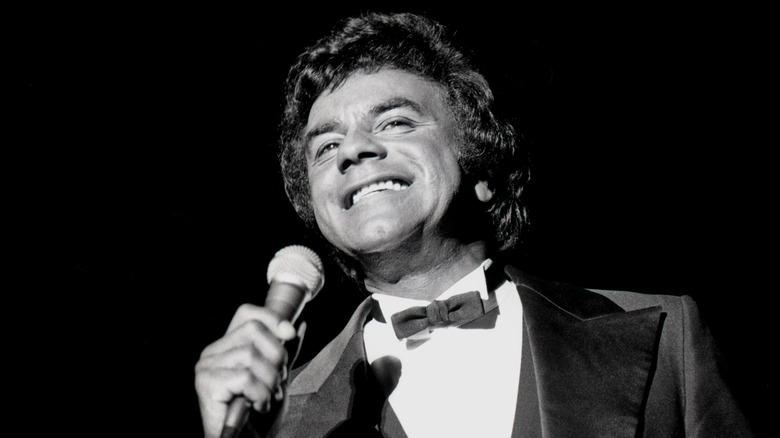
Many of the best-selling albums of all time are "greatest hits" or "best of" albums — collections of singles that serve as both an introduction to and retrospective of an artist's body of work. The very first time a label collected the already released and already wildly popular work of one of its artists and repackaged it as something new to sell to fans came in 1958, when Columbia Records issued "Johnny's Greatest Hits" on behalf of Johnny Mathis.
In 1958, Mathis was the biggest name in gentle pop. A charismatic combination of crooner, balladeer, jazz singer, and soft rock pioneer, Mathis hit the Top 30 over and over with sweet, sentimental, and romance-dripping classics like "Chances Are," "It's Not For Me to Say," and "The Twelfth of Never" (a hit that Mathis himself actually hated). All of those favorites, and nine other timeless Mathis bangers, appeared on "Johnny's Greatest Hits."
Columbia Records put together an album made up of singles, inventing a lucrative music industry practice. It was also quite successful for the company: "Johnny's Greatest Hits" sold three million copies before going on to set some Billboard chart records.
An album of Johnny Mathis' early work kept his fans happy
Greatest hits albums became associated with artists either well-established or on the downswing of their careers, but Mathis had only been a star for about two years prior to the release of "Johnny's Greatest Hits." His records were such a hot commodity for Columbia Records that executive Mitch Miller, a '60s musician we completely forgot about who'd convinced Mathis to move out of jazz and into his broader pop style, suggested the compilation. That would be a way to address Mathis' fans during a period in which the singer would be on tour in Europe, when fresh content wouldn't be forthcoming. "I wasn't able to record anything new, so he threw the first four recordings that I did — both sides on them — and called them 'Johnny's Greatest Hits,'" Mathis told Songfacts, explaining that his "hits" record was actually substantially populated by B-sides as well as smash singles. "That was a little flamboyant, because it was not the greatest hits, yet. But that was a great beginning for a lot of people."
That well executed marketing idea proved to be extremely effective. "Johnny's Greatest Hits" not only proved the viability of the hits album, but it spent three weeks at No. 1 and a total of 490 weeks on the album chart — that's nearly nine and a half years — and a Billboard and Guinness World Record at the time.