

5 Classic Albums That Define The Who
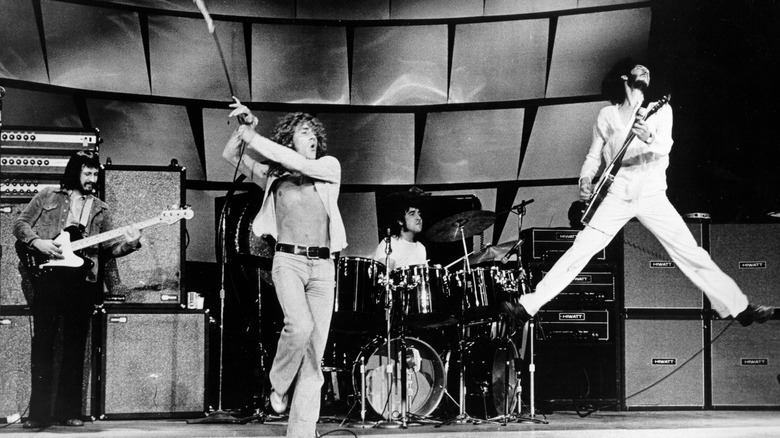
Since the mid-1960s, the Who has released more than a dozen studio albums and a host of live ones. The mod rockers from the U.K., part of the British Invasion who kept chugging along into the 1970s and later as a foundational hard rock, arena rock, and even progressive rock act, are among the most important and famous of all classic bands, and it's thanks in large part to their statement albums. A handful of those full-length releases showed what singer Roger Daltrey, guitarist and songwriter Pete Townshend, bassist John Entwistle, and drummer Keith Moon (a rocker who partied too hard) were capable of, and that was making music that demanded a listen beyond just a couple of singles at a time.
Between 1966 and 1971, the Who reached their creative and commercial peak, releasing multiple near-perfect rock records. "A Quick One," "The Who Sell Out," "Tommy," "Live at Leeds," and "Who's Next" serve as a very entertaining and educational primer for the Who. All five of these albums are a full artistic statement unto themselves, and all bear the hallmarks of what made the Who different than their contemporaries. The songs are based in blues-rock but feature powerful percussion, wailing vocals, acrobatic but precise guitar work, and melodic bass lines. All of it moves rock forward and treads ground in unfamiliar new places thematically and musically.
A Quick One
Following the walloping "My Generation," the Who recorded the more thoughtful and cohesive 1966 LP, "A Quick One." This album provides a proper proof of concept of what the Who was all about, and the path that they would follow: British Invasion-style garage rock, played louder and heavier, while also bearing the imprint of American R&B and introducing experimental long-form storytelling to rock 'n' roll. To that end, a couple of early runtime highlights are a cover of the already classic 1963 Motown hit "Heatwave" with deep-throated vocals by Who front man Roger Daltrey, and the silly but dense "Boris the Spider," written by its singer, bassist John Entwistle.
The centerpiece and album ender "A Quick One, While He's Away" is a glimpse of what the Who could do first and better than any of their '60s rock contemporaries. A concept album in miniature, the nine-minute, six-part track tells the story of a couple who nearly break up due to infidelity that occurs while one partner is out of town on work, only for the guilty party to be gloriously forgiven. It features some of the Who's best-ever work on harmonies as well as Keith Moon's thundering percussion.
The Who Sell Out
The 1967 release "The Who Sell Out" is often critically hailed as one of the finest albums ever recorded. Structured like an underground free-form radio station, the ironically titled "The Who Sell Out" finds the titular band experimenting with a number of new sounds and techniques and having a terrific time doing it. While humorously laced with phony, satirical commercials for the products modeled on the cover by Pete Townshend and Roger Daltrey ("Odorono" and "Heinz Baked Beans," respectively), the album pulls from many musical styles just emerging in the era and which might only be heard on an obscure radio show.
That premise means Who fans get to hear the band try psychedelic rock on "Armenia City in the Sky," spiritual stuff on "I Can't Reach You," and turn the sound way down for a change on the folky "Sunrise." Townshend's nuanced songwriting and guitar work balance with Daltrey's gusto-drenched vocals, a blend perhaps perfected on the LP's central sonic masterpiece "I Can See for Miles."
Tommy
Whether one wants to call it a concept album or a "rock opera," the Who's "Tommy" was monumental upon its release in 1969, a year that changed rock forever. Composed primarily by guitarist Pete Townshend as one work with a beginning, middle, and end — along with some bewildering and tough psychedelic passages — "Tommy" took hard rock to an ambitious new place. Rather than just sit there on vinyl as a bunch of unconnected rock songs, "Tommy" tells the story of a child so affected by trauma that he can't speak, hear, or see, but nevertheless grows up to become a world-famous pinball player and spiritual guru.
A snapshot of late '60s countercultural themes and sounds, "Tommy" also launched some of the Who's most famous songs which work outside of the context of the rock opera, such as "Pinball Wizard" (a hit song that Townshend hates), "I'm Free," and "Tommy Can You Hear Me?" It ultimately became the Who's most famous and adaptable work — a movie version and a Broadway musical followed in the '70s and '90s, respectively.
Live at Leeds
In their prime, the Who enjoyed a reputation as one of the most potent and ferocious rock bands that ever took the stage. Once cited by Guinness World Records as the loudest group on the planet, the Who at their liveliest peak were captured for posterity on the 1970 LP "Live at Leeds."
The collection is something of a victory lap as well as a live greatest hits album. Released just after the Who elevated and expanded the idea of rock 'n' roll with its rock opera "Tommy" and would go on to try to top it, "Live at Leeds" is the Who before the Who got too complicated, recorded when they were still a volatile, late '60s-style hard rock band. There are only five tracks on "Live at Leeds," including classic Who cuts like "My Generation," "Magic Bus," and "Substitute," as well as a devastating and powerful cover of the early rock 'n' roll standard "Summertime Blues."
Who's Next
After attempting to succeed "Tommy" with another far-reaching concept album called "Lifehouse," the Who's Pete Townshend dumped much of that in favor of building 1971's "Who's Next," a more straightforward collection of hard-hitting ragers balanced with tracks that explore the little-seen sensitive side of the band. The result is an LP packed with classic rock radio staples, as most of the Who's best-known and most-loved songs first appeared on "Who's Next." The album starts with the epic, anthemic "Baba O'Riley" — anchored by Keith Moon's unhinged drum work — before eventually rolling out the snotty and blistering "Bargain," the triumphant "Won't Get Fooled Again" and the vulnerable "Behind Blue Eyes."
Probably the most novel thing on "Who's Next" is the persistent experimentation with synthesizers. Predating synth-pop and new wave by about a decade, Townshend uses electronic sounds to evoke a sense of wonder and infinity, particularly on "Baba O'Riley" and "Won't Get Fooled Again."