

Famous Musicians Whose Biggest Hits Were Duets
It's a rare and odd phenomenon in music history: singers that can score major hits, but only if they're part of a duet. Such singers might become very famous from teaming up with another, or maybe they were part of a popular band or notched some hits overseas. But then when they try and go at it alone, the public is indifferent, and what should've been huge solo hits are only moderately successful at best. Without the assist from their connected friend, or not having another voice to play off of or blend with, these duet stars can't get a hit and wind up fading into obscurity.
That's a fate that befell numerous well-known duet partners throughout the late 20th century. It's both surprising and sad that Tammi Terrell, Suzi Quatro, Chris Norman, Siedah Garrett, Barry Gibb, and Odia Coates could never repeat on their own the march to the top of the chart they enjoyed with a hit duet.
Tammi Terrell
In just a three-year period, from 1967 to 1970, Marvin Gaye and Tammi Terrell released several hit transcendent love duets for Motown Records. Some of these singles were absolute classics, including "Ain't No Mountain High Enough," "Ain't Nothing Like the Real Thing," and "You're All I Need to Get By." Tragically, the end of Gaye and Terrell's unified run was brought about by Terrell's death at age 24 from the effects of a brain tumor.
Terrell never got much of a chance to perform or record music in the wake of her stellar slew of Gaye collaborations. But before and concurrent with her time as one-half of one of the biggest pairings of Motown, Terrell's solo career was only a modest affair. Alone, she climbed into the Hot 100 three times. Just before the duet era, "I Can't Believe You Love Me" got up to No. 72. After her work with Gaye made her a star, Terrell's take on the R&B standard "This Old Heart of Mine (Is Weak for You)" could only reach No. 67 in early 1969.
Suzi Quatro and Chris Norman
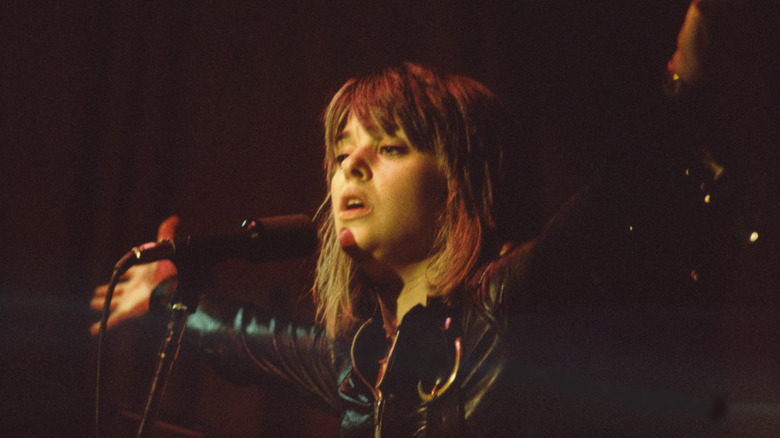
Blending radio-friendly pop-rock with edgier hard rock proved very successful for Detroit-born bassist and singer Suzi Quatro — in the U.K., that is. There, Quatro hit the Top 40 11 times, going to No. 1 with "Can the Can" in 1973 and "Devil Gate Drive" in 1974. Quatro's style was similar to that of the British band Smokie, which was all over the U.K. pop charts in the mid-1970s with songs like "Don't Play Your Rock and Roll to Me" and "I'll Meet You at Midnight." In 1978, Quatro teamed up with Smokie lead singer Chris Norman, and their duet finally got them substantially noticed in the United States. Before the shuffling, gently rocking love song for two hit the Hot 100 in early 1979, a couple of Quatro singles had briefly appeared on the lower rungs of the chart; Smokie made the Top 30 with "Living Next Door to Alice." "Stumblin' In" got massive, reaching No. 4 in America.
Quatro couldn't get anything else to land in her nation of origin. Four subsequent singles — "She's in Love With You," "I've Never Been in Love," "If You Can't Give Me Love," and "Lipstick" — couldn't break into the Top 40. As for Norman, "Stumblin' In" is his only appearance under his own name on the Hot 100.
Siedah Garrett
After working as a background vocalist and songwriter and performing with the pop group Plush in the early 1980s, Siedah Garrett saw her name on a release for the first time in 1984. Dennis Edwards of the Temptations set out on a solo career, and his duet with Garrett, "Don't Look Any Further," was his initial single. Barely a hit, it ascended to No. 72 on the Hot 100. Being a star on the rise in pop and R&B circles, Garrett joined Michael Jackson's camp and contributed to two No. 1 singles from his 1987 blockbuster LP "Bad." She co-wrote "Man in the Mirror" and was the fully credited duet partner for the King of Pop on lead-off single "I Just Can't Stop Loving You."
While "Bad" continued to sell in 1988, Garrett's handlers at Qwest Records acted quickly, coming out with the singer-songwriter's first solo LP, "Kiss of Life." Unfortunately, the album's semi-title track and showcase single didn't inspire purchases the way that Garrett's work with Edwards or Jackson had. Her only appearance on the Hot 100 was the No. 97-charting "K.I.S.S.I.N.G."
Barry Gibb
Objectively one of the most successful musicians of all time, Barry Gibb wrote more No. 1 hits than he'd ever score himself. The vast majority of Gibb's record sales and singles chart triumphs came as a member of the Bee Gees, where, along with his brothers Robin and Maurice, he took nine songs to No. 1, including disco staples "Night Fever" and "Stayin' Alive" from the "Saturday Night Fever" soundtrack, which at one point was the best-selling LP in history.
A false thing commonly believed about the Bee Gees is that the band disappeared when disco grew passé. In the '80s, the Gibbs focused on songwriting and producing, which brought the trio into the orbit of Barbra Streisand. Barry Gibb took the lead on producing Streisand's pop album "Guilty," and he was deemed so vital to the 1980 LP's creation that he's pictured on the sleeve in an embrace with the singer. The second and third singles from that album, "Guilty" and "What Kind of Fool," were Streisand and Gibb duets, and they were both Top 10 hits. Not until 1984 did Gibb issue the first true solo album of his life, "Now Voyager." Neither his track record with the Bee Gees nor his soft rock successes with Streisand helped. The single "Shine Shine" barely squeaked into the Top 40, technically making Gibb a one-hit wonder.
Odia Coates
Odia Coates was a featured performer in the Edwin Hawkins Singers, an influential gospel collective that incorporated R&B and soul elements. In the mid-1970s, former teen idol-style pop star turned adult contemporary crooner Paul Anka produced an LP for the group, and when he heard Coates sing, he realized she'd be the ideal duet partner for a song he'd recently written. That tune, widely regarded by music fans and on Reddit as the worst song of the '70s, was called "(You're) Having My Baby," and it was a musical ode from Anka to his wife and the mother of their children. While heavily criticized in 1974 for its perceived anti-feminist content, "(You're) Having My Baby" was still also a smash, spending three weeks at No. 1. It performed so well that Anka enlisted Coates to sing with him on three duets: "One Man Woman / One Woman Man," "I Don't Like to Sleep Alone," and "(I Believe) There's Nothing Stronger Than Our Love" all made the pop Top 20.
That should've launched Coates' career, but that's not how it worked out. In 1975, United Artists Records released Coates' self-titled debut album. Neither promotional single went very far on the Hot 100. Her cover of Electric Light Orchestra's "Showdown" got up to No. 71, and the Anka-written "Don't Leave Me in the Morning" peaked at No. 91. Coates' LP missed the album chart, and she never appeared on the singles chart again before her death in 1991.