

The 5 Best '70s Live Albums, Ranked
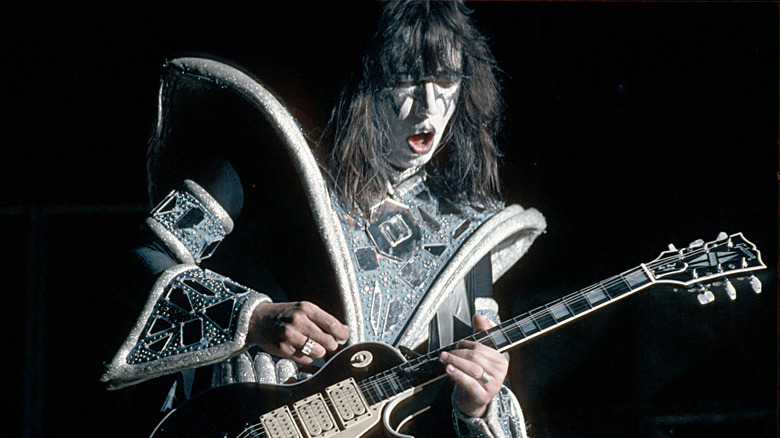
If the 1960's were when rock broke out of its pop origins and demanded to be taken seriously as an art form, the 1970s were the decade that saw that art form expanding in all directions. Stadium concerts engorged with guitar heroics, rock god frontmen, and sprawling legions of screaming worshippers were front and center in the music world's collective unconscious. In that light, it was only fitting that such captivating entries in the annals of musical mythology would be recorded.
To that end, we wanted to look at those live albums that seem to allow some crucial but previously dormant component of an artist's sound to flourish in the concert space. So whether it's The Who coming into their own as a bona fide heavy metal machine or Kiss's intergalactic career finally going full warp-speed, these are documents of those rock concerts from the 1970s that no true music fan will ever forget.
5. Jimi Hendrix -- Band of Gypsies
By 1970, Jimi Hendrix had climbed the electric guitar mountain (and chopped it down with the edge of his hand). While the final year of Hendrix's life was marred by a wide array of personal issues — not the least of which was his own sense of alienation from his craft and uncanny sense of mortality — his "Band of Gypsies" live album is a stunning testament to his life's work and the unrealized potential that passed with him.
Recorded at New York's Fillmore East, the concert's master of ceremonies introduces Hendrix and company as "some old friends with a brand-new name." It's an apt, though overly delicate, appraisal of the state of Hendrix's band. Despite having invited Jimi Hendrix Experience drummer Mitch Mitchell to join the new band, it soon became clear that he needed to move on to an entirely new group of players. To that end, Hendrix enlisted bassist Billy Cox (an old friend from the army) and drummer Buddy Miles.
The degree to which the new blood appears to be reinvigorating Hendrix cannot be overstated. The furious vibrato on "Who Knows" and the career-defining extended solo on "Machine Gun" alone are enough to demonstrate the full breadth and width of his development since Purple Haze had first shredded stereo systems. "Band of Gypsies" is an invigorated and adventurous final album from a guitarist who seemed to have no ceiling on what he could have accomplished if he'd lived. That unrealized potential feels all the more bittersweet considering that in the final months of his life there had been talk between Keith Emerson and Greg Lake about having Hendrix join what was to become Emerson, Lake, and Palmer.
4. Judas Priest -- Unleashed in the East
Many 1970s live albums showcase artists in a state of flux — transitioning from bar bands to stadium legends — and, as such, are rough around the edges in a rather satisfying manner. Such is not the case with "Unleashed in the East," Judas Priest's first-ever live album and one recorded in the wake of an onslaught of increasingly finely honed heavy metal behemoth LPs.
The band responsible for "Sin After Sin," Stained Class," and "Hell Bent for Leather" (as well as their decidedly less metal debut "Rocka Rolla") was showing off the razor-sharp precision of their supremely crafted metal machine. And that is no mere metaphor: as legions of Priest fans the world over are well aware, the band carried the "metal" aesthetic to its most literal degree. Their stage shows were, and continue to be, built around science fiction-themed steel and iron sets that reflect the chromium-plated, gun-metal delivery of the band's furious riffs.
That visual metaphor is fully justified by the performances on "Unleashed in the East." This is the sound of a band whose chops have been refined to such a degree that they seem borne out of telekinetic communication with the metal dimension. That tight sonic refinement led some to speculate that it was actually the result of studio wizardry. To that end, vocalist Rob Halford later clarified that poor recording of his original vocals had necessitated redoing them in post-production.
Irrespective of that speculation, "Unleashed in the East" captures a stunning performance from a band that was poised to release their most enduring classics during the upcoming 1980's. More so than that, however, it is stunning work from a band on the vanguard of the burgeoning New Wave of British Heavy Metal Movement.
3. The Who -- Live at Leeds
"Live at Leeds" is an important history lesson for students of hard rock. The young guard of up-and-coming rockers — those precocious scamps for whom Slipknot constitutes "classic rock" — might be perplexed to learn that The Who were, in fact, a primary influence on heavy metal. After all, recording equipment in their '60s was woefully insufficient to fully capture the sonic onslaught of distorted guitar and what little distortion was available was generally arrived at by cranking amps to the point of blowing out the speaker cones. Technology simply had not kept pace with the vision of so many psychedelic rockers.
Given those constraints, the distortion on early Who albums sound less like a towering wall of impenetrable sizzle and more like errant scratching on the outer edges of an otherwise clean tone. That's where "Live at Leeds" fills in the cognitive gaps for the young metalhead. Recorded live at Leeds University for an audience of roughly 2,000, the guitar is finally able to speak at full volume (pun intended). The chords have the satisfying chunk of AC/DC, the palm-muted speed riffs sound like they're ushering in the age of Metallica, and leads wail with sustain of which their studio counterparts could only dream.
That wider acoustic spectrum benefits the rest of the band as well: John Entwistle's bass joins drummer Keith Moon (who earns his place in rock history with an epic drum solo) in a rhythm section that sounds like melodic cannon fire, and Roger Daltrey's righteous hard rock soul is free to howl above it all. What seemed like a paltry attempt at heaviness in the studio becomes a thundering promise that the doubters won't get fooled again.
2. Kiss -- Alive!
By 1975, Kiss had garnered a reputation as a stellar live act but couldn't do significant sales figures. To that end, the group decided to see if their stage show could move units as well as tickets. 1975's "Alive!" was the end result and it gave Gene, Paul, Peter, and Ace the breakout momentum they'd been craving, hitting No. 9 on the Billboard 200 and setting the stage for 1976's "Destroyer" to hit No. 11 on the same chart.
Taken as a whole, the record sounds remarkably raw and punkish compared to Kiss' immaculately produced studio efforts. That works to the album's advantage in capturing the band's invigorating live energy, but it's also a stark reminder that Kiss was, first and foremost, not a band but a brand. The album's tracks (culled from their self-titled debut album as well as "Hotter Than Hell" and "Dressed to Kill") are fairly simple rock songs devoid of the studio wizardry that would make their subsequent work seem like it rocketed out of another dimension. Thus, what sells the record isn't the songs themselves but the audience's investment in them.
The album was so successful that the band would revisit the formula throughout their career, releasing equally high-charting efforts with 1977's "Alive! II" and "Alive III" in subsequent seasons of the band's existence. A fourth installment in the series was released in 2003 and only charted at 18. (In retrospect, putting a whole symphony in Kiss makeup might have been overkill.)
It's sobering to think of "Alive!" as an advertisement, but it undeniably captured the public's imagination on a grand scale. The band had made it big, and they did it with what was arguably the most effective 1970s commercial since "I'd Like to Buy the World a Coke."
1. Peter Frampton -- Frampton Comes Alive!
"Frampton Comes Alive!" didn't launch Peter Frampton's solo career; it just made it very profitable. Where his preceding studio efforts had stiffed on the charts time and again, the double LP spent a whopping 10 weeks at No. 1 on the Billboard 200 and went on to go 8X platinum and become the top-selling live album of all time. Not a bad showing for the guitar virtuoso and burgeoning heartthrob who had previously only tasted fame as a member of Herd and Humble Pie.
A side-by-side comparison of the album's live recordings versus their original studio versions lays bare the difference in appeal: "Frampton Comes Alive!" sees the soft rock adult contemporary tracks imbued with the energized swagger of the live band, the euphoric crowd, and the in-the-moment rush of Frampton's harder edge emerging from beneath the gentle studio persona. Even an acoustic ballad like "Wind of Change" feels raw, aggressive, and immediate in comparison to its heavily reverberated studio counterpart. Hearing a polished soft rock act embrace a twinge of the animalistic ferocity of live rock 'n' roll makes for a compelling, captivating listen.
But above and beyond adding sweat and snarl to pop listenability, there's the undeniable undercurrent of virtuosity and ensemble interplay that proceeds directly from Frampton's guitar prowess. He doesn't just shred like a seasoned soloist; he knows how to use his own leads to carry the band through dramatic tension/release exercises that, when properly executed, will drive audiences wild. In that light, the nearly religious worship of his ecstatic audience makes more sense. By the time he gets around to the legendary talk box interlude at the end of "Do You Feel Like We Do," he's already been beatified by a sea of enthralled worshippers.