

1991 No. 1, Which Resulted In A Lawsuit, Hit The Top Of The Charts 35 Years Ago Today
We may receive a commission on purchases made from links.
In 1970, the Jackson 5 set a record when their first four charted singles hit No. 1 on the Billboard Hot 100. A couple of decades later, a young Mariah Carey would tie that record with the first four singles from her self-titled debut album — "Vision of Love," "Love Takes Time," "Someday," and "I Don't Wanna Cry" all reached the top of the chart. But that tie wouldn't last long. In October 1991, the lead single from Carey's second album would break the record. "Emotions," from the album of the same name, soared to No. 1 and stayed there for three weeks.
But while Carey was singing high on the charts, trouble was brewing behind the scenes. "Emotions" sparked a plagiarism dispute over its striking musical similarities to "Best of My Love," the 1977 disco hit by the group the Emotions. Maurice White, who co-wrote "Best of My Love," accused Carey's team of borrowing musical elements without his knowledge or permission.
David Cole, a co-producer and co-writer of "Emotions," admitted that Emotions the group inspired "Emotions" the song. But White heard more than just inspiration. As SPIN reported back in 1998, White said, "Sampling is one thing, but she [Carey] took the whole song." The parties reached a settlement agreement, which included retroactive writing credit to White, along with royalties and a payout. That legal controversy, though, wouldn't quiet a voice that seemed committed to challenge the limitations of human vocal cords.
Emotions and notes run high
The lyrics are clear: "Oh-oh, baby, you've got me feelin' emotions / ... higher than the heavens above." Carey also conveys this idea with the range of her voice. "Emotions" became one of the songs that cemented her as the queen of the whistle register, a vocal range that sits above falsetto. It's far beyond the range most singers can comfortably reach and usually only happens when stepping barefoot on a LEGO. But Carey reaches and controls the whistle register in "Emotions," especially near the end of the song where she unleashes rapid vocal marathons into the upper register.
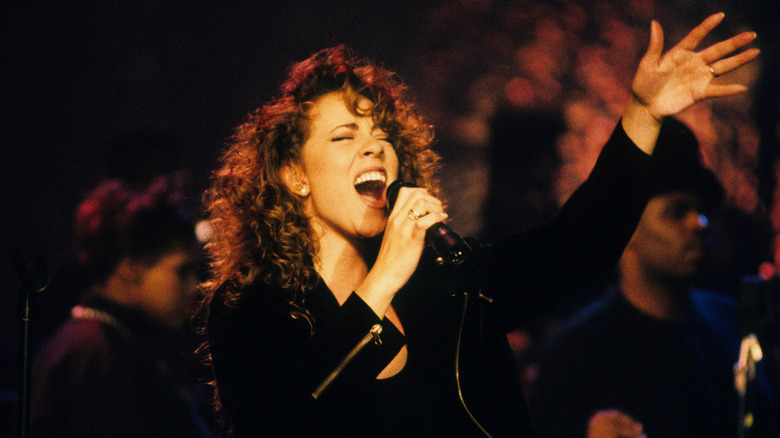
Carey proved she could reach these difficult notes outside the studio when she performed "Emotions" live at the 1991 MTV Video Music Awards. According to The New Yorker, "she reportedly sounded a G-sharp three and a half octaves above middle C, one of the highest notes produced by a human voice in the history of recorded music."
If reaching vocal ranges that are "higher than the heavens above" isn't in your wheelhouse, don't fret. In her MasterClass lesson about "Taking Care of Your Voice," Carey offers reassuring advice: "Stretching for the high notes and pushing the limits of your voice are not the only ways to sing. And I think the delicate moments are sometimes stronger." Of course, that's easy to say when you have a five-octave voice and can probably communicate with dolphins.