

The 5 Longest-Running Rock Supergroups Of All Time
Some rock bands, such as the Rolling Stones, have had tremendously long-lasting and successful careers that remain active to this day. Occasionally, members of such esteemed bands go on to form supergroups of varying quality and success, including Mick Jagger's one-album Superheavy that time forgot. And even more rarely, those supergroups also last a long time.
In general, supergroups usually fail. Sometimes they're designed as short-term, experimental one-offs, as with Dave Grohl, Josh Homme, and John Paul Jones' Them Crooked Vultures, who produced one magnificent album in 2009 built on egoless collaboration. But this is the exception rather than the rule: More often than not, egos clash, chemistry dissolves, and talented individuals who are giants in their arenas can't cope with other giants. This is what happened with Jimmy Page's forgotten supergroup, The Firm, as well as Blind Faith, Velvet Revolver, and plenty of other supergroups.
But when supergroups do last the distance, they can keep going for decades. Such groups run the gamut from extremely commercially successful, such as Bad Company, to lesser-known acts like Phil Anselmo's Down. In all cases, there's some special sauce that keeps them together, even if it's record-label intervention. And in all cases, the longest-lasting supergroups continue to this day, barring some hiccups along the way.
Grand Funk Railroad (1969 to present)
Grand Funk Railroad (GFR) has been getting funky since 1969. Back then, Don Brewer, Mark Farner, and Mel Schacher came together under strange and somewhat forced circumstances to eventually rock the rock world in the '70s with colossal hits like "Some Kind of Wonderful" and the very biographically named "We're an American Band."
GFR's messy origins began with Brewer and a band called the Jazz Masters in Flint, Michigan. As the tale goes, the somewhat slippery DJ Terry Knight met them after a show, convinced them to change their name to Terry Knight and the Pack, and started acting as their manager. The band eventually ditched Knight, changed their name to the Pack, and moved to Cape Cod before moving back to Flint and working with Knight again. That's when they recruited Schacher of ? and the Mysterians into the mix and rebranded themselves "Grand Funk Railroad," based on the name of a song that Knight had written about a literal U.S. railroad called the Grand Trunk & Western Railway. The rebranding was meant to distinguish the band from its former, local reputation.
As it turns out, the trio's chemistry worked — at least with the public. GFR sold almost 12 million records no matter the denunciations of critics. The band went through some typically convoluted lineup changes over the decades, though at present, Brewer and Schacher have gotten back on board, along with Bob Seger alums Mark Chatfield and Tim Cashion. Their extensive touring schedule currently runs all the way through early 2027.
Bad Company (1973 to present)
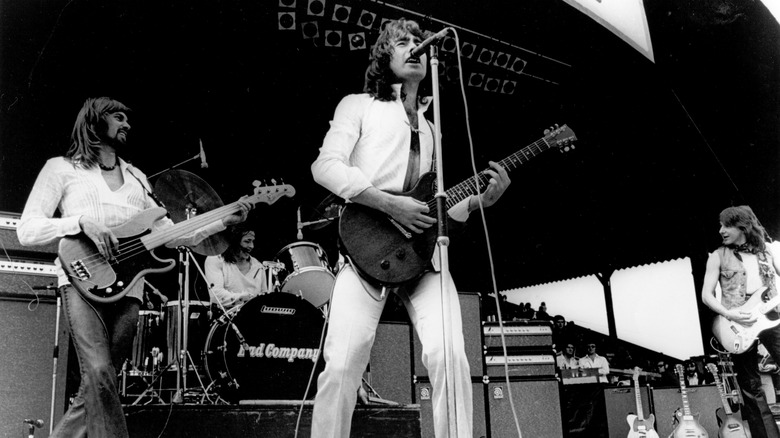
The only time you want bad company hanging around for so long is if it's Bad Company, right? The 1973-formed supergroup blazed a trail across the charts with their 1974 self-titled debut, which went to No. 1 on the Billboard 200, sold over 5 million copies, and set their careers on a path to their 2025 Rock and Roll Hall of Fame induction. And while 1974 was definitely Bad Company's best year, the band has remained alive ever since — with some caveats. That's not too bad for a band that lots of folks don't even realize is a supergroup.
The original Bad Company lineup consisted of four guys: Boz Burrell of King Crimson, Mick Ralphs of Mott the Hoople, and Paul Rodgers and Simon Kirke of Free. This lineup lasted until 1983, when the band disbanded because of typical supergroup infighting combined with crushing burnout. In 1986, their record label wooed the band to reunite after the 1985 greatest hits album, "10 from 6," sold over two million copies, and Ralphs and Kirke bit. The reformed Bad Company added Brian Howe to the mix, followed by Rick Wills and Dave Colwell, and kept on keeping on.
Bad Company's last tour was in 2019, followed by Howe and Ralphs' deaths in 2020 and 2025, respectively. Prior to Ralphs' death, Rodgers said in 2023 the band was still kicking (he'd returned on vocals), while Kirke said they were done. Nonetheless, the band's November 2026 album, "Live in London," brings their tally to 21 live records since 2002. So, call Bad Company sellout corporate rock all you want, as many have done, but they're technically still in the game.
Crosby, Stills & Nash (1968 to 2016)
A top choice for folk rock, supergroup par excellence Crosby, Stills & Nash left a permanent mark on our musical landscape. Combining the power of David Crosby (the Byrds), Stephen Stills (Buffalo Springfield), and Graham Nash (the Hollies), the plainly named Crosby, Stills & Nash (CSN) got together in 1968 and delivered their debut unto the public in 1969, the equally plainly named "Crosby, Stills & Nash." Their approachability and unpretentiousness elevated the trio and their songwriting into commercial success: Their debut went to No. 6, stayed on the Billboard 200 for 107 weeks, and sold over 4.2 million copies.
Crosby, Stills, and Nash met while touring in their pre-CSN bands, and discovered how nicely their voices gelled over dinner one night in 1968. The next year they played Woodstock, where Neil Young joined them ahead of the rechristened Crosby, Stills, Nash & Young releasing their penultimate masterwork, 1970's "Déjà Vu." Young left the group shortly after and reconnected on and off over the years.
But behind CSN's peaceful plucking, things were a nightmare offstage. A hedonistic rock 'n' roll lifestyle and boundless egos led to endless personality clashes. CSN split up, reformed, split up, and came back together numerous times over their career, though they never finally called it quits for good until 2016, when Nash said enough — of Crosby, that is. Before he died in 2023, Crosby cited his poor treatment of his bandmates as his biggest life regret.
Asia (1982 to present)
At the very least, folks who know nothing about the supergroup Asia ought to recognize "Heat of the Moment" from their 1982 self-titled debut. That song, which went to No. 4 on the Billboard Hot 100, represents the most radio-friendly aspects of Asia, which took '70s prog sensibilities and mixed them with '80s pop. Formed in 1981, Asia was at their most successful in their early days, yet the band persists all the way to their 2026 releases, "Live in England" and November's "Indigo."
In its original form, Asia was a quartet of elite '70s prog alums: Steve Howe from Yes, Geoff Downes from Yes and Buggles, John Wetton from King Crimson and UK, and Carl Palmer from Emerson, Lake & Palmer. Asia was a direct, conscious attempt to repackage the music of such bands into a radio-friendly form for a changing musical landscape. Howe, Wetton, and Geffen Records roped Downes and Palmer into the proceedings, the band crafted their debut and follow-up, 1983's "Alpha," and then Howe left. Thus began an absurdly convoluted, ever-changing lineup where no combination of musicians remained the same over any stretch of several years. This "Ship of Theseus" eventually saw its original lineup return from 2008 to 2012, before Howe left again and Wetton died in 2017. The current lineup contains none of the original members.
And yet, for the most part, Asia never stopped existing. You could declare Asia a corporate construction, built for cynical reasons and equipped with a manager-suggested name. However, they're still continuing to put out new music some 45 years after their formation, and that's a feat in and of itself.
Down (1991 to present)
Pantera singer Phil Anselmo's other band, Down, has been getting down since 1991. That's one year after Pantera's landmark, "Cowboys from Hell" (aka the "Cemetery Gates" album), but even as things were blowing up for Pantera, Anselmo formed Down with some buddies who all grew up in and around New Orleans. They knew each other, but had never worked together directly.
Down became a quintet that included Pepper Keenan from Corrosion of Conformity, Jimmy Bower from Eyehategod, and Todd Strange and Kirk Windstein from Crowbar. All of these bands are firmly metal, as is Pantera's genre-defining brand of chunky groove metal. Down, however, skews hard rock with a '70s southern rock DNA injection. The riffs and song structures are pretty simple, something akin to Stone Sour versus Slipknot.
If not for Down's 2026 album, "Volume V," the band may not have made our list. Their prior album came out in 2010 (a live album), preceded by irregular releases leading back to their 1995 debut, "NOLA." But delays in Down's release schedule were never indicative of the same kind of shenanigans that typically plague supergroups. The band members, even with its current lineup, come across as nearly religiously devoted to each other. The special sauce that keeps them together is their New Orleans-forged, pre-fame bond. It's hard to see how Down could ever break apart, barring extreme, unforeseen circumstances.
Liquid Tension Experiment (1997 to present)
To those in the know, names like Tony Levin, Mike Portnoy, John Petrucci, and Jordan Rudess will make eyebrows rise high enough to surmount heads. Such is Liquid Tension Experiment (LTE), a stupefyingly virtuosic prog supergroup that's basically Dream Theater minus the vocals and bassist John Myung swapped out for Levin. For those who don't know: You can consider Dream Theater a metal subgenre-defining successor to King Crimson, the proggiest of '70s and '80s prog bands — the kind with long compositions, lots of interludes, flutes, saxophones, and such.
The band members of LTE have an incredibly elite resume. This is especially true of Levin, whose Chapman Stick (a double-tapped guitar/bass combo) and other various basses contributed to King Crimson, David Bowie, Pink Floyd, John Lennon, and Stevie Nicks, among many other luminaries. Portnoy, Petrucci, and Rudess on drums, guitar, and keyboard, respectively, are basically Dream Theater, reprised. But if you've ever listened to Dream Theater, you'll at least know that's enough of a pedigree, in and of itself, regarding technical musical prowess.
LTE has been kicking around since 1997 with some massive breaks between records. After their self-titled debut in 1998 and follow-up in 1999, it took 22 years to release their third album in 2021, "Liquid Tension Experiment 3." The band hadn't technically broken up, but the members just had too much going on to make another album. That all changed during COVID, which gave the band time to make new music, giving us another head-spinningly and gorgeously complex album full of enough dense orchestration and physical skill to last another 22 years.