

The Classic Rock Album Cover That Immortalized A Split-Second Moment Of Rebellion

The cover of the Clash's 1979 double-length punk rock masterpiece "London Calling" is probably more famous than the music on the vinyl. It preserved and spread a quick but powerful flash of spirited rebellion that was very indicative of the Clash's message, with their bassist Paul Simonon caught in the act of destroying a guitar on stage.
"London Calling" is loaded with songs about anger, disenchantment, and frustration, such as its title track, a song from 1979 that defines rock history. Many of those tracks were on the set list on the evening of September 20, 1979, when the Clash played the Palladium in New York City. When the show wasn't as collectively cathartic or energetic as Clash bassist Paul Simonon would've liked due to crowd-control measures, he got upset. "The show had gone quite well, but for me, inside, it just wasn't working well, so I suppose I took it out on the bass," he later told Classic Rock. Indeed, he hoisted his bass guitar into the air and obliterated it with one violent action.
Just before the moment of impact, tour photographer Pennie Smith took a picture, and it became the basis for the artwork on "London Calling," which hit stores just a few months later. There's plenty of hidden meaning behind this album cover: agitation, protest, and keeping the rebellious spirit of rock 'n' roll alive.
London Calling got its cover thanks to a quick-thinking photographer
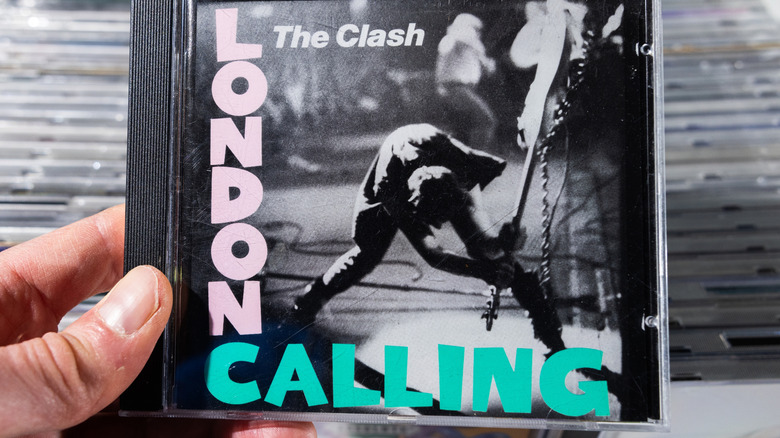
In the late 1970s, rock photographer Pennie Smith had landed so many images in U.K. music magazine "NME" that the Clash hired her to document their fall 1979 tour. She snapped Paul Simonon's guitar-smashing episode as it unfolded, and the reason why it's a bit blurry is because she was in motion — Smith couldn't steady her camera because she didn't want to collide with Simonon.
The bass guitar that Simonon busted up was one of two he used at the time: a thin-bodied backup and a high-quality Fender Precision Bass, the latter of which made famous when Simonon sensed the concert vibes were off. "I was sort of annoyed that the bouncers wouldn't let the audience stand up out of their chairs so that frustrated me to the point where I destroyed this bass guitar," he said in an interview with Fender.
One detail of this classic cover that may have gone unnoticed is the way "London" and "Calling" were placed down the side and across the bottom of the cover in pink and green, respectively. This was inspired by the text presentation on Elvis Presley's debut album from 1956. "When that Elvis record came out, rock 'n' roll was pretty dangerous. And I suppose when we brought out our record, it was pretty dangerous stuff too," Simonon told Classic Rock. His only regret about the photo? "I wish I'd lifted my face up a bit more," said Simonon.