

5 Of The Most Beautiful Voices In Folk Rock History
The classic albums that define folk rock present a myriad of salt-of-the-earth poets pondering philosophical pitfalls. With those gentle, reflective perspectives comes an equally diverse array of voices, most of them untrained in keeping with folk's earthy, commonfolk roots. As such, there's plenty of folk singers (the mighty Bob Dylan, admittedly, among them) whose songs resonate in spite of the nasally, raspy, guttural, or largely atonal voice that delivers them.
But on the tone spectrum between Anne Murray and Jandek there's a multitude of extraordinary folk voices. To that end, the word "beautiful" is a bit amorphous, as it can refer to everything from the melancholic pains of a woman challenging the constraints of traditional family values to the joyous warmth of a whimsical alt-rock balladeer. In those cases and more, we wanted to examine the most beautiful folk-rock voices and, in equal measure, interrogate the spectrum of vocal beauty in all its forms.
Iron & Wine
It's almost difficult to believe that Sam Beam, the man behind the Iron & Wine moniker, is putting enough support behind his whisper vocals to make them carry a tune, but carry it they do, time and again, in the most wistfully haunting fashion. On albums like the mysterious crossover hit "Our Endless Numbered Days," Beam's ghostly tones drift in and out of remarkably intricate acoustic guitar picking patterns, creating lush, delicate soundscapes that sound wafer-thin and as limitless as the wind in the same breath.
It's an appropriate affect for songs that explore the minute details of intimate relationships and emotional vulnerability. Combine that with his rapidly arpeggiating acoustic guitar accompaniment and you've got the recipe for a hypnotic, ethereal coffee shop hipster soundscape. Beam's voice has sat alongside a host of notable vocalists on various recordings including Jesca Hoop, Fiona Apple, and, most recently, his daughter Arden. Time and again, his evergreen whisper proves to be a social butterfly wherever he goes.
Malvina Reynolds
Though contemporary audiences will likely know her "Little Boxes" first and foremost as the theme song for Showtime's prestige dramedy "Weeds," Malvina Reynolds was an elder stateswoman of American folk music in more ways than one. Despite playing violin in her 20s, Reynolds did not begin her career as a folk songwriter until her late 40s, and that maturity gives her voice a maternal charm.
A piece like "Carolina Cotton Mill Song" finds Reynolds addressing a labor-related folk issue like so many of her protest song contemporaries. In this case, it's a withering condemnation of the indifference of textile mill owners to their workers becoming sick with byssinosis, the airway disease more commonly known as brown lung. In that context, Reynolds sings from the vantage of the housewife forced to watch as her husband and his fellow workers each succumb to the dreaded disease, all while admonishing the mill owners who sleep on the nice clean sheets and assorted linens that are the end result.
Folk music is as much about the everyman relatability of the singer as it is the melody itself, and Reynolds provides a unique and often overlooked component of that. Her matronly tone is awash in metered condescension that rivals Bob Dylan's acerbic disdain on "Dogs of War" for its bitter sarcasm. That forthright voice is all the more impactful when she uses it to articulate the struggles of the long-neglected wives and other womenfolk of the labor class. A truly unstoppable spirit, Reynolds continued writing and performing music until just days before her death at age 77 in 1978.
Colin Meloy
The Decemberists' Colin Meloy might not come to mind straightaway when asked to name "beautiful" folk voices. He sounds, to the uninitiated, like Green Day's Billy Joe Armstrong singing for a prog rock folk band with bluegrass instrumentation. (The fact that the Decemberists are a prog rock folk band with bluegrass instrumentation is neither here nor there.) Throughout bookish, cerebral albums like 2005's "Picaresque" and 2006's "The Crane Wife," Meloy guides us through the wildwoods of his imagination with a tone that sounds boyish and daydreamy.
Those latter descriptors point to why his voice registers as beautiful, especially in a folk context. Folk is a genre where lyrics are in the forefront, and thus the tonality of the vocalist has much or more to do with the atmosphere of the music as the wider instrumentation. For songs that come off as imaginative forays through children's book illustrations, you need a singer who sounds like a whimsical kid wandering through enchanted woods.
Joan Baez
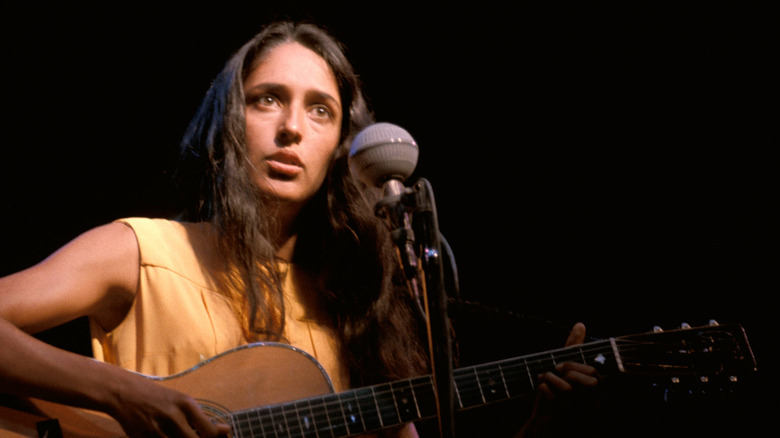
With a vibrato heavy diamond voice that never rusts, Joan Baez stands alongside Bob Dylan as one of the central figures in the mid-century folk boom. But she's equally important to women in rock as a whole. It's a voice imbued with all the world-weary pain of women's struggle, and it bears out in "There But for Fortune," "Jesse," and even her live concert take on "Amazing Grace." It's the plaintive, quiet yearning that began in the '60s, amplified roughly two decades later with Kate Bush, and now thrives in artists like Boygenius and the Last Dinner Party.
As Amy Schaffer of YouTube's Virgin Rock channel noted in her analysis of Baez' take on "It Ain't Me Babe," there's something deeply ironic about songs of heartache and detachment delivered in a soothing, comforting voice. But it's a haunting juxtaposition that has endured and influenced throughout the subsequent decades. Jarring though it may be, Joan Baez' repertoire is chock full of essential folk-rock hits for major life milestones.
Leonard Cohen
Leonard Cohen's voice speaks to the darker dimensions of the word "beautiful." His tones carry not the haunted whisp of Simon & Garfunkel or the shimmering punch of Crosby, Stills, Nash, and Young but instead a sonorous, deadpan gravitas. In his earlier years that presence emerged on 1967's "Songs of Leonard Cohen" as a brooding, introspective but always sincere young poet navigating the dark back alleys of modern love.
By 1988's "I'm Your Man," with its warmly flirtatious title cut, he was the elder lady killer — as confident as he was mysteriously sinister. But through it all, that rich lower register conveyed the romantically exploratory poetry that was Cohen's calling card. It wasn't a voice meant to summon angels, just one that could ward off demons. At the end of his career, with the final albums "You Want it Darker" and "Thanks for the Dance," his hoarse whisper was barely melodic at all, but it delivered his signature ruminations on life, love, and loss with no less infernal majesty.
Cohen himself attributed the gravelly vocal decline to years of substance use. He goes deeper than his warm, hospitable offstage nature would suggest, but he was, nevertheless, able to articulate dark, fascinating musings on the human experience until he finally bowed out once and for all on November 7, 2016.