

5 Garage Rock Bands That Earned Critical Acclaim Without Ever Finding The Fame They Deserved
Garage rock is a sprawling genre that has been ever present in the American music scene after its widespread emergence across America in the mid-1960s. As a direct result of Beatlemania and the British Invasion, and based on the DIY aesthetics of enthusiastic (but not necessarily musically adept) youths playing rock 'n' roll for fun, garage rock has had numerous revivals over the years. The early 2000s are of particular note, when revivalist acts such as the Strokes and the White Stripes achieved commercial and critical acclaim.
But it is also true that many garage rock bands — including its most important innovators — have failed to enjoy the widespread crossover success that they surely deserved. We looked back on gloriously riotous bands that, while being held in high esteem by the garage rock faithful, only gained a fraction of the name recognition of some bands, and never truly gained cult icon status. From proto-garage '60s legends the Sonics to the Boston institution the Lyres, here are five garage rockers who earned critical acclaim but never found the fame they deserved.
The Sonics
The story of garage rock can be said to have started with the Sonics. The Tacoma, Washington band formed in 1960, and took their inspiration from the rock 'n' roll pioneers of the 1950s, such as Chuck Berry. They performed in a fashion that would come to define garage rock as a whole, with a fast-paced, raw style and ragged production values that added to the recordings' DIY aesthetics.
The band's debut album, "Here Are the Sonics" arrived in 1965 to relatively little fanfare across the country and made no impact on the album charts. But tracks like "The Witch," "Strychnine," and "Psycho" became well-regarded garage rock classics, combining sour, fuzz-drenched guitars and Gerry Roslie's delirious vocal style over driving, off-the-rails rhythms.
The band's impact on later acts including the Stooges as well as many of the bands of the punk revolution of the late 1970s has been well-documented, and their debut album has been named the greatest garage rock album of all time by Paste magazine. But sadly they never gained the nationwide fame or sales numbers they deserved to match their profound influence on garage acts. Impressively, however, the Sonics continue to tour — albeit with a much-changed line-up — which is a testament to their multi-generational fanbase.
The Gories
The Gories were a rough-and-ready garage rock trio who, despite forming with basically no musical experience (aside from frontman and guitarist Mick Collins), folded several eclectic influences into their sound and that developed into a rootsy, punk-adjacent racket. Formed in Detroit, Michigan in 1986, the band recorded three albums and released a number of singles. However, they only enjoyed slow-burn success on the local scene and as a cult act among garage rock aficionados.
Their 1989 album "House Rockin'" and follow-up "I Know You Fine, But How You Doin'" — which was released in France in 1990 but only received a U.S. release in 1994 — saw the Gories incorporate classic blues influences from artists such as John Lee Hooker into their music. They also maintained a caustic, punk adjacent sonic palette thanks to a line-up featuring only a drummer and two guitars, with no bass guitar whatsoever.
It goes without saying that the Gories were a huge influence on fellow Detroiter Jack White, whose band the White Stripes also eschewed the need for a bass player. The Gories largely went on hiatus in the 2000s, but have reunited occasionally for infrequent shows, and a live album featuring them at their raw 1988 best was released in 2013.
The Mummies
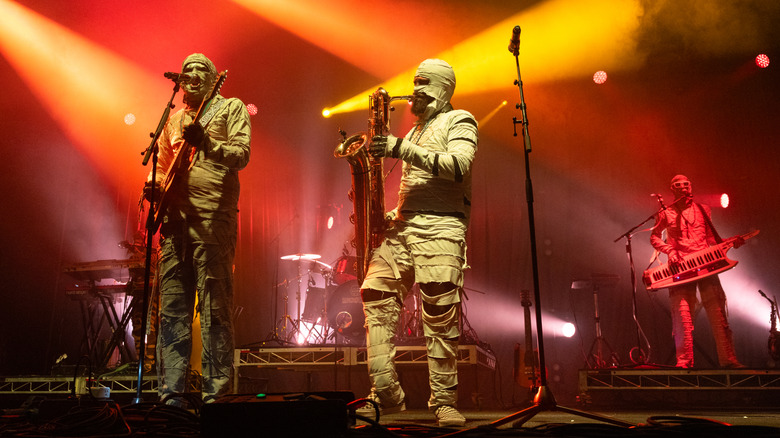
One of the most novel garage rock acts of the late 1980s and 1990s, the Mummies, looked exactly as their name implied. Wrapped in bandages onstage and almost entirely anonymous, the quartet raced through surf and early rock-inspired numbers led by their effervescent keyboard-smashing frontman.
Emerging from the San Francisco Bay Area, the band was playful but also acerbic, freely insulting audience members, dodging the music press, and being intentionally non-commercial in their approach to selling records (they notably avoided releasing their albums on CD, the major format of the era). The band first broke up before the release of their debut album, but reformed just a couple of years later and toured extensively in the mid-1990s.
But amid the chaos was an idealistic embrace of amateurism. The Mummies are credited with the creation of "budget rock," which purposefully aims for a lo-fi aesthetic created through the use of low-cost instruments and equipment and DIY recording techniques. Their approach was massively influential during the 1990s when the arrival of grunge saw a new appreciation of authenticity and keeping things real. Indeed, it is arguable that though the Mummies never found widespread fame in their own right, chances are they wouldn't have wanted it in the first place.
The Litter
Minneapolis psychedelic and garage rockers the Litter earned a small but devoted following in the late 1960s. They turned toward heavy, British Invasion-inspired sounds before imploding by the end of the decade. The group was made up of former members of two bands, the Tabs and the Victors, who came to the attention of producer Warren Kendrick. Kendrick wrote the Litter's debut single, "Action Woman," which has remained their most famous song.
Popular locally as well as in Chicago, the Litter unfortunately never had a nationwide hit nor achieved wider fame during their heyday. However, the inclusion of "Action Woman" on influential garage rock compilations such as the "Pebbles" series has helped the Litter maintain a long tail listenership down the years. This was especially true during garage rock revivals when younger listeners revisited the first generation of acts to see how the originators started it all off.
Lyres
Boston-based Lyres formed in 1979, with frontman Jeff Conolly putting the band together after the demise of his psychedelic surf rock combo DMZ. Lyres drew direct inspiration from the garage rock pioneers of the 1960s, combining covers and originals in incendiary sets that highlighted Conolly's exceptional vocal abilities and devotion to the fuzz and bombast of the bands who had inspired him.
The band's debut single, 1983's "I Want to Help You Ann," was initially a local favorite, and was placed on the Village Voice's end of year Pazz & Jop list as one of the year's best songs. Conolly's taut arrangement was complemented by the prominent, raw drumming that was typical of Lyres' discography. The tune has remained an underground classic, and has been frequently covered.
By this point, Lyres had already overhauled their line-up, and it would become a revolving door of musicians throughout its existence, with Conolly the only constant. Nevertheless, later tracks such as 1985's "She Pays the Rent" show Conolly remained loyal to the spirit of '60s garage rock. Lyres continued performing until his death in 2026.