

Forgotten American Bands That Chased The British Invasion — And Won Big On The Charts
In the mid-1960s, the Beatles led the British Invasion, a sound so commercially successful and artistically vital that many other bands tried to imitate it. Like the numerous forgotten British Invasion bands that once rivaled the Beatles in popularity, many U.S. bands rose and found brief success by adopting the Fab Four's playbook, sound, and look.
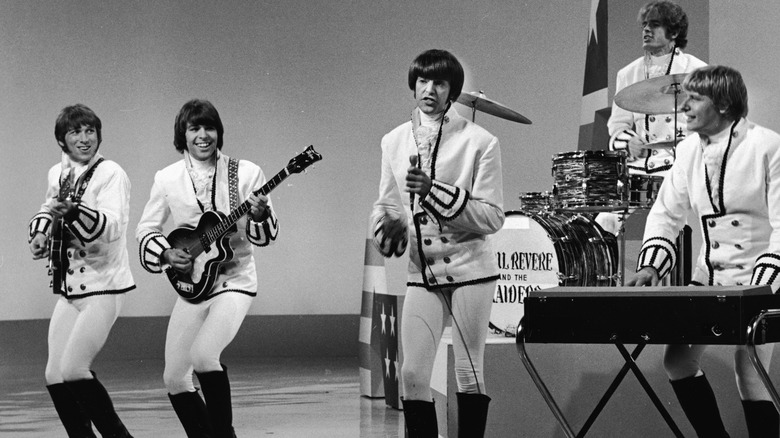
These groups, and some might say shamelessly, emulated the British Invasion ideal, as espoused and perfected by the Beatles. Their songs were catchy, hook-layered, tightly-structured, and often jangly guitar pop; the lyrics were often about the travails of young love, and the musicians tended to favor matching outfits. Following the formula worked. Gary Lewis and the Playboys, Paul Revere and the Raiders, the Buckinghams, the Knickerbockers, and the Association — more or less pretended to be British Invasion acts, and they all scored major hits alongside the Beatles.
Gary Lewis and the Playboys
One of the first and few rock stars with his name in the band who didn't stand at the front of the stage and play guitar, Gary Lewis sang lead for his band, the Playboys, from behind a drum kit. Put together by a Los Angeles-raised musician when he was a teenager, Gary Lewis and the Playboys delighted crowds with a regular performance gig at Disneyland in the summer of 1964. And thanks to some connections from the singing drummer's father — superstar comic actor Jerry Lewis — the group was in the studio with a record deal by the end of the year.
Among the first of the American Beatles bands to get going, Gary Lewis and the Playboys were a legitimate pop sensation all throughout 1965. They became mega-successful off their first single ever when "This Diamond Ring" rocketed to No. 1. Subsequent releases, "Count Me In," "Save Your Heart For Me," "Everybody Loves a Clown," and "She's Just My Style," all found a home in the Top 5. The band put out a dozen Top 40 singles by the summer of 1968, by which time younger music fans had moved on to other late-breaking forms of rock 'n' roll.
Paul Revere and the Raiders
Initially going by the Downbeats, pianist Paul Revere Dick teamed up with fellow Idaho musician Mark Lindsay. The group later became Paul Revere and the Raiders and adopted the colonial-themed costumes that would define its national image. They actually had one pre-Beatlemania hit, as the instrumental "Like, Long Hair" squeaked into the Top 40 in the spring of 1961. But after the Beatles broke out in the U.S. in 1964, Paul Revere and the Raiders tweaked their R&B sound to be more Beatles-esque, and they were nicely rewarded. Between late 1965 and mid-1969, the band notched around a dozen Top 40 hits, including smashes like "Kicks," "Hungry," "Good Thing," and "Him or Me – What's It Gonna Be?"
After the Beatles changed their sound to something more experimental and harder to copy, Beatles soundalikes had to adapt. Paul Revere and the Raiders dropped the colonial schtick, including using the name "Paul Revere" in its title, and the newly christened Raiders adopted a more straightforward, slightly harder rock 'n' roll sound. In 1971, the band scored its only No. 1 hit with "Indian Reservation (The Lament of the Cherokee Reservation Indian)," a popular song that aged poorly.
The Knickerbockers
With airtight harmonies coupled with ringing and just slightly buzzy guitars, the Knickerbockers could've been mistaken for the Beatles. Despite the New York associations of their name, the band took its moniker from Knickerbocker Road near its hometown of Bergenfield, New Jersey. Brothers Beau and John Charles formed the group in 1962, well before the Beatles became household names in the U.S.
After some lineup changes, and solidifying their sound, especially in the wake of the influence of the many popular British bands infiltrating the American radio airwaves, the Knickerbockers released a slew of singles, appeared on TV, and tried to launch a dance craze (also a hallmark of '60s music), with the album "Jerk & Twine Time." Toward the end of 1965, the Knickerbockers broke through nationally with the single "Lies," owing in part to Buddy Randell's raspy singing comparable to that of the Beatles' John Lennon. Only once did the Knickerbockers hit the Top 40, with "Lies" reaching No. 20 in early 1966. After many more musicians came and went in the Knickerbockers, the group broke up in 1971.
The Buckinghams
In 1965, a five-member Chicago group called the Pulsations took shape, and soon after became a house band on the local performance TV series "All Time Hits Show." The show's producers encouraged the Pulsations to adopt a British-sounding name that could capitalize on the British Invasion. A station security guard suggested the Buckinghams, which also appealed to the group because of Chicago's Buckingham Fountain. After quickly building up a regional following, the Buckinghams' single "I'll Go Crazy" became their first to hit the charts.
Then the Buckinghams went all the way to No. 1, with "Kind of a Drag" securing the top position on the Hot 100 for two weeks in January 1967. The Buckinghams racked up four more Top 20 hits, like "Don't You Care," "Mercy, Mercy, Mercy," "Hey Baby (They're Playing Our Song)," and "Susan," and then they never saw the upper echelon of the Hot 100 again. After breaking up in 1970, members Dennis Tufano and Carl Giammarese, managed by bandmate Jon Jon Poulos, had a minor hit as a duo with 1973's "Music Everywhere."
The Association
Terry Kirkman and Jules Gary Alexander first teamed up in the 13-man folk-rock group The Men, reduced to six after a band squabble. The remainders regrouped as The Association, and became a Southern California sensation with frequent performances at area nightclubs and regional releases. Signed to Warner Bros.-aligned Valiant Records, their records were finally heard around the U.S. Their first big hit in 1966 was controversial — rumors persisted that the jubilant "Along Comes Mary" was about marijuana. Nevertheless, it floated into the Top 10, kicking off a two-year period of serious popularity for The Association.
After "Along Comes Mary," the band ascended to No. 1 with the ballad "Cherish," and returned to the top spot in the following year with the shiny "Windy." Follow-up single "Never My Love" nearly topped the charts but stalled at No. 2. The group's seventh and final Top 40 hit, "Time for Livin'," dropped to an increasingly apathetic public in 1968.