

The 5 Best Supergroups That Came Out Of The '60s
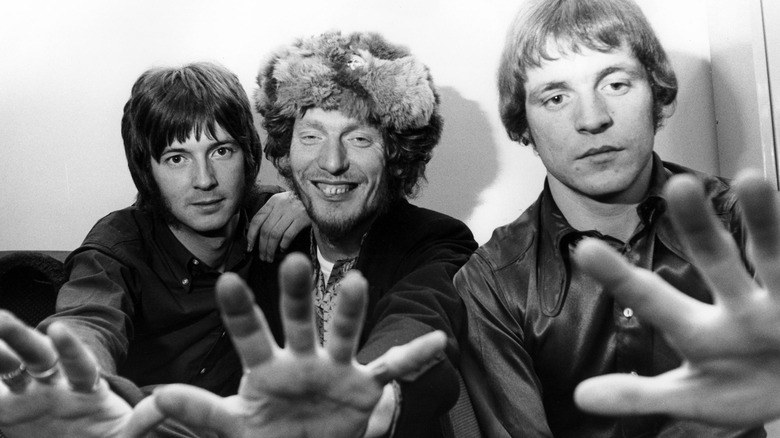
There's just something thrilling about witnessing successful musicians join forces. After all, if one incredibly talented solo act or band can make a successful record, then combining the crème de la crème of musical contemporaries should be a commercial and critical success, right? That's the appeal of the supergroup, a musical collaboration in which already-established performers pool their considerable talents to literally create beautiful music together. The 1960s — the decade widely considered to herald the birth of the modern supergroup — were particularly interesting in this regard, as those years saw many talented musicians come together to blend their distinctive styles.
With that said, bringing together a collection of accomplished musicians doesn't automatically guarantee exceptional results. Some achieved remarkable success, while others barely had enough time together to establish a proper discography. In some cases, the members couldn't even get along. Nevertheless, their collective contributions deserve recognition — especially the supergroups who released career- and even genre-defining work.
In putting together this list of standout '60s supergroups, we considered the members' established reputations, their musical accomplishments, and their lasting influence. It's worth noting that while all of these supergroups were formed during that decade, some lasted far longer than others; in fact, one of these bands was one of the longest-running supergroups of all time. Lastly, while some of these acts had shockingly brief runs, all of them certainly made their time together count.
Cream
If there's one band that arguably established the blueprint for rock legends coming together, it's Cream, the British power trio formed in 1966 by guitarist Eric Clapton, bassist Jack Bruce, and drummer Ginger Baker. Clapton had already established his musical chops with the Yardbirds and John Mayall & the Bluesbreakers, while Bruce and Baker had played together in blues band the Graham Bond Organization (GBO).
Cream released their debut album, "Fresh Cream," in 1966. The album that skyrocketed them into the mainstream, "Disraeli Gears," came out a year later; it featured "Sunshine of Your Love," a song that would become an unprecedented hit not only for the band, but also Atlantic Records, their parent label. 1968's "Wheels of Fire" was a double album that combined studio material with recordings of the band's live performances. Between Clapton's unparalleled guitar techniques, Bruce's unmistakable vocals, and Baker's spotlight-stealing drumming, Cream firmly established their reputation as hard rock royalty.
Unfortunately, Bruce and Baker's volatile working relationship during their GBO days turned out to be an early indication of the issues that would lead Cream to break up. Despite Cream's achievements, ego-fueled internal disagreements rapidly became impossible to ignore, and the supergroup called it quits in 1968. Cream's farewell concert took place at London's Royal Albert Hall that November, with the post-breakup album "Goodbye" following in 1969. Ultimately, Cream's legacy proved considerably more enduring than their short existence, earning the trio induction into the Rock & Roll Hall of Fame in 1993. Clapton, Bruce, and Baker even briefly reunited for four shows in 2005.
The Soul Clan
The '60s supergroup phenomenon wasn't limited to rock musicians, as the Soul Clan showed with its lineup of soul singers. Conceptualized in 1966, the all-star project initially involved Solomon Burke, Don Covay, Wilson Pickett, Otis Redding, and Joe Tex, R&B sensations who were working directly or indirectly with Atlantic Records. Speaking about the reason behind the supergroup's formation, Burke described the Soul Clan as an effort to "interlock [themselves] as a group, to express to the younger people how strong we should be and to help one another, work with one another and support one another" (via Rhino Entertainment).
However, the planned lineup underwent some significant changes. After the tragic death of Redding in a December 1967 plane crash and Pickett's eventual withdrawal, Arthur Conley and Ben E. King joined the ensemble. The quintet recorded "Soul Meeting," backed with "That's How It Feels," in 1968. Although "Soul Meeting" achieved a moderate level of success, it didn't become a major commercial breakthrough. An album came out in 1969; sadly, it wasn't the full-fledged collaborative masterpiece their fans might have anticipated, as it largely featured previously released solo material alongside "Soul Meeting" and "That's How It Feels."
Despite having no shortage of talent, the Soul Clan soon disbanded, allegedly due to lack of support from their label. However, they reunited for a New York performance in 1981 (with Pickett replacing Conley, who had changed his name and permanently moved to Europe). Considering how this illustrious lineup created such little original material, the Soul Clan is perhaps one of soul music's greatest missed opportunities.
Blind Faith
Most people who have heard of Blind Faith probably think about it as Eric Clapton's supergroup that vanished in a flash. Formed in 1969, the British supergroup brought together Cream guitarist Clapton and drummer Ginger Baker, Traffic frontman-keyboardist Steve Winwood, and Family bassist Ric Grech. The seeds of this collaboration were planted the previous year when Clapton, still fresh from Cream's dissolution, played a few sessions with Winwood, who at the time was going through a similarly rough band breakup. Baker, who was present for some of those sessions, was part of the initial lineup of Blind Faith announced in a February 1969 press release, with Grech completing the quartet three months later.
Blind Faith made their public debut at London's Hyde Park in June 1969, to the delight of over 100,000 fans. Their self-titled album, recorded around that time and released in August, contained just six songs, including Winwood's "Can't Find My Way Home" and Clapton's "Presence of the Lord." Despite its modest track count, "Blind Faith" reached the top spot on the Billboard 200 chart, hanging on for two weeks. As fate would have it, this ended up being the supergroup's only studio album, although it was remastered and re-released in 2001 with a few additional tracks.
Unfortunately, after touring in Scandinavia and the United States, Blind Faith underwent a crisis of faith. Clapton become less enthusiastic about the supergroup and increasingly annoyed by Baker's brashness, and the other two members were essentially caught in between. By October 1969, Blind Faith was finished, with each of its members continuing their respective musical pursuits elsewhere.
Crosby, Stills, Nash & Young
Bringing together established musicians is impressive enough, but Crosby, Stills, Nash & Young (CSNY) demonstrated just how remarkable the results could be when four gifted songwriters shared the same stage. The group traces its roots to 1968, when the Byrds' David Crosby, Buffalo Springfield's Stephen Stills, and the Hollies' Graham Nash — all of whom had either left or felt severely dissatisfied with their respective bands — began collaborating. Their debut album, "Crosby, Stills & Nash," was released in 1969, a certified commercial success that even won them a Grammy.
Neil Young, another Buffalo Springfield alumnus, completed the foursome that would become one of the best folk rock supergroups of the '70s. The expanded lineup made its live debut in August 1969; the very next day, they played at the now-legendary Woodstock Festival. In March 1970, CSNY released "Deja Vu," which topped the Billboard 200 albums chart and introduced their unique brand of nostalgic, outspoken, and socially relevant music to a wider audience. A few months later, the supergroup released the single "Ohio," written by Young following the Kent State shootings; the song, which particularly resonated with politically conscious listeners, climbed up to the 14th spot on the Billboard Hot 100.
Unfortunately, their incredible musical chemistry didn't translate into behind-the-scenes harmony. Clashing expectations, differing creative desires, and contrasting working styles caused tensions to boil over within the supergroup, prompting them to split up and reunite multiple times within their nearly half-century-long run before calling it quits for good in 2016.
Humble Pie
In 1969, the British rock supergroup Humble Pie united former Small Faces singer and guitarist Steve Marriott, the Herd's Peter Frampton, Spooky Tooth bassist Greg Ridley, and Apostolic Intervention drummer Jerry Shirley. Marriott's departure from the Small Faces in 1968 became the catalyst for Humble Pie, with the singer co-founding the new project alongside Frampton. Having outgrown their teenage rock roots, the two, alongside Ridley and Shirley, figured it was time for the world to see them in a more serious light.
Humble Pie wasted little time establishing themselves, releasing two albums, "As Safe as Yesterday Is" and "Town And Country," in 1969. The supergroup's first significant commercial breakthrough was their hit "Natural Born Bugie," which reached the fourth spot on the U.K. Singles Chart. Unfortunately, due in no small part to rising tensions with Marriott, Frampton quit in 1971 to pursue his solo career (which culminated in him making one of the best live albums ever a few years later). Colosseum guitarist Dave "Clem" Clempson took Frampton's place; the revised lineup released "Smokin'" in 1972, which featured one of their best-known tracks, "30 Days in the Hole."
Over the next couple of years, Humble Pie continued to perform and release albums. In 1975, after a "Goodbye Pie" farewell tour, the supergroup formally disbanded. Still, there were subsequent attempts to reform the band (with a different roster each time), even after Marriott's tragic demise in a 1991 house fire.