

Rock Bands That Released Back-To-Back Masterpiece Albums
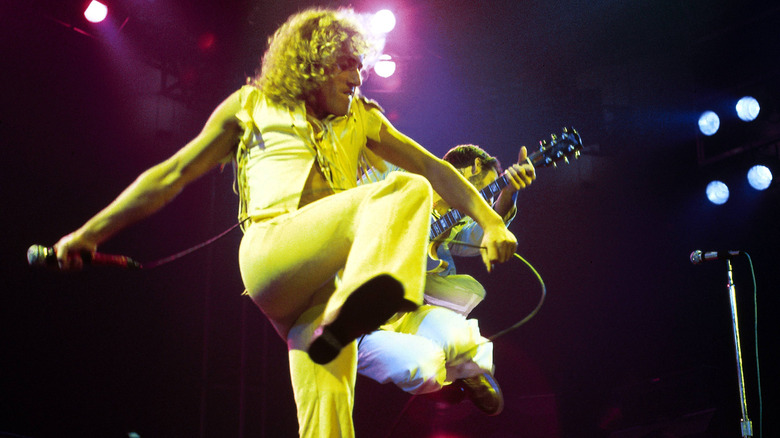
In fields of creative endeavor, lightning can, in fact, strike twice and often in rapid succession. Where some bands struggle to replicate the momentum and majesty of a single massive hit album, some others manage to stave off the law of diminishing returns for at least another go-around. In rare cases, this can result in a sort of career-defining, multi-album meta-opus that showcases a wider insight into the artist's dynamic range.
In this piece, we're looking at those bands and artists that succeeded in releasing out-of-the-park home runs twice in a row. To be clear, we aren't talking about two album sets that were the outgrowth of a single recording process. For example, Guns N' Roses' "Use Your Illusion" parts 1 and 2 or Metallica's "Load" and "Reload" don't make the cut. Whether it's a punk band on a decade-long (and fruitful) hunt for mainstream accessibility or a young virtuoso using Ozzy's solo albums to throw down a shred metal gauntlet, here are five bands that released absolute masterpieces back-to-back.
The Offspring -- 'Smash' (1994) and 'Ixnay on the Hombre' (1997)
The Offspring occupy a curious halfway point in the mainstream evolution of punk rock: Their refined speed metal precision and catchy songwriting leave them entirely too polished for punk purists, while their darker, sarcastic tone and aggressive delivery keep them removed from the pop-punk stylings of Green Day and Blink-182. While their mainstream impact would peak with 1998's "Americana" (which reached No. 2 on the Billboard 200), there is a fascinating musical evolution charted across the two preceding albums, 1994's "Smash" and 1997's "Ixnay on the Hombre."
Both albums were also among the top 10 hits on the Billboard 200, thus tracking a major arc of breakout success for the crossover punk pioneers throughout the '90s. The group's signature sense of humor is apparent throughout — an ironic easy-listening DJ intros "Smash" while "Ixnay on the Hombre" opens with a witheringly sarcastic parental advisory disclaimer – and the subtle textures of Latin and Ska music that would give the band its unique flair are apparent throughout. But most of all, both albums manage to be an unrelenting journey through headbanging and stellar songcraft.
There's also evidence of an intentional conceptual continuity between the two recordings when the "Smash" album fades out with the intro to "Change the World" off the follow-up LP. Both albums are a quantum leap forward from the impudent skater punk heard on the preceding albums (1989's self-titled LP and 1992's "Ignition") while not fully embracing the pop ethos heard on "Americana." As such, they are a fascinating — though always mosh-pit-friendly — timeline in the evolution of one of punk's most accomplished bands.
Tom Waits -- 'Alice' (2002) and 'Blood Money' (2002)
Tom Waits has made a lengthy and prolific career out of writing soundtracks for scenes from the perpetual Tennessee Williams play in his mind. To that end, the 2002 releases of "Alice" and "Blood Money" are a one-two punch from the master of tin pan alley noir, and just rock enough to make this rundown. His songs blend menace and sentimentality into a morbid, surrealistic world all their own, and these two albums capture a particularly fruitful creative period in his long and eccentric career.
What makes the pairing of these two albums work is that they form a stylistic yin-yang in terms of Waits' eerie, back-alley street urchin persona. Waits' sound in "Alice" conjures the image of a homeless vagabond recalling bittersweet memories of better days beneath a flickering streetlamp as winter closes in, and in "Blood Money," he's like a ghoulish imp who guides listeners on a demented carnival tour through southern gothic hellscapes. For example, "Alice" leans on the former persona with tracks like the torch-song title cut and the morbidly melancholic "A Flower's Grave" while only occasionally hinting at the madman persona. "Blood Money" takes the opposite approach with dark tales of a sinister underworld only occasionally intercut with warm regards.
"Blood Money" is a concept album loosely built around the play "Woyzeck" by German poet Georg Büchner. A dark tale of betrayal, mental decline, and murder, the story's themes can reasonably be read as informing the album's harsher themes. That makes the contrast with the melancholic and vulnerable concepts in "Alice" all the more apparent. Taken as a whole, they offer a fascinating journey into the creative mind of the man who reportedly once sent an ominous letter to filmmaker David Lynch.
Ozzy Osbourne -- 'Blizzard of Ozz' (1980) and 'Diary of a Madman' (1981)
The first two Ozzy Osbourne solo albums (1980's "Blizzard of Ozz" and 1981's "Diary of a Madman") did more than just resurrect the iconic singer's moribund post-Black Sabbath Career; they also brought the music world closer to the guitar stylings of Randy Rhoads. Though the wunderkind innovator only appeared on two Ozzy albums (and the lesser-known first two Quiet Riot albums before that), his neo-classical phrasing and blistering speed placed him alongside Eddie Van Halen and Yngwie Malmsteen as one of the quintessential innovators of '80s heavy metal guitar.
As such, the first two Ozzy solo albums, replete though they are with extraordinary performances by the legendary frontman and top-notch songcraft, are united by the common thread of Rhoads' extraordinary playing. Solos like the hammer-on heavy "Crazy Train" off "Blizzard of Ozz" showcase blistering technique, but it's when those hand-blurring shred runs show up on more epic fare like "Mr. Crowley" that we see Rhoads' techniques revealing an unexpected degree of soulfulness and compositional prowess — all without abandoning the kind of dazzling runs that make aspiring young metal guitarists salivate.
That superhuman mastery continues on Ozzy's sophomore solo album, "Diary of a Madman," where Rhoads' fleet-fingered fretwork continues to evolve at a disarming rate. But throughout the record, there's an added emphasis on his finger-style classical guitar work, and the most satisfying moments come when the two styles blend, as on the sentimental but not less haunting title cut. Sadly, that back-to-back guitar gold that was Rhoads' groundbreaking axe work was cut short. Randy Rhoads died tragically in an airplane crash at just 25 years old. At the time of his passing, he'd recently informed Ozzy of his intention to step back from touring and pursue a master's degree in classical music.
Steely Dan -- 'Aja' (1977) and 'Gaucho' (1980)
Although just about any two albums in the Dan's storied career could qualify as back-to-back masterpieces, there's an undeniable, career-defining magic that happened between "Aja" and "Gaucho." Throughout the 1970s, Steely Dan masterminds Walter Becker and Donald Fagen had gradually transitioned away from a fixed band lineup and towards a rotating roster of studio players, turning countless session musicians into legends in the process. That unrelenting commitment to their own standards of perfection had its own toxic undercurrents, but it yielded extraordinary results.
1977's "Aja," arguably the group's magnum opus, is so immaculately produced that it's used to this day to test audio equipment, making it one of the essentials every '70s diehard needs in their listening room. That fiendishly intricate recording process makes for an environment where players like guitarist Larry Carlton and saxophonist Wayne Shorter are able to turn in career-defining performances. That, coupled with cerebral songcraft deeply rooted in jazz harmony, makes "Aja" the apex of the Steely Dan catalogue. Mix in Fagen's particularly withering lyrics and you've got a blend that goes down better than a big black cow at Rudy's.
Those sarcastically melancholic journeys into the world of faded beatnik hipsters continued unabated on 1980's "Gaucho" along with the perpetual pursuit of polyphonic purity. The result is an album that carries on in the tradition of "Aja" to the point that the two records sound like a single LP when played sequentially. Small wonder Becker and Fagen needed a 20-year respite before their 2000 comeback, "Two Against Nature."
The Who -- 'Tommy' (1969) & 'Who's Next' (1971)
It only stands to reason that The Who, a band whose legacy stands as a mighty fountainhead from which all the subsequent decades of punk, hard rock, progressive rock, and heavy metal proceed, would have a set of back-to-back masterpieces in them. As such, the British behemoth closed out the '60s with 1969's concept album "Tommy" – the project that many regard as the first ever "rock opera"– and opened the new decade strong with "Who's Next," in 1971, an album containing some of their strongest and most enduring material.
"Tommy" came as groups like King Crimson and Frank Zappa and the Mothers were evolving the psychedelic rock of the '60s into the sprawling modernist symphonies of progressive rock that would dominate the '70s. Those albums are top-selling classics in their own right, but primarily the sort of thing that gets picked apart and analyzed by music students, not the FM radio masses. That's where "Tommy" delivers a critical contribution: Its progressive rock elements – orchestral stylings on rock instrumentation, atypical song structures, and a plot-driven narrative throughline – are tempered with heavy power chords, thundering drums, and anthemic vocals that remind us that prog rock must rock.
"Who's Next" flips that script: Straight-ahead rock songs are protracted with proggier elements. The album's musical statement is that radio-friendly rockers (and the album quickly became a mainstay of rock radio) could benefit from sonic experimentation and instrumental virtuosity while sacrificing none of the listener-friendly appeal. Songs like "Baba O'Riley" with its oscillating synthesizer or the virtuosic rush of the drums on "Bargain" showcase a band ready to court mainstream audiences and experimentation enthusiasts in equal measure. Throw in a ballad like "Behind Blue Eyes," and you've got the back half of a two-album masterpiece set.