

The 5 Best Albums By The Monkees, Ranked
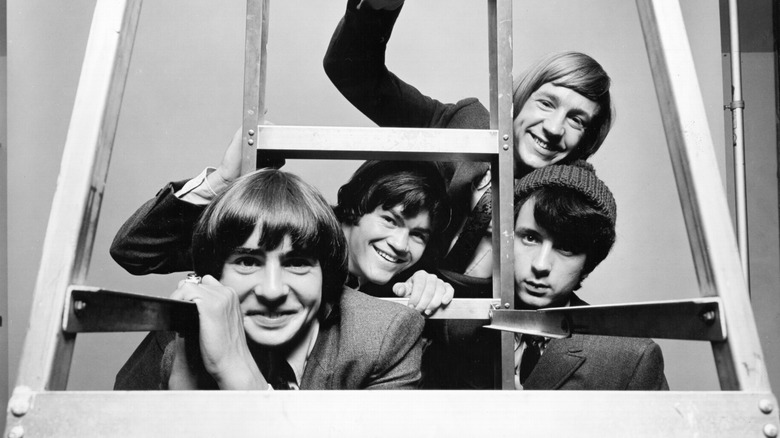
Micky Dolenz, Peter Tork, Davy Jones, and Mike Nesmith were among the 437 artists who auditioned for Bob Rafelson's show, "The Monkees," a series and band that would be surprisingly revolutionary. From the advent of the modern music video to developing an audition process that inspired the likes of One Direction, the American made-for-TV band had an incredible rollout of successful albums — four of them went No. 1 in 1967 alone.
In order to rank the five best albums of their catalog, it's important to create some distinctions. The group has several best selling compilation albums, but only 11 official LPs. For that reason, compilations, EPs, and official soundtracks (like that of their 1968 film, "Head") won't be included. This list will take into consideration the critical and audience reception of their official LPs, and ordered according to factors such as number of stand-out hits, as well as my personal preference.
It's safe to say that although their rise to stardom may have been a complete accident, the Monkees managed to make the most of their chance encounter and change the industry itself. A band with many strange circumstances surrounding them, their five best albums are nothing short of pop perfection.
5. Instant Replay (1969)
When the Monkees released their 1969 album, "Instant Replay," they were short one of the original members, Peter Tork. The television show had already been canceled for a year, and much of the glue and the foundation for the band was starting to deteriorate. All these factors considered, "Instant Replay" doesn't seem to reflect this reality at all.
"Through the Looking Glass" is quite the strong start to an album, embracing the sunshine pop sound that the band was heralded for, all while incorporating some of the more surrealist themes of the decade. "Tear Drop City" peaked at No. 56 on the Billboard Hot 100, and "You and I" has quite the powerful guitar solo by Neil Young. An emotional collection of songs, unafraid to teeter into the stranger and more experimental sides of pop music, the album is easily one of the band's best.
However, for all its strengths, "Instant Replay" doesn't do much to truly set itself apart. A bit derivative at times, with very Beatles-adjacent vocal arrangements and instrumentals, none of the tracks truly stay with me after a listen. A cohesive collection of trademark Monkees sounds, it feels more like an atmosphere than an experience.
4. Headquarters (1967)
The Monkees' 1967 album, "Headquarters," was their first as an independent band free from the musical supervisor of the program, Don Kirschner. As legitimizing as it was liberating, they managed to showcase how well they could truly function as an artistic force of their own.
As happy-go-lucky as the group's music can sometimes sound, they managed to find emotional edge with some standout tracks. "Shades of Gray" perfectly encapsulates the melancholy and indifference that the title suggests, "Zilch" features the four singers in a round without instrumentals, and "Forget That Girl" has some excellent moody guitars and percussion. "For Pete's Sake" preaches love and freedom, an especially poignant message given how the band was being investigated by the FBI for their anti-Vietnam War sentiment. All things considered, the lyrics, musical composition, and feelings evoked with this album erased any doubt that they were mere mouthpieces.
Although I find this album incredibly interesting and dynamic, none of its songs managed to break into the Billboard Hot 100 charts. It does make much more of a personal impact than "Instant Replay," but doesn't quite have the same sense of longevity that their very best albums do. Its spot in the Monkees' Top 5 has certainly been earned.
3. The Monkees (1966)
As far as debuts go, the Monkees' self titled 1966 album is certainly a smashing entrance onto the music scene. Opening with their show's theme song, it's clear that the program is front and center on the record.
Diving into the following tracks, I can only imagine how exciting it must have been to hear these tunes in the series itself. "Saturday's Child" and its punchy guitar riffs, "This Just Doesn't Seem to Be My Day" with its fun dynamism, and the twinkling flourishes in "I'll Be True to You" would enchant just about any audience. While the Monkees themselves weren't responsible for the instrumentals, their incredible vocal performances only enhance the production team's impressive work on the record. "Last Train to Clarksville" became their first No. 1 hit on the Billboard charts, showcasing how they had the makings of a truly industry-defining group.
Quite a way to step out on the scene, critics have even considered "The Monkees" one of the best albums of 1966. While true to some, I find that it scarcely outcompetes my top two picks for the band's best. It is a masterful display of the talent that the group has to work with — as well as the skilled musicians NBC had in their arsenal, undoubtedly earning a high ranking among the band's best.
2. Pisces, Aquarius, Capricorn & Jones Ltd. (1967)
The Monkees' 1967 album, "Pisces, Aquarius, Capricorn & Jones Ltd.," is often ranked as a fan favorite for the group's best. It's not hard to see why, as it cranked their newly liberated experimentation from "Headquarters" up several notches.
"Peter Percival Patterson's Pet Pig Porky" is hilarious, intersplicing some perfectly punctuated alliteration in between two guitar heavy tracks. "Star Collector" features some serious synths, bouncing from futuristic sounds to classic '60s organs. There is a clear sense of playfulness at hand — all while bringing out their soulful side with tracks such as "Don't Call On Me." The lyricism is also amazing, best exemplified in my personal favorite off the album: "The Door Into Summer." A fun tune with scathing lyrics about the true cost of wealth ("With his travelogues of 'maybe next year' places / As a trade-in for a name upon the door / And he pays for it with years he cannot buy back with his tears"), the Monkees knew how to wield the power and access they had been given.
This album also had two stand out hits on the Billboard Hot 100: "Pleasant Valley Sunday" at No. 3, and "Words" at No. 11. It has the highest combined critic and user score according to Album of the Year, making it a pretty clear candidate for one of the Monkees' all time best.
1. More of the Monkees (1967)
1967's "More of the Monkees" is truly where my personal bias comes out. That's not to say that this choice isn't backed by numbers (it boasts the second highest combined critic and user score on AOTY), but it truly feels like the Monkees had absolutely mastered their formula for hit making.
"Mary, Mary" and "Hold On Girl" sound incredibly modern to me, with the intros and some of the instrumentals reminding me of the Strokes or even certain Radiohead riffs. Of course, they are immediately followed up with the classic Monkees vocals and '60s arrangement, but it feels incredibly bright and innovative. The same could be said for "The Day We Fall In Love," which is a beautifully instrumentalized spoken poem. Of course, the glaring star at the bottom of the track list is "I'm a Believer," their best charting song. It ranked No. 1 on the Billboard Hot 100, staying at peak for seven consecutive weeks.
My favorite (and the reason why this album has got to be No. 1 for me) is "(I'm Not Your) Steppin' Stone." Besides just being incredibly catchy and cool, I adore the vocal trajectories across the track. They seamlessly transition from snarling, to smooth, to sing-songy within a matter of seconds. The organ is also just so emblematic of the era, making "More of the Monkees" an album best embodies the band's gripping legacy.