

The Gospel Guitarist Who Helped Invent Rock 'N' Roll Before It Had A Name
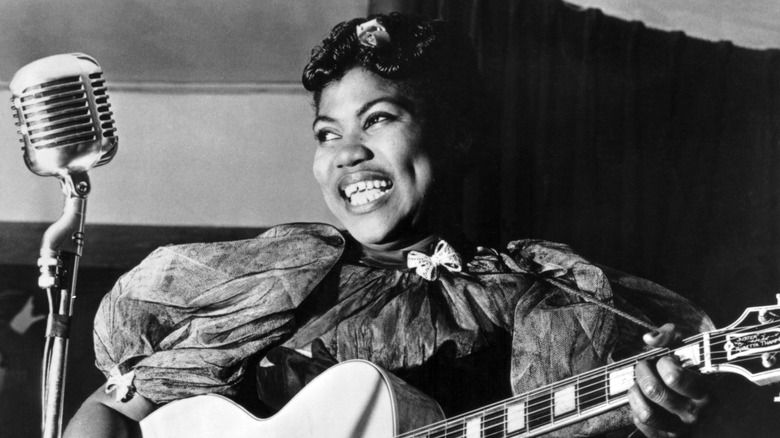
Rock 'n' roll has many standout female artists, but it's still a male-dominated genre, which is why it's important to remember that since it's very inception, a woman, Sister Rosetta Tharpe, had a major hand in the creation of rock. Though she started playing guitar alongside her mandolin-playing mother at just 6 years old, performing at churches and other locations as an evangelist, Tharpe applied her formidable electric guitar skills to both gospel and secular music. She influenced the male artists many people associate with being the pioneers of rock 'n' roll, such as Chuck Berry, Little Richard, Elvis Presley, and Jerry Lee Lewis.
Born in Arkansas in 1915, Rosie Etta Atkins was raised on music. The Godmother of Rock 'n' Roll, as she was later dubbed, moved with her mother to Chicago, where they joined the 40th Street Church of God in Christ, and it was there that little Rosie was embraced and encouraged to develop her talent as a pianist, a singer, and a guitarist — even though the latter instrument was associated with men. Still, no one seemed to try to dissuade the budding musician, and her relationship to music and her guitars outlasted any she had with husbands or partners.
Sister Rosetta Tharpe's breakthrough and biggest hit
As a teen, Rosie Etta Atkins became Sister Rosetta Tharpe — the "Sister" part is a common designation for members of a congregation; the Tharpe surname came from a marriage when she was 19 years old. The marriage didn't last, but she kept the name, even though she had two more husbands during her life, as well as female romantic partners. All the while, she maintained her career as a working musician, slowly gravitating from traditional gospel to incorporating more "hymn-swinging" sounds, according to biographer Gayle Wald (via the Rock & Roll Hall of Fame).
Tharpe caught the attention of wider audiences in 1938 when she performed at Harlem's Cotton Club, playing traditional gospel music from Black churches with a kind of "emotional expressiveness," as Wald explained, which stemmed from fervent worship. White audiences heard it, and it struck a chord, making her a draw for an integrated audience, even as Jim Crow laws prohibited Tharpe from staying at many hotels or going into restaurants while she toured. Tharpe continued to perform and release albums throughout the '40s and '50s, garnering her biggest hit, "Strange Things Happening Every Day," in 1944, which went to No. 2 on what Billboard called the "race" chart. Today, it's known as the R&B chart.
Sister Rosetta Tharpe influenced future rock icons
By 1954, popular music was changing. Sister Rosetta Tharpe was getting older and needed a win. She released an album of secular songs, but her gospel fans weren't having it, and it didn't connect with the teen market — not the masses, anyway. But it connected with some. In 1956, four young, ambitious musicians used Tharpe's music as warm-up practice at Sun Records, each of them looking to expand the limits of commercial music. According to PBS, those musicians were Johnny Cash, Elvis Presley, Carl Perkins, and Jerry Lee Lewis.
In 1957, as those artists rose to fame, Tharpe told the Daily Mirror, "All this new stuff they call rock & roll, why I've been playing that for years now" (via the Rock & Roll Hall of Fame). Though she fell out of popularity in the late '50s and 1960s, she was embraced in the U.K. and Europe and toured heavily there with acts like Muddy Waters, pianist Otis Spann, and the Diz Disley band with Ginger Baker on drums. These traveling caravan tours of blues, gospel, and folk artists attracted plenty of British youth, including future rock icons such as Jeff Beck, Keith Richards, Jimmy Page, Paul McCartney, and Eric Clapton, and in that way, Tharpe further influenced the classic rock 'n' roll that we know and love. The history-making guitarist died in 1973, but she was inducted into the Rock & Roll Hall of Fame for her influence on rock in 2018.