

The Best Live Albums Of The '60s
The '60s are often remembered as the era in which recorded music took the shape that would come to define it to this day. It was the decade that gave rise to modern rock, modern pop, modern country, modern R&B, and pretty much every other genre canon defined by the word "modern." But it wasn't only studio recordings that flourished in the 1960s; it was also a phenomenal decade for live music.
The momentousness of landmark live events like the Beatles' appearance on "The Ed Sullivan Show," Bob Dylan's electric switch-up at Newport Folk, and era-defining festivals like Woodstock and Monterey Pop goes without saying. But the bevy of great live music offered up by the '60s extends far beyond the big iconic mileposts. It was a decade in which energy and excitement about the possibilities of music seemed to course through the work of every band and every singer, and made virtually every stage show — whether an improvisational rock jam, a voice-and-guitar folk solo, or a 25-piece jazz concerto — feel like a surge towards an untapped future.
A vast number of great live albums were recorded in this period, including classics like "Live/Dead" by The Grateful Dead, "Kick Out the Jams" by MC5, and "Sunday at the Village Vanguard" by the Bill Evans Trio, any of which could just as well be on this list. The five you'll find below are just a few of the era-defining, lightning-in-a-bottle '60s concert experiences that have thankfully been preserved for posterity on polyvinyl chloride; what you can be sure of is that they're all masterpieces.
Nina Simone in Concert — Nina Simone
Nobody could hold court quite like Nina Simone. Born Eunice Kathleen Waymon, the colossal singer-songwriter, pianist, and activist made live shows a central element of her protean artistry, using it to reframe the mystique of her studio work as a brief, magical flutter of communion between herself and her audience. Any given era of Simone's career was punctuated by its share of great live performances, but her greatest ever, fittingly, was the one that inaugurated her apogee: 1964's "Nina Simone in Concert," the album that marked the beginning of her virtuous, full-fledged, unapologetically political years at Philips Records.
Assembled from three 1964 concerts at Carnegie Hall, "Nina Simone in Concert" finds Miss Simone combining three cuts from her debut album, 1959's "Little Girl Blue," with four songs handpicked to channel her newfound dedication to the U.S. Civil Rights movement. In between renditions of "I Loves You Porgy," "Plain Gold Ring," and "Don't Smoke in Bed" that feel typically overpowering in their purposeful simplicity, Simone turns "Pirate Jenny" from "The Threepenny Opera" into a rallying cry for exploited Black maids, shoots acid-filled quatrains at an embodied "Old Jim Crow," and improvises topical, NAACP-themed additions to anti-nuclear protest song "Go Limp."
The whole run is wondrous for its effortless dance between searing political severity and the relaxed, humorous conviviality with which Simone reels in her public closer and closer, getting them to erupt into ecstatic applause at the tiniest strokes of wit, drama, lyrical shrewdness, and musical dexterity. And then, of course, it all culminates in "Mississippi Goddam," maybe the single most incendiary five minutes of her entire career.
Etta James Rocks the House — Etta James
With her one-of-a-kind ability to fuse the emotional intensity of soul, the complexity of jazz, the full-bodied catharsis of gospel, and the contagious rawness of rock 'n' roll, Etta James made her voice a genre unto itself; just hearing a few seconds of her letting loose at her prime remains enough to stop anybody in their tracks. In fact, solid and consistently tasteful as James' studio discography may be, its polished stylings don't always do justice to what a force of nature James could be at the mic. For an unbridled showcase of said power, look to 1963's "Etta James Rocks the House."
Released halfway through her golden run of early '60s singles, "Rocks the House" was James' first live album, even though she'd been active in the industry for nearly a decade by that point — and it inevitably makes you wonder what took the industry so long. Singing into somewhat substandard recording infrastructure in Nashville's tiny but legendary New Era Club, a 25-year-old James opens her set with a thunderous performance of her self-penned gospel standard "Something's Got a Hold on Me."
She then proceeds to rip through a canny selection of the best that early '60s blues and R&B had to offer, pushing herself to heights of feeling, charisma, and vocal athleticism that could only have been possible with a rapt, jam-packed audience of just over 100 people cheering on her every run and growl. More than a great album, it's an invaluable historical artifact — a time machine that puts you right there on the New Era floor in the middle of two deeply special nights.
At Folsom Prison — Johnny Cash
Johnny Cash's image as a hard-edged outlaw was so convincing that, coupled with the deep empathy for the incarcerated expressed in songs like "Folsom Prison Blues," it had many people believing he had served prison time himself — which he never actually did. By the late '50s, Cash was seen as a peer and a champion by many convicts around the U.S., and began to accept invitations to perform at prisons; in 1968, it all came full circle when he visited the site of "Folsom Prison Blues" to record two live performances for Columbia.
"At Folsom Prison" is such a vivid, arresting (no pun intended) listen that it's almost easy to completely forget what a bold swing it was for a pop star of Cash's stature; the second he starts strumming on his guitar and shooting the breeze with the inmates like they're his longtime friends, it immediately feels like an album that had to happen one way or another.
While a cheeky sense of humor pervades both the repertoire and Cash's performance thereof, with both him and his audience savoring the rascally shenanigans of songs like "25 Minutes to Go," "Dirty Old Egg-Suckin' Dog," and "Flushed from the Bathroom of Your Heart," what really makes the record monumental is Cash's unbridled, almost feverish method acting: He sings every note of rage, bitterness, regret, and despair on the setlist's gloomy cell block ballads with such conviction that you keep waiting for him to put down the harmonica and turn over in his bunk bed. It's legendary stuff for a reason.
Judy at Carnegie Hall — Judy Garland
It's not called "the greatest night in show business history" for nothing. Judy Garland's mythological Carnegie Hall concert on April 23, 1961 wasn't just a resurgence and a crowning for an Old Hollywood megastar whose genius the public had much too easily forgotten in between health struggles and tabloid firestorms; it was also a perfect display of showmanship, down to every minute and every pause.
As for the experience of listening to "Judy at Carnegie Hall," the double LP that preserves said display and made Garland the first woman to win the Album of the Year Grammy, it's about on par with observing a once-in-a-century comet through a refracting telescope. Coming after years of lavish vaudeville ensemble extravaganzas, the 1961 Carnegie Hall shows were pared-down, back-to-basics endeavors meant to re-center the voice and the stage presence of Judy herself. And to say they succeeded would be the grossest of understatements.
Given space, encouragement, and genuine artistic credence to simply sing her heart out and connect with her audience, Garland offers up the most fully-developed version ever recorded of her signature emotional ferocity, leaving nothing on the table and sweeping up her spectators into a giddy, out-of-time daze. Across the minimally edited two hours, you hear her play around with her own voice, crack sharp-tongued, dry jokes, tell life and showbiz stories with the proficiency of a stand-up comic, melt into puddles of "aw, shucks" appreciation at the audience's reverence, then suddenly lay into impossible high notes and theatrical vocal runs like it's no big deal — and it's impossible to feel anything but awe at the woman that she was.
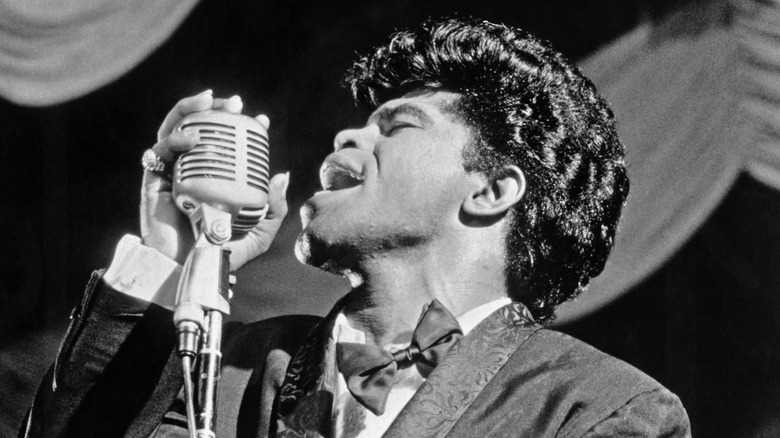
Live at the Apollo — James Brown
The original pressing of "Live at the Apollo," James Brown's sweaty, seismic 1963 magnum opus, runs only 31 minutes long. What's more, it technically spans just a handful of songs, originally presented as a continuous unindexed stream of music and later divided into a mere eight tracks on subsequent CD remasters. And yet, you come out of it feeling like you've been ground to dust.
Part of it, of course, it's that it's next to physically impossible to listen to "Live at the Apollo" without spending its entire runtime in a tizzy of euphoric movement. Backed by his vocal group the Famous Flames and a band of irreproachable R&B instrumentalists, the Godfather of Soul offers a savvy sampler of songs he had already fully mastered and galvanized in the studio, and proves that there was yet room for them to get even better and more electric: Atop the Apollo stage on the fateful night of October 24, 1962, James Brown the singer ascended into James Brown the deity.
There's no other word but "transcendental" to describe the cumulative sound of the band's Manhattan-sized jamming, the breathless furor of the audience, and Brown's own voice as he contorts himself in real time into the heaving, elastic shape of what was to become known as funk music; by the time he's cavorting with the horns on "Think," he might as well be shuffling off his mortal coil and becoming a mass of pure energy. It's one of the best live albums in classic pop history, and, if ever a half-hour of music lay claim to the "epic" descriptor, this was it.