

4 Classic Rock Bands That Sounded Completely Different Before They Were Famous
It's been more than half a century since classic rock was at its peak, and it is remarkable that, in many cases, the discographies of the bands who dominated the genre back in the 1960s and 1970s still hold up for modern listeners. Indeed, there is something rather miraculous about these jewels of albums that have come to enjoy near-universal acclaim from rock fans. However, the truth is that the most beloved classic rock bands didn't typically come fully developed — as we are about to see, even the most distinctive groups often took years to evolve into their definitive forms, and may have sounded radically different when they first got together, tuned up, and turned up their amps.
Here are four undisputed classic rock titans that sounded completely different before they were famous. From blues rockers who evolved a more commercial sound after the arrival of new personnel to those who, with some inspired stylistic changes, managed to create a whole new genre single-handedly (yes, we're talking about Black Sabbath of course), each of these bands had to undergo a major transformation before they truly hit it big.
Pink Floyd
The late 1960s and 1970s were the heyday of the concept album, with early examples such as the Beatles' "Sgt. Pepper's Lonely Hearts Club Band" in 1967 giving way to ever more ambitious work by following artists. Along with the Who, Pink Floyd were one of the classic rock groups who came to define the concept album era with "Dark Side of the Moon" and "The Wall," which combined progressive, folk, and hard rock while balancing experimentation and accessibility, representing critical and commercial high points.
But the Pink Floyd that emerged on the British rock scene in the mid-1960s was a very different beast compared to the band that would conquer the world with epic instrumentation, arrangements, and stage shows. Known back then as "The Pink Floyd," the band's focal point as they established themselves on the London rock club scene was their beguiling original frontman, Syd Barrett. Barrett was both an eye-catching performer and a talented composer of pastorally-inflected psychedelia, the sound of which characterized the band's 1967 debut album, "The Piper at the Gates of Dawn."
However, by the following year Barrett was forced to leave the band as he began to suffer from mental illness, likely exacerbated by his heavy hallucinogenic drug use. Pink Floyd's other members — Nick Mason, Roger Waters, and Richard Wright, who would remain with the band as they grew in popularity — had by then brought in guitarist Dave Gilmour, and in doing so created a line-up that would come to utterly overhaul the band's sound.
Black Sabbath
The impact of the Birmingham four-piece Black Sabbath has been widely touted since the death of the band's legendary frontman Ozzy Osbourne in 2025. Sabbath has been credited by many music fans with being the main originators of heavy metal, with the band's down-tuned guitar and bass bringing a depth to their early releases that few other rock groups had been able to achieve before. Osbourne's powerful, often haunting vocals as well as Sabbath's gleefully occult-inspired image — an aesthetic choice rather than one based on any belief in infernal forces — also cast a long shadow over rock music. But the band's sound and look didn't come fully formed with the release of their self-titled debut in 1970.
When Osbourne, Tony Iommi, Geezer Butler, and Bill Ward first came together in 1968 under the name Earth, they did so with years of experience playing with various musicians on the Birmingham beat scene, bringing with them a wide range of influences from jazz and R&B as well as rock 'n' roll and blues. Iommi and Ward had been in a band called the Rest, while Ozzy, who was a huge Beatles fan as a teenager, was inspired to become a rock vocalist. Indeed, during their early years they more closely resembled a typical blues rock band who made occasional forays into psychedelia, which was then at its commercial height, rather than the heavy metal outfit we remember them as today.
Fleetwood Mac
Few major bands transformed as radically during their early years as Fleetwood Mac. Today, the British-American group remains best known for the work they created in the mid-1970s, most notably the 1977 album "Rumours." Recorded by the band's classic line-up of Stevie Nicks, Lindsey Buckingham, Christine McVie, John McVie, and Mick Fleetwood, the album draws on the strained romantic entanglements between the band's members — most notably Nicks and Buckingham, which serve as the material for one of the most popular pop rock albums of all time. The same line-up was also present on other notable releases, including the band's 1975 self-titled studio album, and the follow-ups to "Rumours," "Tusk" and "Tango in the Night."
This version of Fleetwood Mac has received acclaim for the quality of its songwriting, its lush instrumentation and arrangements, and its incredible chemistry. But the band didn't start out aiming for such a shimmering and luxurious sound. In fact, Fleetwood Mac had been going since as far back as 1967, when Mick Fleetwood started the band alongside Peter Green and Jeremy Spencer in London, England, with John McVie joining shortly after.
Green was a visionary guitarist, and with him the group established themselves as a well-regarded blues rock outfit, cutting their first self-titled album "Peter Green's Fleetwood Mac" in 1968. Green would leave the band in 1970 and largely retreat from the music industry, leading to a revolving-door period which saw the line-up change repeatedly along with the band's sound. Though there are plenty of gems among the band's early work, it was only with the arrival of Nicks and Buckingham in 1975 that Fleetwood Mac finally found its classic form.
Queen
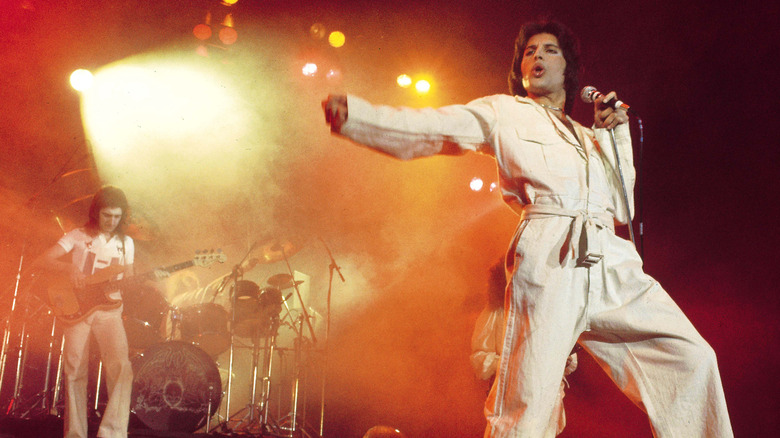
Stadium rock heroes Queen will always be inseparable from the memory of their incendiary former frontman Freddie Mercury, who died in 1991 at the tragically young age of just 45. But the truth is, now the band has existed for longer without Mercury than it did with him.
But Queen also existed in embryonic form before Mercury's arrival, albeit under a different name. Guitarist Brian May first came into contact with drummer Roger Taylor after recruiting him to join Smile, the British blues rock group he had formed with bassist and vocalist Tim Staffell and keyboardist Chris Smith. Smith left shortly after and the group briefly existed as a trio, with Mercury first coming into contact with them as a fan and friend of Staffell. When Staffell left the group to explore other styles outside of rock, Mercury lobbied to take his place. The line-up was later augmented by the arrival of bassist John Deacon.
When Queen's self-titled debut arrived in 1971, the band were still predominantly in a blues rock mode, with the album being compared in the music press to the 1969 debut from Led Zeppelin, one of the band's key early influences. But before long, Mercury's theatricality and eclectic taste for other genres including gospel, disco, and opera began to shape their sound, leading the band to compose the songs for which they are beloved, such as the 1976 masterpiece "Bohemian Rhapsody."