

Not The Beatles, Not The Rolling Stones: The Rock Star Behind Britain's First Million-Selling Single
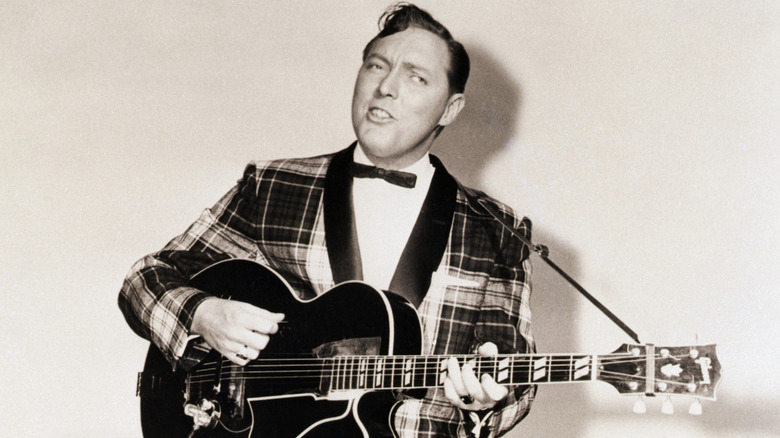
For a while, particularly in the 1960s, it looked like England was going to steal rock 'n' roll from America, as if they were carrying out some strange revenge plot for the 13 colonies seceding from King George III nearly 200 years earlier. After Elvis Presley made rock stardom a worldwide concern, the British Invasion re-centered the rock spotlight on acts such as the Beatles, as well as a surprising number of other bands who rivaled the Fab Four's success. But make no mistake: the first hit song to showcase the power of rock overseas was as American as apple pie. The Beatles may have put more No. 1 hits on the charts, but Bill Haley and His Comets' "Rock Around the Clock" was the U.K.'s first rock 'n' roll million-seller.
In fact, the popularity of "Rock Around the Clock" was so strong that it became a hit for the group more than once — keeping fans of multiple generations rockin' until the broad daylight.
The Clock was ticking for this slow burn hit
Bill Haley, a Pennsylvania-raised singer, started out recording country swing tunes until a cover of the seminal single "Rocket 88" moved him in a whole new direction. In 1953, the early rock tune "Crazy Man, Crazy" became a national hit, and when Haley first heard "Rock Around the Clock," he almost immediately added it to his live performances.
But it took time for the "Clock" to strike in Haley's favor. His original label wouldn't let him record it due to a feud with the songwriter, and when he finally cut a version for Decca Records in 1954, they had to carefully combine two takes after the first drowned out Haley's vocals. The track was released as a B-side, and was only a modest hit. That might have been the end of the story, if not for a young boy whose father, actor Glenn Ford, asked to borrow some records for a film he was starring in.
The picture was "Blackboard Jungle," a drama about an inner-city high school, and its use of a rock 'n' roll soundtrack was something that had never been done before. (Elvis Presley, a rocker turned movie star, was still a year away from national success.) "Rock Around the Clock" was re-released in 1955 to capitalize on the film and topped all of Billboard's major charts — its list of bestsellers, the top radio hits, and the most popular songs in jukeboxes. It took Haley two years, but the song was an unquestionable hit.
Rock Around the Clock was a U.K. hit three times over
"Rock Around the Clock" became a sensation after 1955. Bill Haley and His Comets became the first rock act to perform at Carnegie Hall, and even appeared in two movies following its peak, one of which was called, you guessed it, "Rock Around the Clock." But the song's popularity in America was nothing compared to how U.K. audiences received it, and sales across the pond were such that it became the nation's first million-selling single.
In fact, "Rock Around the Clock" actually hit the U.K. charts months before the song went to No. 1 and stuck around considerably, finally reaching the top for three weeks before Christmas 1955 as well as the first two weeks of 1956. Even more remarkably, the song was re-released twice in England and became a Top 40 hit both times, reaching No. 20 in 1968 and No. 12 in 1974. (At that time, the song had just been heard in "American Graffiti," the hit film by "Star Wars" director George Lucas.
The song would further live on as the theme to the first two seasons of the sitcom "Happy Days" before it was replaced with an original song, and remained Haley's signature song after his death in 1981. Though the track towered over his other achievements, Haley seemed pleased to be associated with that magical time in rock history. "Strangely enough, after 20 years of it, it's just as invigorating for me last night as it will be tomorrow," he told the BBC in 1974.