

The 5 Most Beautiful Male Voices Of The '50s
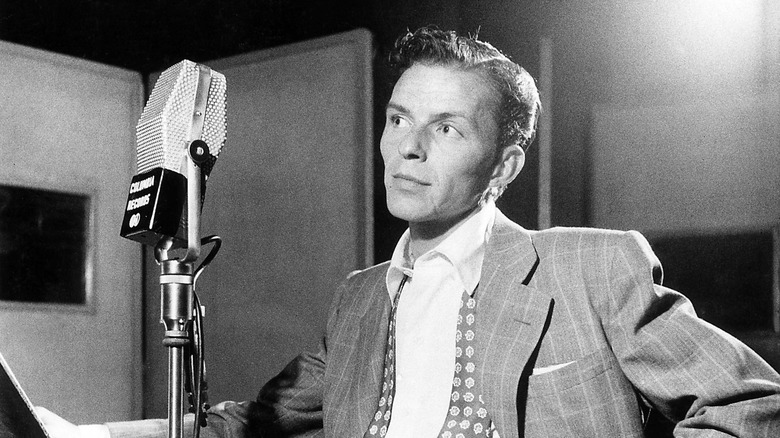
Before video killed the radio star, most musicians relied on impressive vocals and impactful instrumentals to captivate the public and sell records. Of course, the tastes of the times shifted what audiences were looking for, and these five men managed to completely shift the musical landscape with just their voices alone.
Beauty is, of course, subjective, so in order to select the most beautiful male voices of a decade, it needs to be backed by some kind of quantifiable metric. For this, we will be looking at elements such as record sales, cultural impact, and legacy to determine who deserves this title. Of course, there are very few musicians who were solely active over the course of one decade. Although many of these artists were active in the decades prior and following the '50s, they may not have had the same degree of dominance or era definition as the best male vocalists of the '60s.
Musical movements and trends may come and go, but a truly spectacular voice is eternal. Many, if not all of these stars are still musical staples — whether it's thanks to their iconic holiday songs, references by other artists, or biopics being written about them, there's no denying that these male singers deserve to be remembered 70 years later.
Elvis Presley
Who better to represent one of the best voices of the '50s than the King of Rock 'N' Roll himself, Elvis Presley. Besides his provocative stage presence and signature quiff, he had quite the diverse and unique vocal sound and range. As the Memphis Recording Service office manager, Marion Keisker, recalled after the then-18 year old walked in to record some ballads, Presley knew "I don't sound like nobody" (via "The Great American Popular Singers").
Influenced by the blues and black gospel singers of his Pentecostal upbringing, his career truly started to pick up in 1955 after signing a deal with RCA Records. By January of the next year, his singles "Heartbreak Hotel" and "I Was the One" went No. 1 on the Billboard pop and country charts, and No. 5 on the R&B. Just this single alone broke into the millions, and his chart success was replicated with the 1956 "Elvis Presley" self-titled album. The '50s also saw Presley get into acting, lending his pipes and dance skills to the silver screen.
It was precisely his vocal range, being mostly referred to as a tenor or high baritone, that allowed him to spotlight the most beautiful part of his performance — his expression. The passion and energy behind songs such as "Hound Dog," "Baby Let's Play House," and "I Want You, I Need You, I Love You" would be refined and mature over his career, but it's no surprise that he was a star right from the jump.
Little Richard
The rock 'n' roll sound we all know and love owes its entire existence to one petite man with a massive voice — Little Richard. Although 'beautiful' voices are often associated with smoother and deeper sounds, there is something to be admired in the raw and raspy magnitude of his performance.
For one thing, there is an undeniable degree of control when it comes to his performance of songs such as "Tutti Frutti" or "Long Tall Sally." His ad libs, "oooohs," vocal runs, and other embellishments never feel as though he's lost control; rather, he's absolutely sliding up and down his vocal range in the same way one might drag a hand down piano keys. Especially when it comes to ballads such as "Send Me Some Lovin'," that control and grit only helps to amplify his passionate performance. Audiences at the time certainly seemed entranced with him, as by the end of the '50s, he had sold approximately 18 million records.
Although his most famous song, "Tutti Frutti," only peaked at No. 12 on Billboard, "Long Tall Sally" managed to make it into the Top 10 at No. 6. He has also received several notable honors such as the Grammy lifetime achievement award, Rhythm and Blues Foundation Pioneer Award, and he was inducted into the Rock & Roll Hall of Fame in 1986.
Frank Sinatra
Although Frank Sinatra was by no means a nobody at the start of the '50s, he was coming off of a rather rough patch in his career. He didn't have the best childhood, and his original stint as the lead singer of Tommy Dorsey's band in 1939 allowed him to climb from poverty to stardom. Although his solo work in the '40s was incredibly impactful, his pivot to acting nearly overshadowed his singing career.
However, after signing to Capitol Records in 1953, his vocals truly became the star of the show. His warm, sultry, and smooth legato helped to amplify each emotional swell of his songs, giving us hits such as "All The Way," "High Hopes," and his No. 1 hit, "Learnin' The Blues." He's also credited with the advent of the first cohesive album — not merely a disjointed collection of singles, but a cohesive narrative told through the progression of songs.
It's hard to meet even a Gen Z'er who hasn't heard of Sinatra, whether through his iconic Christmas songs, or his direct reference in bops such as the Avalanches' "Frankie Sinatra." His career may have spanned before and beyond the '50s, but it's certainly the decade where the great singer got his voice back.
Bing Crosby
Another member of the multi-decade vocalist club, Bing Crosby deserves to have his talent highlighted in the '50s because it was a peak in his stardom. His singing career actually started all the way back in 1926, giving him nearly 25 years worth of recording and acting to establish himself in the industry.
The '50s for Crosby started off hot, winning Best Original Song at the Academy Awards in 1952 for "In the Cool of the Evening" alongside Jane Wyman. Although many of his hits were recycled from the decade prior, his continuous remastering allowed for singles such as "White Christmas" to chart on the Billboard Hot 100 nearly a decade after it was originally released. He also performed on "The Ed Sullivan Show" for the first time in 1956, proving that he was not the kind of artist to just coast on his classics — he was actively pursuing performance and showing off his effortlessly smooth, well-articulated, and characteristically jazzy voice.
As the original radio star, it's no surprise that Crosby's voice is branded into the bones of the modern musical psyche. The '50s may have just been another decade for the "La Vie En Rose" singer, but his voice never lost its warm and fuzzy feeling.
Harry Belafonte
As much as folk rock took the '60s by storm, many artists owe their success to '50s legend Harry Belafonte. Taking Caribbean folk calypsos mainstream, it is truly the power behind his silky and boisterous voice that allow it to still reverberate in our ears today.
It was in 1956 when the young, curious singer went from performing in New York's nightclub circuits to taking the music industry by storm. His album, "Belafonte," was the first ever No. 1 Album on the Billboard 200, and he managed to repeat the same milestone for 31 consecutive weeks with his follow-up, "Calypso." Featuring iconic tracks such as "Day-O (The Banana Boat Song)" and "Jamaica Farewell," the richness and playful melodies helped to bring an entire culture into the public eye — emboldened by Belafonte's native Jamaican accent, as well as his deep and exclamatory voice.
In particular, "Day-O" with its call and response structure, was an obvious and energizing hit, further reinforced through its appearance in films such as Tim Burton's 1988 classic, "Beetlejuice." "Calypso" sold in the millions, showcasing not only how heart and soul can bring people together, but also how music is best when it's bringing people together. A beloved activist as well as artist, there is no doubt that Belafonte's is deserving to be ranked among the best voices of the '50s.