

5 Musicians Who Helped Invent Prog Rock As We Know It
Progressive rock is a vast, sprawling musical landscape whose timelines and stylistic trajectories encompass countless movements, subgenres, and fluctuating degrees of public interest. To capture all the innovators and masterful players responsible for neo-prog, progressive metal, rock in opposition, and every other stylistic niche under the prog banner would be nigh impossible — especially when boiled down to just five.
So today we're honoring the innovators who played pivotal roles in the core formation of the prog rock idiom. Whether it's the sarcastic American composer whose maddeningly complex compositions beguile music students to this day or the English frontman whose personal issues cast a dark aura across the genre, these are the central figures whose insights and innovations served to codify progressive rock.
Robert Fripp
Outsiders to the genre won't fully understand, so here's an analogy: Robert Fripp is to progressive rock as Louis Armstrong is to jazz. That is no hyperbole. The perpetually seated guitarist, the founding and only constant member of King Crimson, has played a central and instigating role in the creation and evolution of progressive rock since the genre's inception.
That reigning influence began with the group's debut LP, 1969's "In the Court of the Crimson King." One of the prime examples of why 1969 changed rock forever, the album finds Fripp and his collaborators (bassist Greg Lake, drummer Michael Giles, lyricist Peter Sinfield, and multi-instrumentalist Ian McDonald) navigating a labyrinthine world of stylistic directions. The opening track alone, "21st Century Schizoid Man," encompasses proto-doom metal guitar, funk, jazz fusion, and intricate rhythmic motifs, all serving as set pieces for a vocal that screams hoarsely of nuclear annihilation.
But focusing entirely on the madcap virtuosity of that one, admittedly captivating, track fails to full capture what "In the Court of the Crimson King" has on offer. Subsequent track "I Talk to the Wind" finds Fripp and company delicately exploring haunting, contemplative baroque motifs and mysterious lyrical passages with a deft touch and a wholly original identity that keeps the material from sounding too derivative of similar works from the Beatles ("The Fool on the Hill") or the Moody Blues ("Nights in White Satin").
Any direct associations to the time period fall away, and the album is wholly its own world. That unabashed originality proceeds forward across the remaining tracks, where the template for progressive rock is formulated before our ears. The uncompromisingly original album proved to be a remarkable hit despite its insular nature, setting the stage for Fripp to beguile generations of guitar students for years to come.
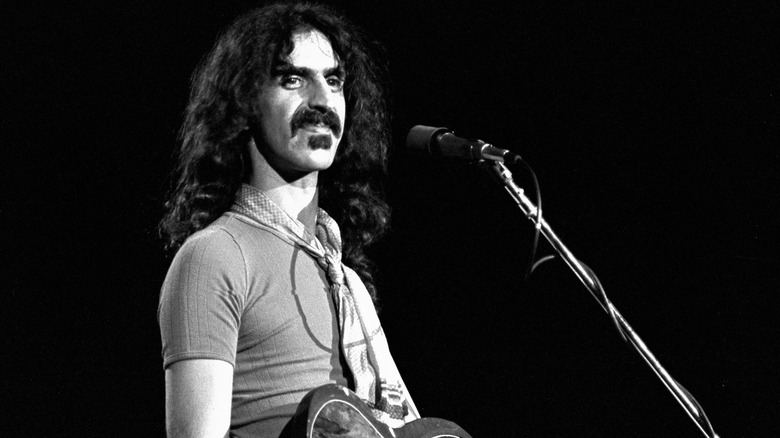
Frank Zappa
Just as some of the greatest science fiction authors reject that label for their writing, Frank Zappa never actually identified as a progressive rock musician and had a dubious relationship with the concept overall. Nevertheless, his legacy towers over the genre to the point of ubiquity.
Beginning in 1966 with the "Freak Out!" LP, Zappa and the Mothers of Invention (his rotating lineup of top-shelf players) eschewed traditional rock song structures and notions of commercial relatability and instead focused on merging the outer extremes of classical experimentation (Zappa had been a devotee of French-American avant-garde composer Edgar Varese) with the cherished doo-wop sounds of his youth. That sort of boundless, wide-reaching vision might be seen as commonplace now, but at the time, it was a vanguard forerunner of the sort of contemporary-meets-classical ethos that would come to undergird progressive rock.
So while Zappa wasn't consciously contributing bricks to the compositional construction project that was progressive rock (as exemplified by early Yes, Genesis, and Gentle Giant recordings), he was, nonetheless, working within its larger ethos. A composer who prioritizes instrumental virtuosity from rock band players, disregards traditional song structures, and creates album-length conceptual art projects full of odd time signatures and sonic experimentation is operating under the prog umbrella like it or not.
The fact that Zappa's debut release predated the experimental landmark that was the Beatles' "Sgt. Pepper's Lonely Hearts Club Band" only further underscores how relevant he was to the expansive musical innovation that formed the basis of progressive rock. It was a legacy that would unfold across the subsequent decades, even going mainstream with a pop hit in the form of "Valley Girl" before quickly returning to fiendishly intricate rock albums and equally multi-layered orchestral projects.
Syd Barrett
Syd Barrett's presence lies less at the heart of prog rock than in its Jungian shadow. When discussing the genre, with its emphasis on compositional exploration and instrumental virtuosity, it feels natural to prioritize the top shredders or the most intricate of composers. But even so, this is still rock, and any rock genre needs a poet laureate wrestling with his own demons. Thus, Syd Barrett joins the prog timeline not as a master player but as a window into its dreamlike imagination.
The founder and original frontman of Pink Floyd, Barrett handled the meteoric rise to fame poorly and was soon ousted from the band as his unreliable nature and mounting mental health issues made him impossible to continue working with. The controversial split — which came not long after the release of the group's 1967 debut LP "Piper at the Gates of Dawn" — made him the stuff of rock mythology: a ghost in a machine to which he'd only just been welcomed.
The documentary "Have You Got it Yet: The Story of Syd Barrett and Pink Floyd" would argue that the real reason Syd Barrett left Pink Floyd was ultimately down to his own rejection of rock stardom and a desire to return to an ordinary life, but it nevertheless captured the imaginations of fans the world over who saw him as a sort of prog rock J.D. Salinger. Among those fans were the remaining members of Pink Floyd, who used his absence as the inspiration for material from their '70s masterpiece albums, including "Dark Side of the Moon," "Wish You Were Here," and "The Wall."
Thus, Barrett's influence on prog is wholly poetic. It's a dark and mysterious story that's captivated the scene and its bands for decades. He died in 2006, but how we wish he were here.
Dave Brubeck
Jazz pianist Dave Brubeck might not be the first name to come to mind when discussing the origins of progressive rock, but when no less than Jethro Tull's Ian Anderson cites him as an influence, there might be something there. While the pianist's primary musical contributions come during the '50s and '60s — 10 to 20 years prior to the golden years of progressive rock — his compositions (and their notable commercial viability) were central to establishing one of the central tenets of prog rock music: mainstream appreciation of odd time signatures.
Brubeck's fascination with the possibilities that lay beyond the standard 4/4 time of most popular music came under the tutelage of mentor Darius Milhaud while the young pianist studied at Mills College in Oakland, California. By 1951, Brubeck had partnered with alto saxophonist Paul Desmond, one of his most central and crucial collaborators, for the Dave Brubeck Quartet (an earlier eight-piece ensemble had disbanded by that point). That fruitful collaboration led to 1959's "Time Out," an album that proved to be as commercially successful as it was influential among arthouse musicians yearning for the avant-garde.
"Time Out," as the name implies, leans on odd time signatures. Notable classics from the album include "Blue Rondo à la Turk" (9/8 time) and "Take Five" (5/4 time). The latter piece would go on to be the Quartet's signature hit and help to mainstream the use of odd time in popular music. As the aforementioned Jethro Tull indicates, that influence helped pave the way for Rush, Dream Theater, and Tool to become hitmaking outside-the-box timekeepers in their own right.
Robert Moog
Here's an analogy that won't be easily refuted: Robert Moog is to the synthesizer as Les Paul is to the electric guitar. Though not known for his own work within a band, the keyboardist and consummate inventor created the Moog synthesizer in 1964 in collaboration with jazz pianist Herb Deutsch and the instrument would go on to be indelibly linked with progressive rock. The instrument entered the prog keyboardist's technological lexicon with Keith Emersons' swirling, ethereal benediction on the solo for Emerson, Lake, and Palmer's "Lucky Man" and continued to explode in popularity with the contributions of Yes' Rick Wakeman, Roxy Music's Brian Eno, Rush's Geddy Lee, and countless other prog rock luminaries.
That influence reaches back to encompass the forerunners of progressive rock: The Doors' Ray Manzarek uses an early Moog synth on the band's second album, "Strange Days." The instrument has also endured beyond the golden era of progressive rock with modern artists like noisecore misfits the Locust and Dream Theater's Jordan Rudess among countless others expanding the instrument's reach across the landscape of modern music.
An all-encompassing list of major players making major use of the Moog synth would easily rupture our word limit. Suffice to say, it's a sound as ubiquitous to prog rock as distorted guitar to heavy metal.