

Hidden Messages Led Zeppelin And Other Bands Etched Into Their Vinyl Records

We may receive a commission on purchases made from links.
Got a vinyl record on hand, perhaps even a vintage one? Remove it from the sleeve and take a close look at that empty spot between the grooves for the last song on a side and the label. That space, often referred to as dead wax or the runout groove, could contain a surprising amount of info. Here, you'll find any number of prosaic things, for instance, matrix numbers that could help track a record's path through production (like info denoting the mastering engineer or pressing facility partially responsible for the vinyl's existence). But, if you're lucky, you might just spot a mysterious message stamped or seemingly scrawled into that space. One of the most famous examples of a runout groove inscription comes from Led Zeppelin and links up to a rather spooky part of the band's history, but the missives hardly stop there. Over the years, careful collectors have spotted runout groove inscriptions all over the place, from proto-goth darlings Joy Division shouting out German director Werner Herzog to the quintessential dad rock band, the Eagles, getting a bit silly.
To be fair, these messages aren't the most hidden, though it would be easy to miss them if you'd eagerly grabbed a vinyl out of its cover and put it in the player as soon as you got back from the record store. But the meanings are often cryptic, and these etchings are certainly treated like hidden messages for fans, with references or in-jokes that only the most dedicated listeners will get.
Led Zeppelin referenced an infamous occultist
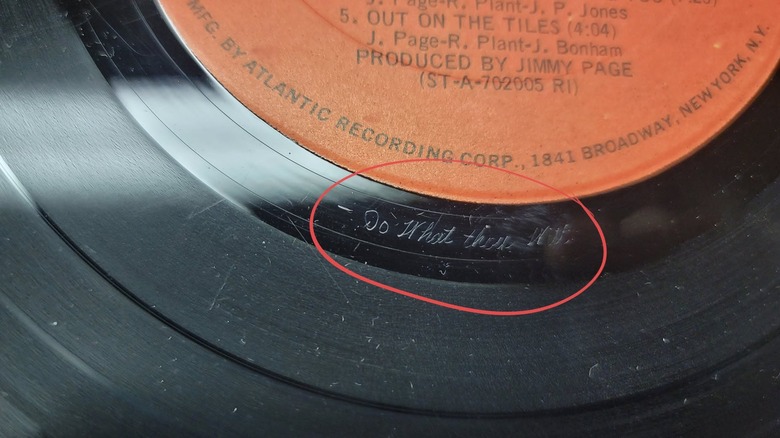
Robert Plant may have shot down rumors there were hidden audio messages on Led Zeppelin albums, but there is actually something to the band's occult links, from their individual symbols to vinyl runout grooves. The 7" single of "Immigrant Song" sported the etching, "Do What Thou Wilt Shall Be The Whole of the Law," while the original release of "Led Zeppelin III" also included "Do what thou wilt" in the record's surface (and "So mote it be" on the reverse).
It all goes back to Aleister Crowley, the infamous British occultist and founder of the new religious movement of Thelema. Crowley claimed that a spirit dictated a text he called "The Book of Law," which includes the phrase "Do what thou wilt shall be the whole of the Law." It's not about doing whatever you want — though Crowley's own messed-up history sure reads that way, sometimes — but instead directs Thelemites to uncover their "True Will," or ultimate purpose, and do what they must in order to fulfill it.
Jimmy Page clearly found this interesting, though reports that the Led Zeppelin guitarist worshipped the devil were wildly overstated. However, he really did buy a home once owned by Crowley, Boleskine House, built next to Scotland's Loch Ness. Bought by Crowley in 1899, it was used as a suitably quiet place for his involved rituals. Yet, Crowley, never exactly good with money, had to sell the manor in 1918. Page purchased the home in 1971.
The Eagles got a bit cheeky with some runout groove messages
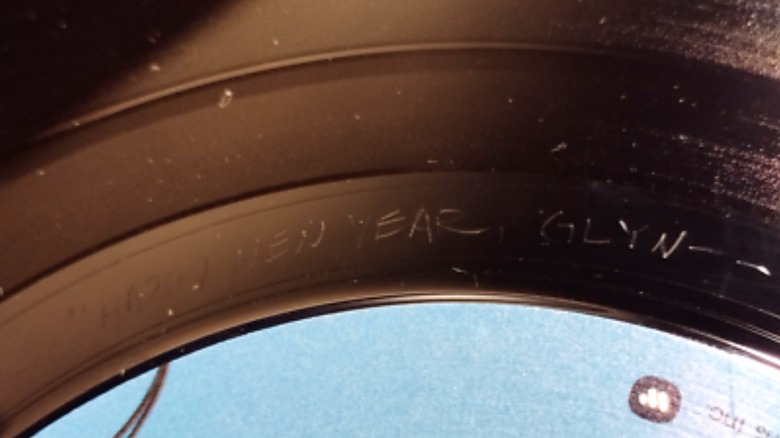
In quite a few cases, etchings into the blank spaces of a vinyl record were simply excuses to have a bit of fun. Some are a cheeky way to lay claim to one's part in the process (mastering engineer George Peckham is one of the earliest participants, signing records starting in the late '60s with his nickname of "Porky" or deeming a vinyl to be a "Porky Prime Cut"). Others are witticisms and in-jokes, including those put out by the Eagles throughout the decades. On the "Hotel California" album, released in December 1976, the first side is emblazoned with the query, "Is It 6 O'Clock Yet?," while the reverse proclaims that "VOL is five-piece live!" This is reportedly the work of producer Bill Szymczyk, who was quite proud of the fact that the album track, "Victim of Love," was indeed recorded by the band in a single live take.
Later albums speak back to Szymczyk's proclamation. "The Long Run," on which he also worked as a producer, included an etching that references his Polish ancestry, using a term that perhaps wasn't routinely considered derogatory back in 1979 but generally is today. A couple of years later, the album "There Goes the Neighborhood" claims in its runout groove inscription that, "After 15 Years, I Still Can't Spell Szymczyk." Others are more overtly kind, with new year's well-wishes etched on their 1971-1975 greatest hits album.
Joy Division drew attention to Werner Herzog
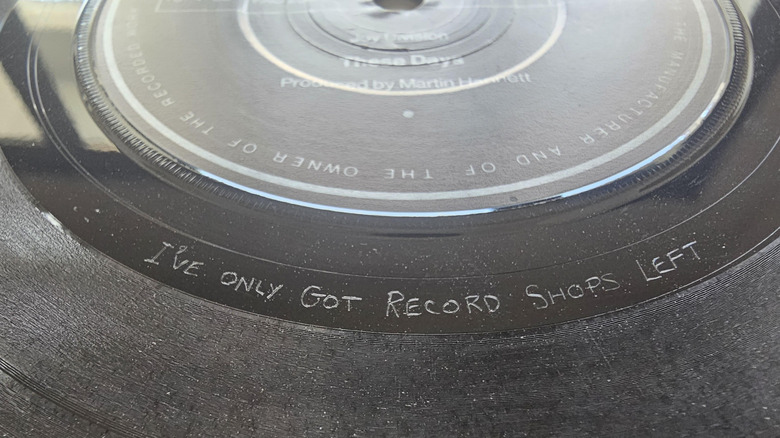
Take a close look at an old Joy Division vinyl, and you might just find a message etched into the record's runoff groove. The Factory Records 7" of "Love Will Tear Us Apart" included both "DON'T DISILLUSION ME" and "I'VE ONLY GOT RECORD SHOPS LEFT," both pretty downbeat messages that nevertheless fell in line with the Joy Division's rather tragic post-punk story. Meanwhile, some copies of 1979's "Unknown Pleasures" get almost mystical, with the A side proclaiming "This is the way," while side B encourages you to "Step inside" — though inside what, exactly, is left open to interpretation (but perhaps it's no fun to definitively answer the question).
Another runout groove inscription from 1981's "Still" reads "the chicken won't stop," with inscribed chicken footprints and "the chicken stops here" on the B side. This is widely understood as a reference to Werner Herzog's "Stroszek," an acidly dark West German comedy from 1977 that critiques the American dream. Ian Curtis reportedly had just finished watching a television airing of the film, in which the protagonist meets his end while a chicken mindlessly dances on screen, before his own death via suicide. However, even if the runout groove etching speaks to Curtis' connection to "Stroszek," it would be overly simple, even grotesque, to implicate the movie in his tragic end. Speaking to the BBC, Herzog himself said, "I wish this singer was still alive and hadn't seen 'Stroszek' at that moment," but that he also believed Curtis was dealing with multiple problems that had little to do with the film (via Far Out).
Iron Maiden was typically intense, even in the dead wax
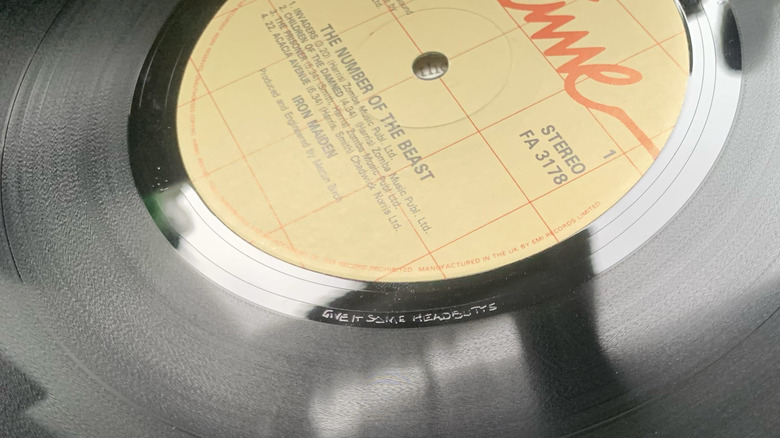
When you put an Iron Maiden album on the turntable, you surely don't think you're in for a soothing, cuddly time. This is a band that features a comically grotesque mascot popularly known as "Eddie the Head," and with his grinning, ghoulish visage leering out from practically every Iron Maiden single and album, you ought to know what you're in for before the music even begins to play. Need another reminder? Check that dead wax. The 1982 release of "The Number of the Beast" includes an etched message to "give it some headbutts." Just what deserves a headbutt or two isn't specified, but it could range from the prosaic to the philosophical, depending on your mood. Or maybe it's just Eddie himself, who's been the recipient of theatrically aggressive headbutts or similar antics during the course of many Iron Maiden performances.
Further confirmation of that cartoonish attitude lies in the runout groove of other Iron Maiden records, like the "Powerslave" inscription that proclaims "There's only one 'um, and that's f*** 'um." The exact inscription depends quite a lot on where the vinyl was released. Fans online have reported that U.S. releases of the 1984 album have been censored, with a progression of Xs standing in for the naughty word. But maybe Iron Maiden should be allowed a cuss or two if they're also introducing listeners to classic works of literature like "The Rime of the Ancient Mariner" from the same album.