

4 Motown Singers Whose Voices Were More Famous Than Their Names
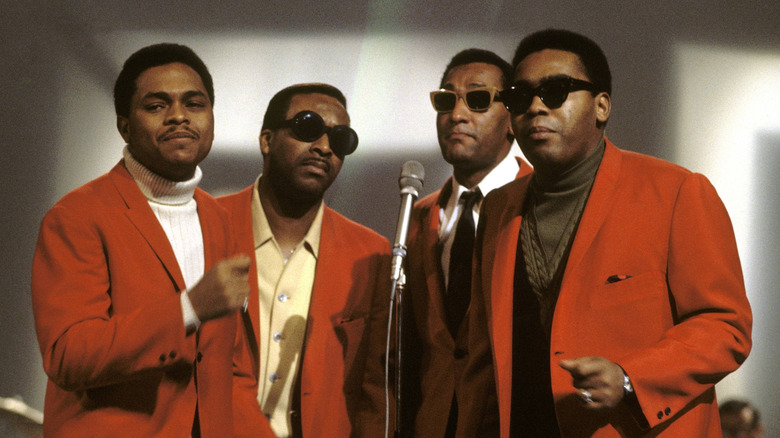
Founded by Berry Gordy Jr., Motown Records emerged as one of the most successful, influential, and prolific record labels of the 1960s and 1970s. With a specific sound obtained through rigorous, factory-like techniques for every step of the process, Motown records became Motown hits with a joyous, lush vibe bolstered by horns, strings, bass lines, and some of the best singers in the world. Many of those Motown vocalists became superstars, such as Diana Ross, Lionel Richie, Marvin Gaye, and Eddie Kendricks of the Temptations. Others scored massive hits as part of a group, and the public never quite memorized their names.
Motown churned out so many vocal groups and bands — some with changing membership — and released so many hits that fans often didn't learn much about individual performers. Their lead vocalists ranked with the best Motown talent, but their names were never widely known. Here are the stories of four of these egregiously lesser-known Motown icons, such as the Contours' Billy Gordon and the Marvelettes' Gladys Horton.
Billy Gordon of the Contours
Known for their energetic stage performances, the Contours were one of the first successful Motown Records acts and also helped fuel the British Invasion. Their best-known song and only Top 40 hit was a monster, reaching No. 3 in the U.S. in 1962. That tune, "Do You Love Me," went to No. 1 in the U.K. when covered by Brian Poole and the Tremeloes, and a version by forgotten British Invasion act the Dave Clark Five was that band's first U.S. hit. It's a mixture of the most exciting parts of '60s R&B and early rock 'n' roll, especially its snappy percussion and the gritty, wide-ranging vocal talents of Billy Gordon.
While the Contours would include more than two dozen members throughout the group's history, Gordon made his voice the most prominent. "Do You Love Me" begins with a pained spoken section describing how a girl dumped him because he didn't have any dance moves. Then the song kicks in, showing off his gritty wail and bombastic ability to hit the high notes and show off. It's worth noting that after Gordon, the last remaining founding member, departed the Contours in the mid-'60s, the group never had another hit.
Gladys Horton of the Marvelettes
With a keen ability to interpret and present songs about young love and all its complications and joys, the Marvelettes regularly scored major hits throughout the 1960s. They're best remembered for "Don't Mess With Bill," "Playboy," "When You're Young and in Love," and "Too Many Fish in the Sea." No song ever did as well as the Marvelettes' first hit, however. The bouncy, bopping pop classic "Please Mr. Postman" spent a week at No. 1 in 1961. That marked the first Motown release to ever top the pop chart in the U.S.
Throughout their hit-making era, the Marvelettes were led by singer Gladys Horton. They started as a five-member group before ultimately settling into a trio, but Horton's versatile and expressive voice always led the way. With a style that reaches and strains when it goes high and impresses when it goes low, Gladys Horton propelled some of the best Motown hits that still get boomers dancing.
Levi Stubbs of the Four Tops
The Four Tops are among Motown Records' most esteemed and lucrative acts. Their elegant soul pop is synonymous with the label's '60s output, and the Four Tops' biggest hits are a virtual soundtrack of the decade. Lead singer Levi Stubbs had such a rich, reaching, and emotionally resonant voice that he could make listeners feel what he felt when he picked up the lyric sheet, belting, crooning, and rocking his way through dynamic hits like "I Can't Help Myself," "It's the Same Old Song," "Reach Out I'll Be There," "Standing in the Shadows of Love," and "Bernadette." For all intents and purposes, Stubbs and the Four Tops were one and the same, particularly because the Motown superstar-on-paper never launched a significant solo career.
Stubbs remained a member of the Four Tops until his death in 2008. His most prominent gig outside of the group was one that similarly featured his voice but which didn't connect it to a face or a name. Stubbs provided the speaking and singing voice of the man-eating plant Audrey II in the 1986 movie musical "Little Shop of Horrors," billed as "Levi Stubbs of the Four Tops." He sang on the soundtrack single "Mean Green Mother from Outerspace."
Jean Terrell of the Supremes
The Supremes popularized the Motown sound perhaps more than anyone in the 1960s, sending 12 hits to No. 1, including "Baby Love," "You Can't Hurry Love," and "Someday We'll Be Together." A vocal group that successful couldn't exist without star power, and Supremes lead singer Diana Ross was such a force that by the end of the '60s, the act was billed as "Diana Ross and the Supremes." Upon Ross' almost inevitable departure for a solo career in 1970, Motown opted to keep its lucrative Supremes franchise afloat and brought in a new talent to lead the trio: former Ernie Terrell and the Knockouts member Jean Terrell.
Given the unenviable task of succeeding one of the most dominant frontwomen ever, Terrell proved she was up to the job. She's among the more successful band member replacements ever despite being relatively forgotten in terms of Motown history. The Supremes didn't flop when they lost Ross but thrived under Terrell's leadership, which lasted until 1973. With a sweet, soulful, and emotionally evocative voice comparable to Ross', Terrell took the lead on Top 20 hits like "Up the Ladder to the Roof," "Stoned Love," "Nathan Jones," and "Floy Joy."