

The Most Beautiful Female Voices Of The '50s
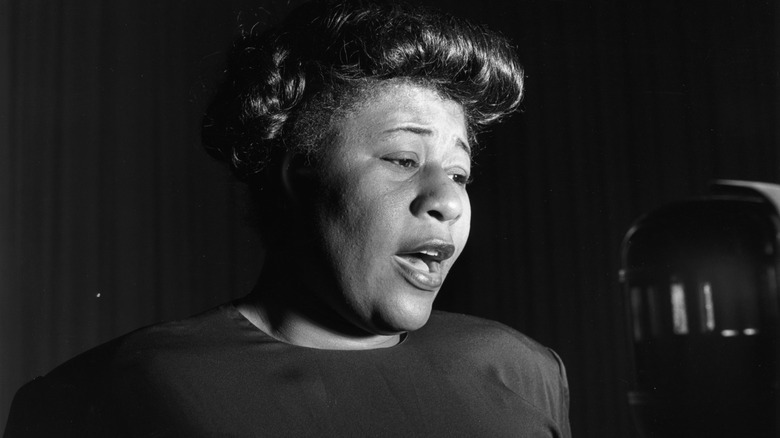
Whether from solo female acts or the best girl groups of the 1950s, that decade certainly gave us a long list of classic songs, and a few of those singers were so outstanding that they helped to expand an entire genre, an accomplishment that puts them in one of music's rarest categories. It's one thing to touch people with a beautiful voice, but it's another to bring legions of people to a kind of music that was once considered esoteric.
We've chosen the most gorgeous voices from that decade, while highlighting their specific skill set and the songs that helped to make them legends. Each of our entries possessed a special distinctiveness, presence, and command that allowed their voice to cut through the instruments and touch the listener in ways that no one else could. In other words, all of these singers were able to take any song and make it theirs and no one else's, even if other renditions were made. And even if they didn't bring attention to a genre, these voices will forever be praised for what they did with notes and harmony.
Sarah Vaughan
"The Divine One" is a nickname perfectly suited to describe Sarah Vaughan's voice, which she was able to masterfully bend and shape around tunes. Vaughan could either use a light and cheery delivery to brighten pop songs like 1959's "Broken-Hearted Melody," add a level of sultriness to jazz cuts like "Misty," or use her gospel background to wow listeners on tracks such as "City Called Heaven," also released in 1959.
But regardless of what she sang, Vaughan always maintained an unparalleled level of control, and whether she expanded it or held it back to match the song's feeling, she painted it with unique colors to make it her own. Take her 1955 release "Whatever Lola Wants," a playful tune that might encourage a singer to focus more on whimsy than technique, yet Vaughan used the same level of artistry as she did on more serious songs, such as "My Man's Gone Now."
"I feel lucky to have had the chance to share this world with Sarah," said Miles Davis (via UPI) after Vaughan's death in 1990. "She advanced her musical artistry to the point where she was more concerned with the texture of sound, the surfaces of sounds, the joy of sound. Her music was in a place where nobody had ever been."
Julie London
Julie London's voice wasn't considered big or powerful, but one could say that was its greatest quality. Her singing style was direct and intimate, as if she were giving the listener a personal concert, which made it easy for one to feel the emotion of her songs within the first few lines. In her 1956 rendition of "Cry Me a River," for example, London used her low pitch and throaty delivery to fill it with a soothing warmth.
Between London's close-to-the-microphone singing style and the sparse production she sang over, songs such as 1955's "I'm in the Mood for Love" and 1958's "Blue Moon" have a seductive, alluring quality that can't be ignored. London admitted that her smoky delivery wasn't intentional; her voice just didn't naturally project, although it didn't need to. Instead, she brought an uncommon type of elegance to each track, something that even some of the most powerful singers don't achieve.
Ella Fitzgerald
Ella Fitzgerald's voice was so grand, beloved, and impactful that she didn't just bring wide attention to her music, she also helped to bring jazz to a mainstream audience. One of Fitzgerald's amazing qualities was her ability to use her youthful vocal tone to make songs easily digestible, such as "Too Darn Hot" and "Cheek to Cheek" (with Louis Armstrong), both released in 1956, which highlight her crystal-clear pitch and her talent for giving tunes a shiny and pretty luster, regardless of the subject matter.
Then there's the 1951 release of "Someone to Watch Over Me," in which Fitzgerald's voice weaves over the instrumentation with ease, clarity, and a liquid-like flow, something she did whether singing jazz, bebop, swing, or pop. That unique talent was probably why she won Amateur Night at the Apollo Theater as a teenager, which ended up being Fitzgerald's big break.
"She could take a great song and make it even greater," said late jazz historian Dan Morgenstern to NPR in 2017. "She had a wonderful sense of melody. She had that beautiful voice. She had that perfect intonation. And she always knew what the right tempo should be. And she put so much feeling into what she did."
Doris Day
There are some singers whose voice alone makes a song excellent, while others use their personality, but Doris Day brought both to her music. Consequently, her light tone and bubbly charm make '50s pop tunes such as "Everybody Loves a Lover" and "Whatever Will Be, Will Be (Que Sera, Sera)" sound so inviting. She was able to fill a song with merriment, but she also had serious jazz chops and was influenced by Ella Fitzgerald as a child, despite wanting to be a dancer at first, a career goal of Day's that came to an early end.
"Autumn Leaves" in particular, released in 1956, makes you feel like you've been transported to the front row of a late-night jazz club. "Doris was a great performer with warmth and expressiveness," said singer Frankie Laine via Day's official website. "She had a wonderful Jazz vibrato voice and could have been one of the top jazz singers."
Day admitted, however, that although she showed a high level of skill, she relied more on passion than technique, instinct more than careful thought, which brought a certain looseness to many of her releases. "No," Day answered when Roger Friedman of Showbiz411 asked if she was conscious of her artistic choices while singing. "I knew the song that we were going to do. We would put them together at my house ... The words were there, and the words told a story. I can't say any more than that except I loved singing."