

5 Musicians Who Helped Invent The Power Ballad
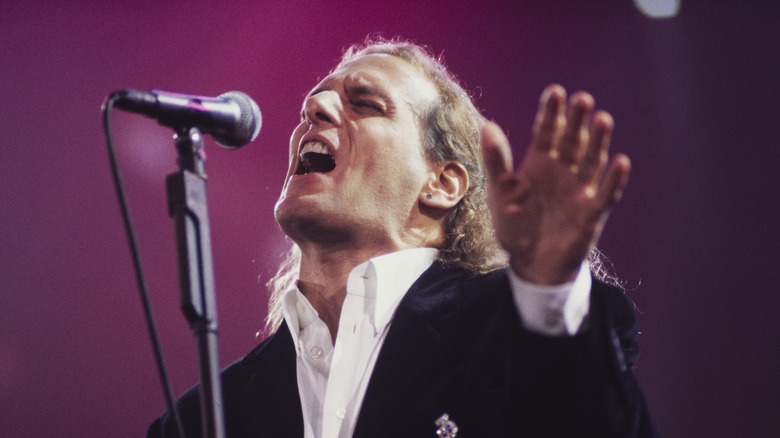
The power ballad didn't just appear on the music scene fully-formed and grabbing for our hearts; it developed over time into one of the most recognizable song formats of the 20th century. A well-made power ballad had the power to resurrect flagging careers and aid adult contemporary artists in crossing over to a rock audience, and vice versa. Thanks to several key figures in the sphere of popular music, the power ballad became an invention of sheer melodic wizardry, a blend of silk and steel audiences thrilled to as they sang along at top volume.
Who were these wonder workers who advanced the power ballad concept through decades of musical evolution? Early adopters like singer-songwriter Roy Orbison, brand-name producers like Jim Steinman and David Foster, and '80s icons like Michael Bolton all contributed to the tropes that transformed love songs and tunes about the triumphs of the human spirit into the greatest power ballads in music history.
Roy Orbison
The original king of power balladry, Roy Orbison had one of the earliest examples of giving a stirring love song a dose of emotional bravura with his dramatic classic and No. 2 smash "Crying." Orbison wrote the 1961 paean to pain with a slow-burn opening and a rousing first chorus, which returns for a restrained second verse before exploding into a rafter-raising final chorus. That sneak-attack structure became the framework for future power ballads, showing other songwriters and performers that letting loose with raw feelings could take an otherwise staid love song to the next level of melodrama.
Another Orbison tune, his 1961 No. 1 hit "Running Scared," changed up the structure but kept the power ballad dramatics intact: Throbbing bandolero-style guitar work and sweeping strings and horns gradually climb to a crescendo as Orbison's fragile warble finds its strength. Its first-rate romantic swells and unbridled emotional climax put Orbison on the map as an innovator of the power ballad trope, giving future waves of musicians a skeleton over which to compose their own high-powered ballads.
Jim Steinman
Breaking out as the songwriting and production partner on Meat Loaf's scorching debut album "Bat Out of Hell" in 1977, Jim Steinman applied his love and talent for theatrical, musical-like compositions that gave the rock world some of its most memorable power ballads. "Two Out of Three Ain't Bad" started his run, showcasing the softer side of Meat Loaf and introducing the industry to a new master of this unique song style.
When Steinman started lending his skills to other artists in the '80s, he came up with winning partnerships such as the iconic No. 1 power ballad "Total Eclipse of the Heart" by Bonnie Tyler, one of the preeminent works in the power ballad catalog. Steinman turned all the dials on the board to 11 and added thunder, drama, and choir voices to create a mini melodrama that changed the game.
Steinman would spend the rest of the '80s and much of the '90s crafting similar pieces for his old partner Meat Loaf ("I'd Do Anything for Love (But I Won't Do That")), Celine Dion ("It's All Coming Back to Me Now"), and Air Supply ("Making Love Out of Nothing at All"). His supercharged versions of the power-ballad layout filled the radio with energetic hits that were equal parts rock song and love song.
Dennis DeYoung
As keyboardist, songwriter, and one of the lead voices of '70s and '80s rockers Styx, Dennis DeYoung helped usher in the age of the power ballad. The first and most noteworthy of his contributions was "Lady," a 1973 song that blended the band's edgy hard-rock sound with a piano-based elegance that kept audiences rapt. The 1979 tearjerker No. 1 hit "Babe," which alternated chiming electric piano verses with thundering choruses and a scorching third-act guitar solo from Tommy Shaw, showed distinct refinement of the band's earlier power-ballad tinkering.
As part of the 1983 concept album "Kilroy Was Here," Styx dropped another power ballad for the ages, "Don't Let It End," which felt like a standalone song and gave DeYoung a chance to blast in his upper range. It was another emotionally charged turn of events for the power ballad concept, reminding fans of what the band had created and how capable they were of delivering captivating love songs with searing rock-infused arrangements.
Though Styx added their musical prowess to the songs, they were all DeYoung's compositions. His love of the power ballad extended into DeYoung's post-Styx solo work, which included the highly polished "Desert Moon," a perfect tune for 1984 and an extension of the format he helped pioneer.
David Foster
Songwriter and pianist David Foster used his talent in the '70s to help turn top-tier bands like Earth, Wind & Fire and Hall & Oates into world-class acts. But his biggest contribution to the world of music was his refinement of the power ballad of the '80s. Starting with Chicago and their striking "Hard to Say I'm Sorry" in 1982, Foster had a string of top-charting power ballads with the band, instigating their transition to an adult contemporary powerhouse act where ballads of power were the main draw.
As the '80s rolled on, Foster also worked behind the scenes with platinum-level names such as Olivia Newton-John, Celine Dion, and Barbra Streisand, helping them find footing in a decade where the usual balladry required a modern spark and a blast of electronic arrangement to keep up with the pack.
Foster also fancied himself a performer of his own works and released two solo albums in the late-'80s, showcasing his talent for blending pseudo-classical piano melodies with technical flourishes that became a signature sound. In the '90s, he gave Dion a whole market share of power ballads, including some of her biggest hits. Songs like "The Power of Love," "Because You Loved Me," and "All By Myself" all bore his power-ballad fingerprints, advancing the model for new artists to pick up and run with.
Michael Bolton
Michael Bolton transitioned from funky pop-rock in the '70s and hard rock in the early '80s to a more adult contemporary format as the decade rolled on. His Bon Jovi-like blend of synths and power chords on songs like "Fool's Game" became a smoother, more mass-market sound that swung toward soulful love songs and straight-on pop. At the center point of both sounds was the Michael Bolton power ballad, an evolution of the format that put Bolton's double-barreled vocals in front of sleek production.
Once he made the leap, Bolton's voice became the anchor for the power-ballad movement. His No. 1 hits like "How Am I Supposed to Live Without You?" and "When a Man Loves a Woman," as well as Top 10 smashes like "Said I Loved You... But I Lied," and "When I'm Back on my Feet Again" turned the singer into a superstar. Even his lighter fare, including covers of the Bee Gees' "To Love Somebody" and Otis Redding's "(Sittin' on) The Dock of the Bay," had a muscular power that helped clinch his spot as the power-ballad king of the '90s.