

3 Girl Groups That Launched Successful Solo Stars
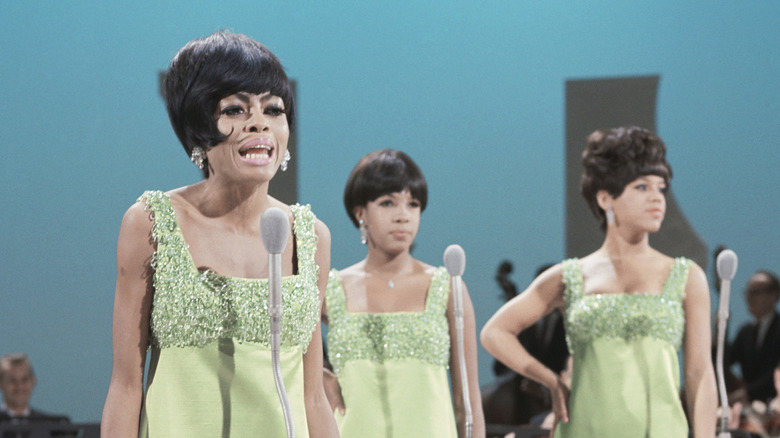
At their essence and when they were most effective, "girl groups" showcased the formidable vocal talents of their three or more members. Emerging in the 1950s and employing an established format by the 1960s, girl groups generally featured a couple of substantially-voiced backup singers whose work supported the lead vocalist. Very often, that performer who was literally in the spotlight became a breakout star, eventually departing the group that made her famous for the exciting world of solo work. Many of the biggest girl groups ever, across the decades, served as the point of origin for headlining pop stars.
These girl group-trained celebrity singers with lengthy resumes of hits and adored music to their name — and only their name — got so big that their past as part of a collective gets overlooked and overshadowed. Here then are the stories of the Blue Belles, the Supremes, and Destiny's Child — now best known for launching successful solo stars.
The Blue Belles
Along with Cindy Birdsong, Patti LaBelle jumped from her church choir to an early '60s vocal group she named the Ordettes, later the Blue Belles. They had a few pop hits, including "I Sold My Heart to the Junkman," and modernized remakes of "Danny Boy," "You'll Never Walk Alone," and "Somewhere Over the Rainbow." By 1967, when Birdsong left for the Supremes, the group was going by Patti LaBelle & the Bluebelles. At the dawn of the 1970s and adopting a sound that incorporated edgier soul, funk, rock, and futuristic elements, the group — now consisting of Sarah Dash, Nona Hendryx, and its founder — changed names once more, to LaBelle.
After seven albums and just one big pop hit — the 1975 No. 1 smash "Lady Marmalade" — LaBelle, one of the best girl groups of the '70s, disbanded, freeing up their eponymous frontwoman to launch a significant solo career. Successful in the worlds of R&B, pop, and soft rock, Patti LaBelle was an '80s superstar, responsible for big hits of the era like "On My Own" (a No. 1 duet with Michael McDonald), "New Attitude," and "Stir it Up."
The Supremes
Motown Records provided the indelible and instantly recognizable sound of 1960s pop, and its premiere, or rather supreme act, was the Supremes, one of the best girl groups of the '60s. Originally the Primettes, the Supremes made grand and elegant soul pop, and the public sent 12 of their singles to No. 1, such as "Where Did Our Love Go," "Baby Love," and "Stop! In the Name of Love." Every member of peak-era Supremes grew very famous; but Diana Ross was the leader, and she possessed one of music's greatest voices, and so her stature eclipsed that of bandmates Mary Wilson and Florence Ballard. In 1967, the trio swapped out Ballard for Cindy Birdsong, and Motown began billing them as Diana Ross & the Supremes. That format didn't last long, as Ross officially departed in 1970 after reaching No. 1 one last time with "Someday We'll Be Together."
As pop and R&B evolved rapidly, Ross kept up with the changes, expanding her musical capabilities and her fame, too. She hit No. 1 six times between 1970 and 1981, trying out classic Motown soul ("Ain't No Mountain High Enough"), ballads from movies she starred in like "Theme From 'Mahogany' (Do You Know Where You're Going To)", treacly adult contemporary (the Lionel Richie duet "Endless Love"), and disco ("Upside Down" and "Love Hangover").
Destiny's Child
The millennium-era answer to the Supremes, Destiny's Child blended R&B, hip-hop, and pop in innovative new ways, and in doing so, became one of the best-selling groups around. Originating in 1990 with Beyoncé Knowles and LaTavia Robertson, the former's father, Matthew Knowles, built the act into an entertainment machine, booking them on "Star Search" and adding in new members Kelly Rowland and LeToya Luckett. They made their national debut in 1997 with the single "No, No, No," the first of 13 Top 40 hits including No. 1s "Say My Name," "Bills, Bills, "Bills," and "Independent Women Part I." Through that run, Destiny's Child shifted from a quartet into a trio, dropping Robertson and Luckett and bringing in Michelle Williams.
While Beyoncé's bank account exploded after she ditched the band, she wasn't the first Destiny's Child member with an extracurricular. Rowland's duet with rapper Nelly, "Dilemma," spent 10 weeks at No. 1 in 2002, and she'd hit the Top 40 four more times. Williams has been quite successful in the gospel sector, releasing five albums of spiritual music. Beyoncé has recorded acclaimed LPs like "Lemonade," released nine No. 1 hits like "Irreplaceable," "Crazy in Love," and "Single Ladies," and won the album of the year Grammy for "Cowboy Carter," her first attempt at country music.