

The 5 Best One-Hit Wonders Of Glam Rock
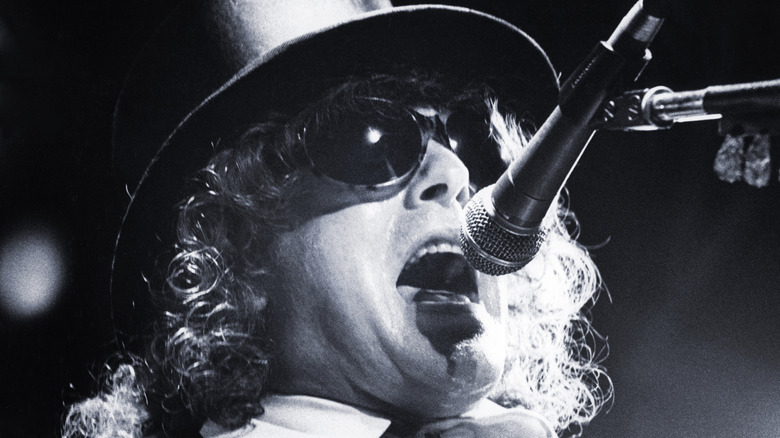
Glam rock was one of the most exciting musical interludes of the 1970s. Its acts made straightforward, stripped-down rock 'n' roll as if it came from the '50s but which also sounded futuristic due to characteristics like heavy drums, psychedelic-style guitar licks, and theatrical, media-savvy performers who often wore costumes and makeup to further push the envelope. The glam rock era didn't last long, but it did give the world a lot of classic standards, and many were made by artists that never saw the Top 40 again.
Most of the bands and singers that made a name for themselves in glam rock did so in the U.K., where they originated. Glam rock was never as massive in the United States, but it did influence acts like KISS and the many hair metal bands of the '80s. The glam hits on the Billboard Hot 100 pop chart were by and large made by one-hit wonders, with the occasional well-known names among them. Here then are the five biggest and best offerings from the acts who registered just one well-made and recognizably glam rock song in the Top 40: T. Rex, Ace Frehley, the Rubettes, Starz, and Mott the Hoople.
Bang a Gong (Get it On) — T. Rex
A one-hit wonder in the United States, T. Rex was huge in the U.K. from the late 1960s until the late 1970s, when their enigmatic, whisper-growling front man Marc Bolan died in a tragic car accident. After starting out as a psychedelic folk group called Tyrannosaurus Rex, Bolan and percussion specialist Mickey Finn found a new sound so refreshing — choppy and buzzy electric guitars and clapping, tight drums — that it necessitated a name change and reinvention as T. Rex.
All of those elements are present on "Bang a Gong (Get It On)," which is arguably the most demonstrative and perfect example of '70s glam rock. It's fast enough that it inspires dancing or grooving, while the guitars pop, shimmer, and fuzz along with the truncated rhythm section as it all leads to bombastic, sing-along choruses. From the 1971 album "Electric Warrior," the sensual and slightly dangerous-seeming "Bang a Gong (Get It On)," rocked up to the No. 10 spot on the Hot 100 in 1972. The equally cool and glam rock-proving follow-up "Telegram Sam" was the last time T. Rex graced the American pop chart, but it could only make it up to No. 67.
New York Groove — Ace Frehley
At the height of their fame in 1978, make-up sporting theatrical hard rock band KISS staged an audacious publicity stunt, simultaneously releasing four solo albums by each of its members. Only one of the musicians was able to get a Top 40 hit out of the gambit, and it wasn't either co-front man Gene Simmons or Paul Stanley, or even drummer Peter Criss. Instead, lead guitarist Ace Frehley climbed to No. 13 with "New York Groove." Powered by a hooky, stomp-clap-smash style of percussion and Frehley's alternately simmering and then showy guitar work, "New York Groove" was a change of pace for the metal-adjacent shredder. And he found success on his own by harkening back to a pre-KISS glam rock style.
"New York Groove" isn't a Frehley original. His solo LP was produced by KISS collaborator Eddie Kramer, whose assistant suggested that Frehley record "New York Groove," a song that appeared on British glam rock band Hello's 1975 album "Keeps Us Off the Streets." It was a Top 10 hit in the U.K., but so obscure in the U.S. that Frehley could reuse it. His version, and Frehley's only solo hit, was such a faithful cover that it's a virtual clone of the original glam classic.
Sugar Baby Love — The Rubettes
Of the most pure and direct bands to embrace the glam rock sound, the Rubettes paired a love of old time rock 'n' roll with a distinct and striking performance look: The band usually took the stage in matching outfits and large white caps. It's part of the messed up truth of the 1970s music industry that producers and record companies frequently had ace session players record songs that another group of hired, telegenic performers would play live, and that was the initial setup for the Rubettes. "Sugar Baby Love" was made by studio musicians under the guidance of Polydor Records' U.K. higher-up Wayne Bickerton, while a different group promoted the single, which almost inadvertently skewed less toward manufactured bubblegum pop and more to swirling glam rock confection. "Sugar Baby Love" includes that familiar stomp, dramatic key changes, and rock star swagger while also recalling early '60s pop-rock with its falsetto vocals and tight harmonies.
The Rubettes hit the U.K. Top 40 nine times, of which "Sugar Baby Love" was their only No. 1 hit. In the U.S., they're a one-hit wonder with that single, which peaked at No. 37 in 1974.
Cherry Baby — Starz
Starz should've been the next KISS — they had the same managers and put on a spectacle of a stage show in the 1970s. They're also one of the few American bands to go glam, bringing with them the necessary pop sensibility. The bassist and drummer from Looking Glass — purveyors of the 1972 No. 1 soft rock single "Brandy (You're a Fine Girl)," teamed up with a couple of hard rock guitarists to create Starz in 1975. On their four late '70s albums, they called back to the wealth of glam music that had so thoroughly rocked Britain just a few years earlier. "Cherry Baby" leads off 1977's "Violation" and showed what Starz was all about — exposing Americans to glam once and for all. The song is loaded with layers of pleasure that make the piece pop, such as harmonies and a commanding vocal performance by singer Michael Lee Smith. Starz sounded like a brand new thing, especially because they injected the tried-and-true glam rock with louder, more meandering and virtuosic guitar parts and let the percussion go unrestrained.
Because of the music and the outwardly charged-up lyrics, "Cherry Baby" undoubtedly inspired numerous glam metal, or hair metal, bands of the 1980s. But the song that served as a bridge between glam's past and future just barely connected with the public. Starz's only big hit, it topped out at No. 33 in 1977.
All the Young Dudes — Mott the Hoople
In the grand glam rock scheme, ballads were rare, which makes a well-executed one all the more special. David Bowie wrote many songs for other musicians, and notable among them is "All the Young Dudes" performed by Mott the Hoople. Glam rock, despite its ambitious and glitzy name, could be rough around the edges, and the complementary elements of the song work in its favor. As heard in the introductory riff, one of the shortest and catchiest guitar solos in rock history, Mick Ralphs' licks are clean, epic, and restrained, and Buffin Griffin's drums are persistent but forceful and keep everyone in line. But then Ian Hunter's slightly off-key vocal croak makes everything just messy enough to place "All the Young Dudes" in the musically chaotic early '70s. The result is an anthemic ballad that feels wistfully nostalgic for an era and events as they unfolded.
"All the Young Dudes" was the first of eight hit singles in Mott the Hoople's native U.K., reaching No. 3. Over in the U.S., it made it up to No. 37 in 1972, the group's only Top 40 showing ever.