

5 Of The Shortest Guitar Solos In Rock History — And The Catchiest
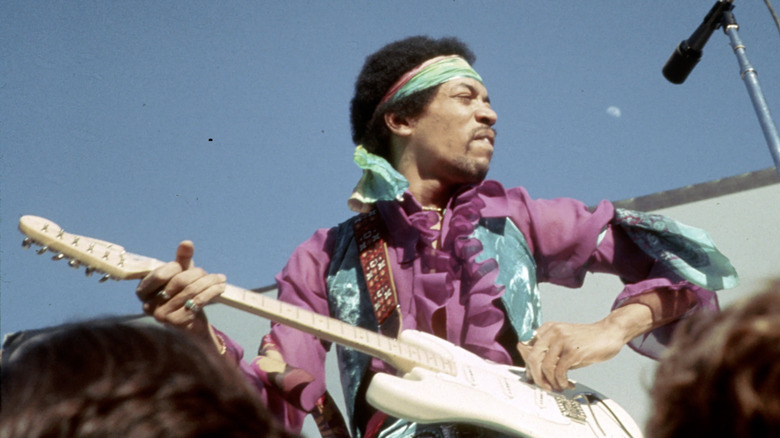
"Short but sweet" isn't a phrase most people associate with rock music, the domain of freewheeling guitar jams and extended cinematic solos. Fitting the excess and larger-than-life reputations of its performers, the genre is home to some of the longest guitar solos in history — but also some of the shortest. Some great guitarists have learned to craft licks that are catchy, serve the song, and even act as one of its highlights, while managing to pull back out to the band before getting old.
We've gathered here five solos with a maximum length of 15 seconds — that's a full solo in and out within a quarter of a minute. They had to be complete, meaning they didn't milk extra seconds by sustaining and hanging around into the next section, and they had to be memorable. The five here, coming from artists like Jimi Hendrix, the Cars, and all the way up to Sum 41, are all not only quick but also catchy enough to sing back to yourselves after hearing them. Read on for five of the shortest guitar solos in rock history that also happen to be absolute earworms.
Just What I Needed — The Cars
It should be no surprise to hear anything of the Cars described as catchy. The band, led by the brilliance of hit-maker and future all-star producer Ric Ocasek, were known for churning out one radio hit after another in rapid succession. With 18 singles on the Billboard Top 100 during their initial 10-year run, the Cars became a radio fixture for a generation, led by hook-forward songs like "Shake It Up" and "You Might Think." Even when the band opted for their version of straightforward rock, like on "Just What I Needed," they just couldn't help but bring that knack for earworm-worthy melodies, which includes its 15-second guitar solo.
As guitarist Elliot Easton told Guitar Player, repeated gigging helped him gradually zero in on the "Just What I Needed" solo, and that "by the time I got into the studio, I knew exactly what I was going to play, so I would call that a composed [solo]." Its forethought is self-evident, as the solo really does come across as a section without a single note out of place. The initial, bluesy bends catch the ear from the jump before Easton builds up to an even higher plateau. From there, he slides and builds still higher and higher to close the song out with a false climax, one suddenly interrupted by Benjamin Orr's thick vocals. It's neat, tidy, and gets the job done well. Best of all, it is impossibly catchy.
Whole Lotta Love — Led Zeppelin
Jimmy Page's guitar work on Led Zeppelin's "Whole Lotta Love" is legendary, but mainly for its all-time classic riff. Made from just a pair of alternating notes and a single simple power chord, the "Whole Lotta Love" riff is somehow arranged into one of the greatest in the '70s, if not rock history — pure lightning in a bottle. Next to such a monumental part, the song's other guitar parts, like its solo, are often underappreciated. The solo, despite being a mere 15 seconds in length, is broken into brief, pithy segments, all of which combine into a section that betters the song and is immediately memorable.
The solo has an important job in "Whole Lotta Love." In addition to the normal energetic climax required of it as a spotlight performance, it also has to bring the song back to normalcy after its avant-garde, backward-echoing middle section. It does so by breaking in with two punched power chords, which it repeats every bar throughout the section's brief lifespan. In between the chords, Page employs standard E minor blues licks, but, like the song's central riff, there's magic in the way he plays them. The solo's peak comes from a screaming precision bend that jumps two full steps up (twice your average bend) before a couple more common licks bring it back home, and in doing so, bring "Whole Lotta Love" back to its rocking core.
All the Young Dudes — Mott the Hoople
Unlike the rest of the solos here, and the majority of guitar solos in general, the guitar solo on Mott the Hoople's anthem "All the Young Dudes" doesn't come after two full cycles of verse, chorus, and various supporting sections. Instead, late Hoople guitarist Mick Ralphs uses the solo to kick the song off with a melodic hook that burrows into the brain from its very first second. Despite lasting barely 13 seconds, the "All the Young Dudes" solo leaves an instant impression, and its melodic, vocal-like bends are unforgettable, even more than 50 years since its release.
Of course, David Bowie wrote the song, but what he gave them was a general outline — chords, lyrics, and his services producing it. It was Ralphs who wrote the intro solo, and it's the kind of solo that has attained an iconicity all its own. As Joe Elliott, lead singer of Def Leppard and Ralphs's friend, told MusicRadar, "Mick wrote the intro, and it's astonishing... it's the lick of all licks. You hear the beginning of that song and — boom! It was a revelation for a whole new generation of kids."
The intro guitar's pattern, a 1-2-3-4 before hanging on some bends, is rhythmically interesting enough to stick in the ear within seconds. After that, it merely repeats the pattern once, bends up a bit higher, and quits while it's ahead. In doing so, it turns all ears to the song, leaving them open for Ian Hunter's unique voice and Bowie's iconic lyrics.
Fire — Jimi Hendrix
Jimi Hendrix is without a doubt the greatest of all time, and he has no shortage of extended solos to prove it, some that even changed rock forever. His "Voodoo Child" is five minutes of the most iconic guitar in history, and his soloing on "Machine Gun" is 12 minutes of feverish, tour de force mastery. Part of being the greatest, however, is also knowing when to heed the maxim "brevity is the soul of wit," and Hendrix displays a deep understanding with his 12-second solo on "Fire."
Hendrix was always an artist before an instrumentalist (or anything else, really), and it would make sense that he would match as many aspects of "Fire" to their blazing subject matter. Like an actual fire, the song's solo doesn't last, but during its short life it bends and waves, reaching high into the sky before fading out. In service to the song, the solo is built around bends that Hendrix hangs on for a couple of beats, allowing drummer Mitch Mitchell to work even more percussive magic than usual. His fills are a thunderous hybrid of jazz and rock, and every microsecond the sustained guitar bends allow them, the drums fill with enough fire to match Hendrix's own. It's still very much Hendrix's solo, but it's the type that is built around the song, not the player. The repeating bends of the "Fire" solo may die out quickly, but their catchiness has kept them alive as embers in the minds of fans for generations.
In Too Deep — Sum 41
Sum 41 are some of pop-punk's most successful and beloved champions. Alongside peers like Blink 182 and Green Day, Sum 41 ruled the early 2000s pop-punk heyday and exemplified its core components: youthful angst, underdog spirit, and burning bright but fast. Pop punk songs are known for being quick, and at 3:27, the band's 2001 hit "In Too Deep" is actually on the genre's longer side. Its solo, however, isn't. At an impressively quick nine seconds in length (up to 11 if you count the sustained but rapidly down-mixed final note), the "In Too Deep" solo is one of the shortest imaginable, and yet it's still structured, tells a story, and is incredibly catchy.
After the second chorus, right where you'd expect a traditional rock solo to be, guitarist Dave Baksh delivers, and he makes those nine seconds count extra. The solo is built from rapid sets of pull-offs that vary in rhythm to keep things interesting and also alternates between quick sections of pure melody. There isn't a single two-second section of the solo that doesn't vary rhythmically and melodically from its neighbors. By the time it ends with a harmonized bend, the solo has crackled like lightning through the song, bringing the energy even higher than its already-lofty baseline. The solo to "In Too Deep" is about as short as you'll ever hear, but it's still catchier than any of its larger cousins.