

The Greatest Storytellers In Country Rock, Ranked
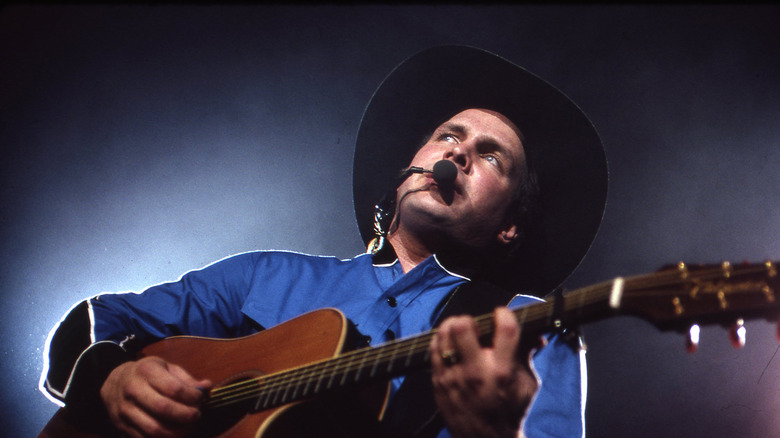
Can't decide between genres when putting together a playlist? Why choose? Country rock is a unique genre that, true to the name, fuses elements of both country music and rock 'n' roll, with classic country-style instruments like steel guitar and banjo meeting up with rocker faves like the electric guitar and a driving drumbeat. There's a lot of crossover here, but if an artist wasn't afraid to use electric instrumentation, pick up a rocking rhythm, or display the crossover swagger of an artist ready to embrace all the genres, they ought to count among the ranks of country rock. Among those are many storytellers who are able to craft narratives that entrance audiences through brilliant musical magic. The following are the best of the bunch, rising to the fore with a heady mix of musical ability, onstage charisma, and lyrics full of dramatic turns and unforgettable characters.
Truly masterful storytellers like these country rock superstars tell audiences of the exploits of wayward adventurers, lovelorn protagonists, and rebels against society who go on a journey ... even if it's not always a happy ending. Sometimes the story is tragic, sometimes it's roguishly silly, and other times shows someone with a fist raised at the sky. Whatever the story, a truly good storyteller will be able to make it compelling through lyrical brilliance and nuanced delivery.
5. Charlie Daniels
Charlie Daniels certainly wasn't afraid to blend country, rock, and whatever other genres fit his fancy, all with a tinge (or more) of his Southern musical heritage. Starting off as a session musician who worked with Bob Dylan, Daniels broke through with "Uneasy Rider" in 1973, a largely spoken-word track that tells the story of a hippie getting one over on a small-town bar of rednecks. Daniels was partially inspired while staying in Baton Rouge, Louisiana, where he was struck by the "long-haired hippie type people" staying at their hotel, especially because, as he told Songfacts in 2007, many appeared to worry "that somebody was going to run out with a pair of shears and cut their hair and threaten their life." Daniels took that scenario and turned it into a winking commentary on the generational and cultural conflicts of the era.
The real headliner of Charlie Daniels playlists everywhere is, of course, "The Devil Went Down To Georgia," which rose to No. 3 on the Billboard Hot 100 and netted Daniels a Grammy in 1979. In the song, which relates a musical showdown between a trouble-seeking Devil and a fiddler named Johnny, Satan plays a rock-infused tune but is ultimately defeated by the down-home stylings of Johnny. Daniels played all the fiddle parts in the song, though he intentionally made the devil's part a jumbled, unmelodic mess. It's all pretty exciting, whether you take it as an allegory for regional Southern pride or just a really good story about kicking the Devil's butt and getting a gold fiddle for your troubles.
4. Kenny Rogers
You might get into an argument about which genre Kenny Rogers occupies, but there are very definitely elements of soft rock and country in the mix (not to mention his early history as a psychedelic rocker), and there's simply no denying the fact that Rogers was darn good at telling a story. There are his recordings of "Ruby, Don't Take Your Love to Town" and "Coward of the Country" to consider, but we bet you're already singing "The Gambler."
This standout track in the Kenny Rogers catalogue was written by Don Schlitz and tells of a man encountering an aged gambler ready to dispense wisdom on a long train ride. It was originally recorded by Bobby Bare in the late '70s, though it didn't garner much attention; neither did a subsequent cover by Johnny Cash. Instead, Rogers' gently rolling and well-observed cover is what took "The Gambler" to the country rock stratosphere and made 1978 a banner year for Rogers.
Nashville promoter Bobby Fischer told American Songwriter that he didn't much care for Schlitz's song "[until] Kenny did it. Then I remember thinking how wrong I was." Paired with Rogers' weary, yet comforting delivery (smooth with just a hint of grizzled vocal fry), the song goes beyond a simple train ride, transforming into a meditation on moving through life with grace and a few well-placed metaphors. Besides crossing over into the Billboard Hot 100, the song also led to a full-length television film, "Kenny Rogers as The Gambler," four sequels, and a "Gambler"-themed slot machine. Rogers even performed the song on "The Muppets," complete with a Muppet-fied Gambler.
3. Neil Young
With his complex, lyrical work, when Neil Young sets out to write a storytelling song, it's going to be good, as evidenced by deep, challenging songs like "Pocahontas" and "Cortez the Killer." But the best type specimen of a Young story song is easily "Powderfinger," a dreamy, haunting tale sung by a doomed young man. True Neil Young fans have been turning it over in their minds for decades since its release on 1979's "Rust Never Sleeps." Young had actually first offered the song to Lynryd Skynyrd, showing that there weren't really any hard feelings between them, despite a lyrical callout addressing Young in "Sweet Home Alabama." However, Lynyrd Skynyrd's 1977 plane crash that took the lives of three band members derailed those plans, leaving Young to record the song himself.
Perhaps Lynyrd Skynyrd would have done great things with it, but Young's rendition of "Powderfinger" leaves you feeling dizzy in the face of its spare, poetic narrative. In it, the unnamed narrator faces the approach of a heavily-armed group descending upon his home. "Look out, mama," he sings, "I think you'd better call John / 'Cause it don't look like they're here to deliver the mail."
What they really want is left unsaid, but Young's song gives you no quarter for cozy fantasy, as the narrator falls almost as soon as he tries to defend his family. "Powderfinger" so effectively communicates the looming dread of its narrator that, even if we're not quite sure when this story is meant to take place, it's darkly gripping.
2. Garth Brooks
You want spectacle? Then you want Garth Brooks, who took country rock to new heights in the '90s with arena shows featuring pyrotechnics and dramatic wire work, among other stunts. But Brooks has the songwriting and performance chops to make his songs the gripping chart-toppers many became. Brooks has said he wants to be remembered as a songwriter, and with songs like "That Summer" and "The Thunder Rolls" bearing his co-credit, you can understand why.
"The Thunder Rolls" is an example par excellence of what brought him such widespread attention. Co-written with Pat Alger, Brooks came up with the idea of an unfaithful spouse and ominously rolling thunder, though Alger initially didn't take the imagery very seriously. Still, Tanya Tucker liked it — when Brooks and company offered her the song, she agreed to record the track. Later, as an increasingly successful musician in his own right, Brooks released his version on the album, "No Fences" (so named because of his desire to break away from the staid traditions of country and bring in more rock).
The moody song lays out a narrative in which an unfaithful man is confronted by his wife as metaphorically bad weather rumbles in. The music video was controversial, as it made the song's oblique references to domestic violence more obvious and led to some broadcast bans. Brooks later expressed regret about the music video, saying the controversy over its content drew attention away from the song itself.
1. Johnny Cash
Throughout his long career, Johnny Cash defied the boundaries of musical genre, taking his albums from country to rock and back again (with plenty of stops along the way). He also demonstrated his mastery of the storytelling song. It's hard to pick just one, but "A Boy Named Sue" is a pretty good place to start. It was written by author Shel Silverstein, who was also a multi-talented songwriter, illustrator, and recording artist who wrote with mordant humor and sharp, compact storytelling.
With respect to Silverstein's witty lyrical narrative, his own 1968 recording of "A Boy Named Sue" is ... well, it's fine. But Cash's take on the song, which tells the story of the titular Sue hunting down the absent father who named him, is brilliant. Cash's delivery is at turns gritty, laconic, heartbroken, angry, and darkly humorous. It was first recorded by Cash during a 1969 performance at San Quentin State Prison for the album "Live at San Quentin," where the audience reaction reflects Cash's charisma and abilities as a performer.
Cash also wrote his own storytelling songs, like "Five Feet High and Rising," which retells his childhood experience of the Great Flood of 1937 when the Cash family lived in Dyess, Arkansas. Though his family survived, the flood clearly left its mark. Cash's lyrics capture the growing panic he must have felt as the waters swept over their home. "How high's the water, mama? " he sings. "Three feet high and rising" comes the response in one verse, its inexorable count of the rising feet lending urgency to the tune.